
 OpenAI - ChatGPT, Sora
 Google - Gemini, Nano Banana
 Anthropic - Claude
 xAI - Grok
 Deepseek
 Alibaba - Qwen
 ByteDance - Doubao
 All Models
 Enterprise Plans
 AI Application Development
 AI Translator API
 AI SEO/GEO Service
 GEO-Optimized PR Service
 Web Scraping Service
 OpenClaw
 Top AI Tools
 Top AI Robots
 Log in





Best AI Search Engines 2025 Perplexity vs ChatGPT vs Gemini and Copilot Compared
🚀 Executive Summary: The AI Search Revolution
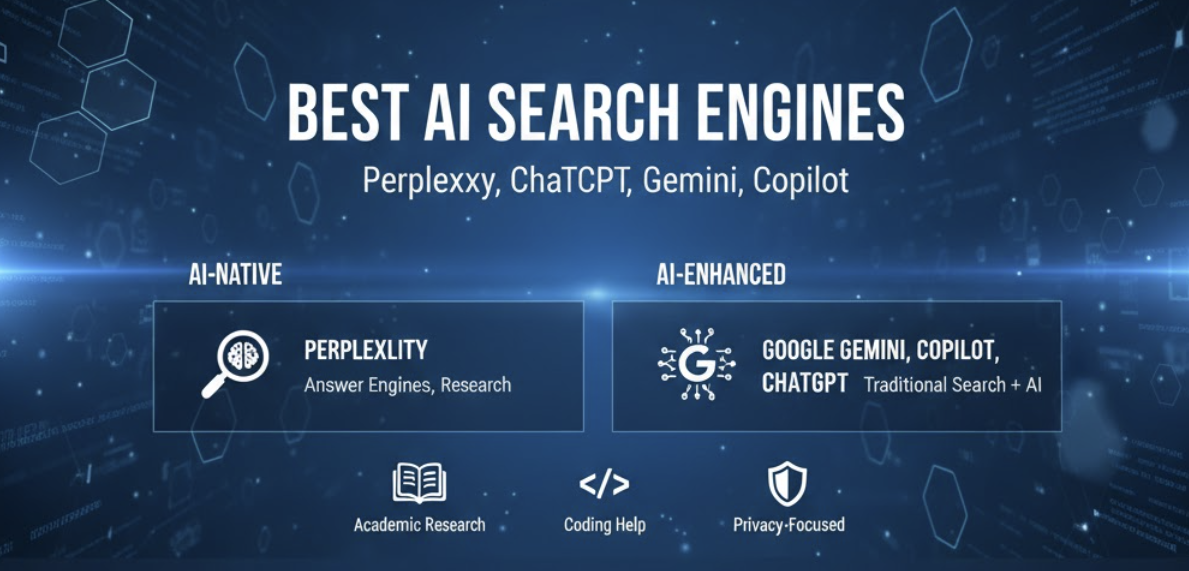
The digital search landscape has shifted from a list of links to a conversational dialogue. Modern AI search platforms now combine Large Language Models (LLMs) with real-time web access to provide synthesized, source-cited answers. As noted in the original guide "Lead / Quick Orientation", the market is now divided between AI-native "Answer Engines" like Perplexity and AI-enhanced giants like Google Gemini and Microsoft Copilot.
What Is an AI Search Engine?
At its core, an AI search engine utilizes Retrieval-Augmented Generation (RAG). Unlike traditional search, which ranks pages based on keywords, these systems follow a sophisticated three-step process:
- Parsing: Understanding user intent through natural language processing.
- Fetching: Retrieving relevant data from the live web or specialized databases.
- Synthesis: Summarizing the data into a coherent, cited response.
Key Differentiators: Unlike standard "blue link" results, AI search offers answer synthesis, maintains conversational context for follow-up questions, and provides source transparency for immediate fact-checking.
Top Contenders for 2025
| Platform | Primary Strength | Ideal For |
|---|---|---|
| Perplexity AI | Citation transparency & Research focus | Academics, Journalists |
| Google Gemini | Ecosystem integration (Workspace/Gmail) | Enterprise, General Users |
| ChatGPT Search | Conversational reasoning & Content creation | Creatives, Developers |
| Phind | Technical accuracy & Code grounding | Software Engineers |
| Brave Leo | Privacy-first & Anonymous access | Privacy Enthusiasts |
In-Depth Platform Analysis
🔍 Perplexity AI: The Research Benchmark
Perplexity is an AI-native answer engine built from the ground up. It offers a unique "Focus" mode that allows users to target specific datasets like Academic papers or YouTube transcripts. Its standout feature is Source Attribution, which allows researchers to verify claims instantly. However, it can be less optimized for transactional or local "near me" queries.
🛠️ Phind: The Developer’s Assistant
Phind serves as a specialized RAG pipeline for coders. By integrating live documentation, Stack Overflow, and GitHub, it provides code snippets grounded in current standards. As noted in "Phind", it is frequently praised by the developer community for reducing the friction of debugging and system design.
🛡️ Brave Leo: Privacy Without Compromise
Brave Leo offers anonymous AI search. It does not store user queries or track identities, addressing the primary concern of data exposure. It uses models like Mixtral and Gemini but operates them in a non-logging environment, making it the top choice for privacy-centric knowledge work.
How to Choose the Right AI Engine
Ask yourself these four diagnostic questions before selecting your primary tool:
Citations Needed?
Choose Perplexity or Consensus.
Technical/Code?
Choose Phind or ChatGPT.
Productivity?
Choose Gemini or Copilot.
Anonymity?
Choose Brave Leo or Kagi.
The Future: Agentic & Multimodal Search
The next frontier of AI search is Agentic Action. Platforms are evolving from simple answering machines into agents capable of booking flights, managing emails, and summarizing multi-hour video content. We are also seeing a "Citation Arms Race," where platforms compete on the granular level of source attribution to win back user trust following the rise of AI-generated misinformation.
Frequently Asked Questions (FAQ)
1. What is the biggest difference between AI search and traditional search?
Traditional search provides a list of links ranked by relevance. AI search synthesizes those links into a direct, conversational answer using RAG technology, saving the user the time of clicking through multiple websites.
2. How can I trust that an AI search engine isn't hallucinating?
The most reliable tools use "grounding" and citations. Always check the numbered sources provided by the engine. If a platform refuses to provide a citation for a factual claim, it is a significant red flag for potential hallucination.
3. Is my search history private on these platforms?
It depends on the provider. Giants like Google and Microsoft generally use search data to improve their ecosystems. If privacy is your top concern, use Brave Leo or DuckDuckGo AI, which prioritize anonymity and non-logging policies.
4. Which AI search engine is best for students and academics?
Consensus and Perplexity (in Academic mode) are leaders. They focus on peer-reviewed journals and provide granular citations that are essential for academic rigor and literature reviews.