
 OpenAI - ChatGPT, Sora
 Google - Gemini, Nano Banana
 Anthropic - Claude
 xAI - Grok
 Deepseek
 Alibaba - Qwen
 ByteDance - Doubao
 All Models
 Enterprise Plans
 AI Application Development
 AI Translator API
 AI SEO/GEO Service
 GEO-Optimized PR Service
 Web Scraping Service
 OpenClaw
 Top AI Tools
 Top AI Robots
 Log in



Claude vs ChatGPT 2025 Best AI for Coding Writing and Research Review
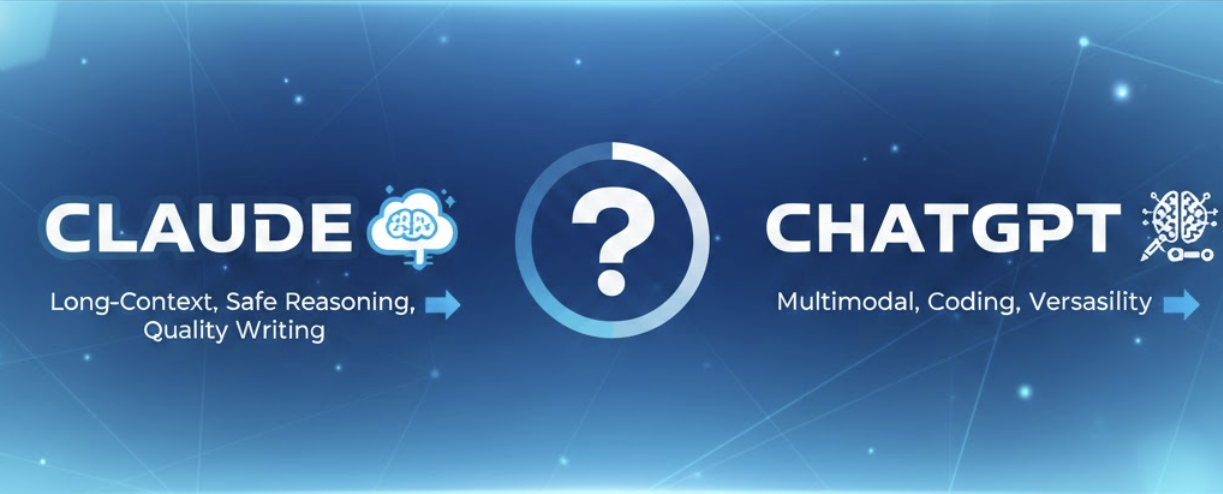
The modern AI landscape is defined by sharp competition among advanced assistants. For students, professionals, and enterprise teams, choosing between Claude and ChatGPT has become a strategic decision. As noted in the original analysis "The modern AI landscape is defined by sharp competition among advanced assistants", this comparison explores their strengths in language understanding, reasoning, code generation, and creative applications, helping you identify which model best complements your specific workflow.
Origins and Design Philosophy
OpenAI’s ChatGPT
OpenAI pursues beneficial AGI, rapidly evolving the GPT family into today’s reasoning- and multimodality-focused systems. Its huge training corpus and RLHF (Reinforcement Learning from Human Feedback) methods enable remarkable flexibility, creativity, and broad adoption across industries.
Anthropic’s Claude
Anthropic embeds safety at the core of its design. Based on Constitutional AI, it continuously self-evaluates to uphold helpfulness, truthfulness, and harmlessness. This emphasis on alignment shapes Claude’s reliability in complex, high-stakes settings.
These different philosophies shape their distinct "personalities": OpenAI’s models are often more expressive and adaptive, while Anthropic’s models are analytical, context-aware, and deliberately cautious with uncertain input.
Technical Foundations
The structural differences between these models dictate how they handle data and user requests:
- Context & Memory: Claude leads with up to 200K tokens, making it the ideal choice for full-book or massive dataset analysis. ChatGPT’s window, while smaller (typically 128K), is highly optimized for relevance and conversational continuity.
- Multimodality: The GPT lineup handles images, audio, and data natively. Claude can interpret images and documents with high precision but focuses primarily on text-first intelligence and does not generate images.
- Efficiency: Anthropic’s architecture is often perceived as lightweight and cost-effective for deep, lengthy analysis, whereas OpenAI prioritizes real-time multimodal processing power.
Core Capabilities: Head-to-Head
1. Language Understanding & Style
GPT-4o and its successors deliver highly coherent, human-like outputs. They are masters of "persona," adapting fluidly across various tones. In contrast, the Claude 3.5 Sonnet and Opus series favor a precise, academic, and objective style. In extended sessions, Claude benefits from its long-context logic, ensuring consistent reasoning over hundreds of pages of documents without losing the "thread."
2. Reasoning & Accuracy
Each system excels in structured problem-solving, but their approach varies. Opus generally leans toward caution, especially in analytical tasks—it would rather admit it doesn't know than risk a hallucination. ChatGPT offers greater creative flexibility, which is excellent for brainstorming but can occasionally introduce minor errors in highly technical exploratory work.
3. Coding & Technical Work
ChatGPT is outstanding for rapid code generation, debugging, and system design. Its integration with the wider developer ecosystem makes it a favorite for quick scripts. However, Claude 3.5 Sonnet has recently gained significant traction among developers for complex refactoring and its ability to identify secure or high-risk patterns within large codebases.
| Feature | Claude 3.5 (Sonnet/Opus) | ChatGPT (GPT-4o/o1) |
|---|---|---|
| Context Window | 200,000 Tokens (Industry Leading) | 128,000 Tokens (Optimized) |
| Image Capabilities | Analysis only | Analysis & Generation (DALL-E) |
| Primary Strength | Research, Nuance, Safety | Versatility, Ecosystem, Creativity |
| Safety Model | Constitutional AI (Strict) | RLHF (Flexible) |
Safety, Limitations, and Performance
Anthropic’s model uses a stricter alignment architecture that enforces predictable, responsible responses. OpenAI’s assistant, which is more permissive by design, supports exploratory dialogue but may occasionally produce hallucinations.
Benchmark Insights: Recent coding benchmarks show Claude 3.5 Sonnet and GPT-4o/o1 forming the top tier of performance. While Google's Gemini edges out the competition in specific multimodal metrics, Claude and GPT remain the leaders for real-world bug-fixing and complex document synthesis.
Decision Guide: Which One to Choose?
Choose Claude if you:
- Need to analyze entire books, long legal documents, or massive datasets.
- Require a neutral, academic, or professional tone for writing.
- Prioritize safety and factual consistency over creative flair.
- Are performing deep technical refactoring.
Choose ChatGPT if you:
- Need multimodal tools (generating images, using voice mode).
- Are focused on creative storytelling, marketing, or casual brainstorming.
- Want access to a vast ecosystem of plugins and custom GPTs.
- Require a highly versatile assistant for daily administrative tasks.
Conclusion: Making the AI Choice
There’s no single “best” assistant, only the one that fits your goals. Test both on real projects; the right AI will amplify your productivity and align seamlessly with your workflow. As both models evolve, the trend is clear: ChatGPT is growing into a versatile productivity ecosystem, while Claude is doubling down on deep, reliable knowledge work.
Frequently Asked Questions (FAQ)
Q: When should I use Perplexity vs ChatGPT vs Claude?
Use Perplexity for rapid, cited search and fact-finding. Use ChatGPT for creative ideation, image generation, and coding. Use Claude for deep analysis of large files and structured, long-form writing.
Q: Which AI is better for coding?
It is incredibly close. Developers often prefer ChatGPT for rapid snippet generation and ecosystem tools, while many now favor Claude 3.5 Sonnet for its superior code comprehension, documentation clarity, and lower hallucination rate in complex logic.
Q: Does Claude generate images like ChatGPT does?
No. Anthropic has focused Claude strictly on text and document intelligence. If you need AI image generation (DALL-E 3), ChatGPT is the correct choice.
Q: Is there a difference in privacy between the two?
Both offer strong privacy commitments for enterprise and organizational users. However, Claude is built on "Constitutional AI" principles, which some users find provides more predictable and ethical safety boundaries for sensitive data work.