
 OpenAI - ChatGPT, Sora
 Google - Gemini, Nano Banana
 Anthropic - Claude
 xAI - Grok
 Deepseek
 Alibaba - Qwen
 ByteDance - Doubao
 All Models
 Enterprise Plans
 AI Application Development
 AI Translator API
 AI SEO/GEO Service
 GEO-Optimized PR Service
 Web Scraping Service
 Top AI Tools
 Top AI Robots
 Log in



Evolution Stages of AI from ANI to AGI Capabilities and Future Impact
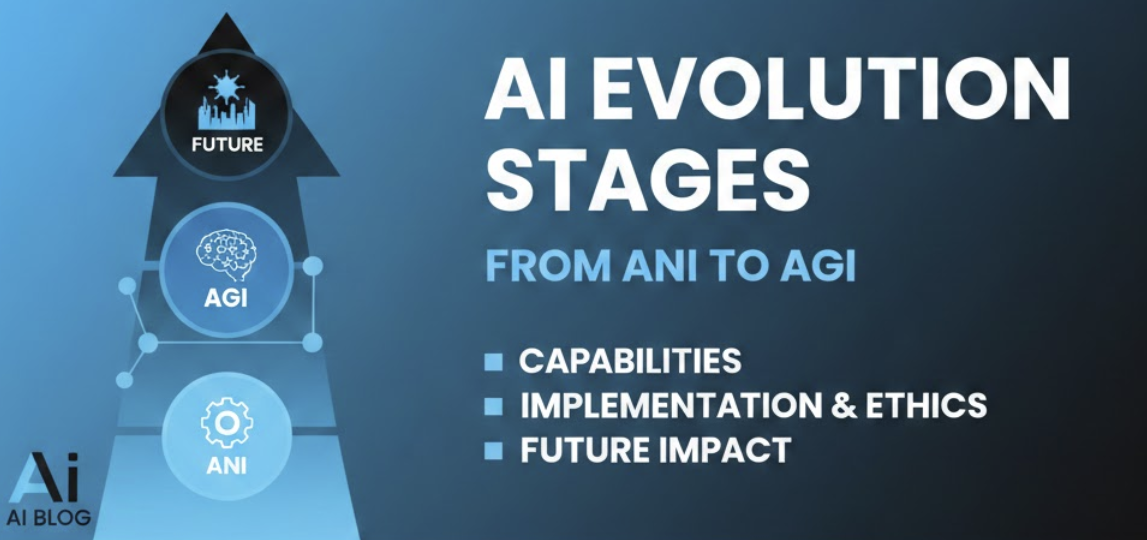
Artificial Intelligence (AI) is rapidly shifting from a theoretical concept to an omnipresent tool. Understanding its developmental stages is essential for anyone navigating this transformation. As noted in the original analysis {AI Evolution Stages: From ANI to AGI - Capabilities, Implementation, Ethics & Future}, AI staging is not just a historical timeline but a framework that classifies systems by capability and complexity.
Foundational AI Concepts
Machine intelligence is defined as a system’s ability to perceive environments, process data, and act to achieve goals. The evolution is typically categorized into three milestone levels:
| Stage | Definition | Status |
|---|---|---|
| ANI | Artificial Narrow Intelligence: Optimized for specific tasks. | Current |
| AGI | Artificial General Intelligence: Human-level cross-domain learning. | Hypothetical |
| ASI | Artificial Superintelligence: Exceeding all human cognitive areas. | Future Potential |
The 5 Stages of Cognitive Sophistication
- 1 Rule-Based Systems: Reactive AI that follows predefined logic without learning.
- 2 Limited Memory: Context-aware systems (e.g., Tesla Autopilot) using recent history to inform decisions.
- 3 Theory of Mind: Understanding human emotions and intentions (Research phase).
- 4 Self-Aware AI: Systems with consciousness—the ultimate peak of AGI.
- 5 Superintelligence: Radical cognitive expansion beyond biological limits.
The Shift to Autonomous Agents
We are witnessing a fundamental shift from passive assistants to active agents. Modern technical architecture has evolved through:
🚀 Multimodal Processing
Moving from structured data to massive collections of text, image, and audio via Transformer architectures.
🤖 Agentic Workflows
Systems that formulate multi-step plans and interact with software tools to execute complex tasks autonomously.
Ethical & Safety Frameworks
As capabilities grow, so does the risk. Modern AI governance focuses on:
- Bias Mitigation: Ensuring fairness in training data.
- Privacy: Utilizing Federated Learning and Differential Privacy.
- Alignment: Ensuring advanced systems reflect human intent.
- Regulatory Tiers: Oversight corresponding to the potential risk of the AI system.
Organizational Maturity Model
Integrating AI into an enterprise is a journey, not a destination. Most companies follow this four-phase trajectory:
1. Exploratory: Ad-hoc experiments with ChatGPT or ready-made APIs.
2. Pilot: Validating ROI through targeted business use cases.
3. Industrial Scaling: Implementing MLOps and enterprise-wide governance.
4. Full Transformation: AI-first strategy where models drive core operations.
Future Trajectory & Conclusion
The path to AGI may be a gradual steady climb or a series of discontinuous leaps driven by recursive self-improvement. While the industry currently thrives in the ANI stage—aided by powerful tools like AI/ML API—stakeholders must prepare for a world where AI performs general reasoning.
Responsible advancement hinges on balancing innovation with protection, ensuring AI’s trajectory supports humanity’s long-term goals.
Frequently Asked Questions (FAQ)
Q1: Are current LLMs like GPT-4 considered AGI?
No. While they show "sparks" of AGI through multimodal reasoning, they are still considered sophisticated statistical models within the ANI/Pre-AGI spectrum.
Q2: What is the main difference between ANI and AGI?
ANI is specialized for a single domain (like a chess engine), whereas AGI can learn and apply knowledge across any cognitive task a human can perform.
Q3: How should businesses prepare for the AGI era?
Focus on building a robust data infrastructure, investing in AI literacy, and establishing ethical governance frameworks today while using current ANI tools for immediate value.
Q4: What is AI Alignment?
AI Alignment is the field of study ensuring that AI systems' goals and behaviors are perfectly in sync with human values and intentions.