
 OpenAI - ChatGPT, Sora
 Google - Gemini, Nano Banana
 Anthropic - Claude
 xAI - Grok
 Deepseek
 Alibaba - Qwen
 ByteDance - Doubao
 All Models
 Enterprise Plans
 AI Application Development
 AI Translator API
 AI SEO/GEO Service
 GEO-Optimized PR Service
 Web Scraping Service
 OpenClaw
 Top AI Tools
 Top AI Robots
 Log in












Generative AI in Financial Services 2025 Use Cases and Implementation Guide
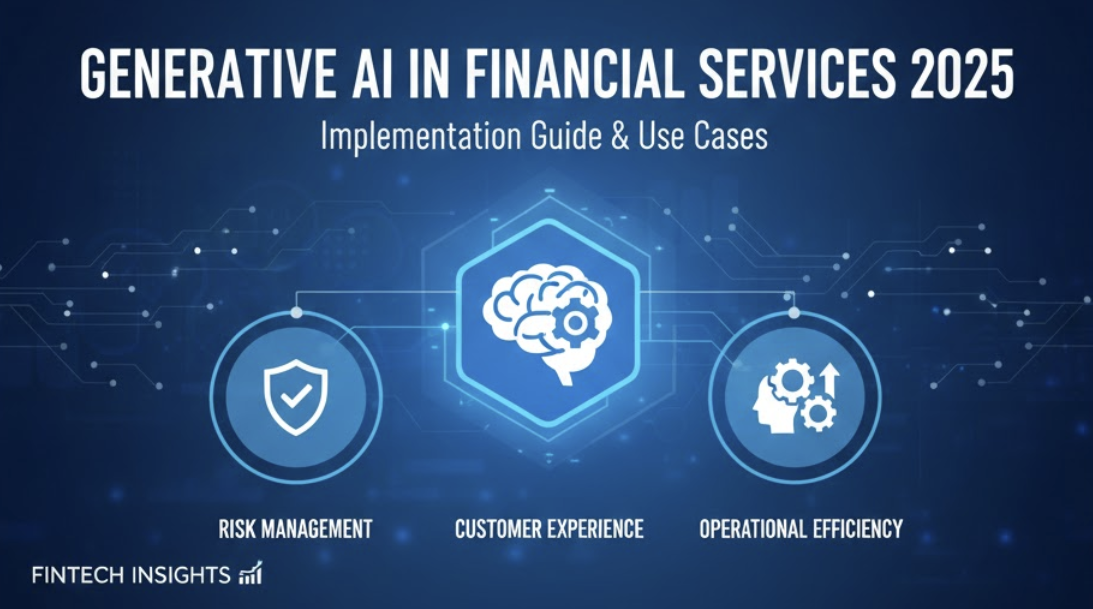
Generative AI represents a fundamental paradigm shift from traditional analytical systems. While conventional machine learning excels at pattern recognition and regression, generative models have the unique ability to create novel, contextually relevant content—ranging from complex financial reports to synthetic data and strategic market scenarios.
As detailed in the original analysis, "The Evolution of AI in Finance", the transition from rules-based systems to foundational models like GPT, Claude, and Gemini marks the most significant technological pivot since algorithmic trading began. Today, over 75% of major financial institutions have moved GenAI initiatives into production, with dedicated budgets growing at a staggering 45% annually.
Core Technological Foundations
The modern financial AI stack is built upon a sophisticated intersection of several key components:
💻 Multimodal Systems
Advanced models can now reason across text, tables, invoices, and even audio from earnings calls within a single, unified workflow.
🔍 RAG Architecture
Retrieval-Augmented Generation (RAG) ensures accuracy by grounding AI responses in verified, proprietary knowledge bases, virtually eliminating "hallucinations."
Transforming the Front Office
GenAI is moving client interactions from reactive support to proactive, hyper-personalized engagement.
- ✔ Advanced Virtual Assistants: Handling over 85% of routine inquiries with 24/7 multi-language support.
- ✔ Hyper-Personalization: AI analyzes life-stage indicators and transaction history to drive 30-35% higher conversion rates.
- ✔ Relationship Augmentation: Automating client briefings and outreach scripts, allowing advisors to focus on high-value human connections.
Reinventing Risk & Compliance
The ability to process massive volumes of unstructured data is a game-changer for control functions:
| Function | AI Impact |
|---|---|
| Fraud Detection | Detection rates increased by 50%; false positives reduced by 40%. |
| Regulatory Reporting | Drafting compliance reports (10-K, Pillar 3) with a 60% workload reduction. |
| Credit Assessment | Narrative justifications for decisions, enhancing transparency for regulators. |
Alpha Generation and Operational Excellence
In the back office and investment wings, AI is driving immediate ROI through intelligent automation:
Investment Strategies
Processing alternative data like social media sentiment and satellite imagery to identify patterns invisible to human analysts.
Operational Automation
Reducing loan processing times from 45 days to under a week, and lowering data entry errors by 75%.
Navigating Implementation Hurdles
Adoption is tempered by significant challenges that require deliberate, strategic solutions:
⚠ Privacy & Security: Utilize private cloud deployments and strict data encryption to protect sensitive financial records.
⚠ Governance: Extend existing Model Risk Management (MRM) frameworks and mandate Human-in-the-Loop (HIL) validation for high-stakes decisions.
⚠ Talent Gap: Invest in upskilling programs to bridge the divide between AI engineering and domain-specific financial expertise.
The future of financial services points toward increasingly autonomous systems.
The rise of agentic AI—capable of executing multi-step workflows with minimal oversight—will redefine how the industry functions, shifting the focus toward explainable, causal AI that provides clear reasoning for every decision.
Frequently Asked Questions (FAQ)
Q1: How does Generative AI differ from traditional AI in finance?
Traditional AI is primarily analytical, focusing on classification and prediction. Generative AI creates new content, such as drafting customized investment reports or simulating stress-test scenarios, offering a broader range of creative and operational applications.
Q2: What is "RAG" and why is it essential for financial institutions?
Retrieval-Augmented Generation (RAG) connects an AI model to a verified, internal database. This ensures that the AI’s answers are based on real, up-to-date regulatory documents and transaction data, reducing the risk of errors or made-up facts.
Q3: How much does AI help in reducing operational costs?
Financial institutions have seen up to an 80% straight-through processing rate for small business loans and a 60% reduction in the workload required for complex regulatory reporting tasks.
Q4: What are the main risks of using GenAI in banking?
The primary risks include data privacy breaches, model "hallucinations" (generating false info), and regulatory non-compliance. These are typically managed through hybrid cloud deployments and Human-in-the-Loop oversight.