
 OpenAI - ChatGPT, Sora
 Google - Gemini, Nano Banana
 Anthropic - Claude
 xAI - Grok
 Deepseek
 Alibaba - Qwen
 ByteDance - Doubao
 All Models
 Enterprise Plans
 AI Application Development
 AI Translator API
 AI SEO/GEO Service
 GEO-Optimized PR Service
 Web Scraping Service
 OpenClaw
 Top AI Tools
 Top AI Robots
 Log in













How ChatGPT is changing the way we use technology every day
The landscape of information retrieval has undergone a seismic shift. Just three years ago, fixing a leaky faucet or understanding economic trends meant Googling, searching YouTube, or asking a voice assistant like Alexa. Today, the gateway to information has fundamentally changed.
As noted in the analysis How ChatGPT is changing the way we use technology every day, we are witnessing a transformation in how humanity interacts with technology, driven largely by generative AI.
The Rise of ChatGPT: A New Gateway
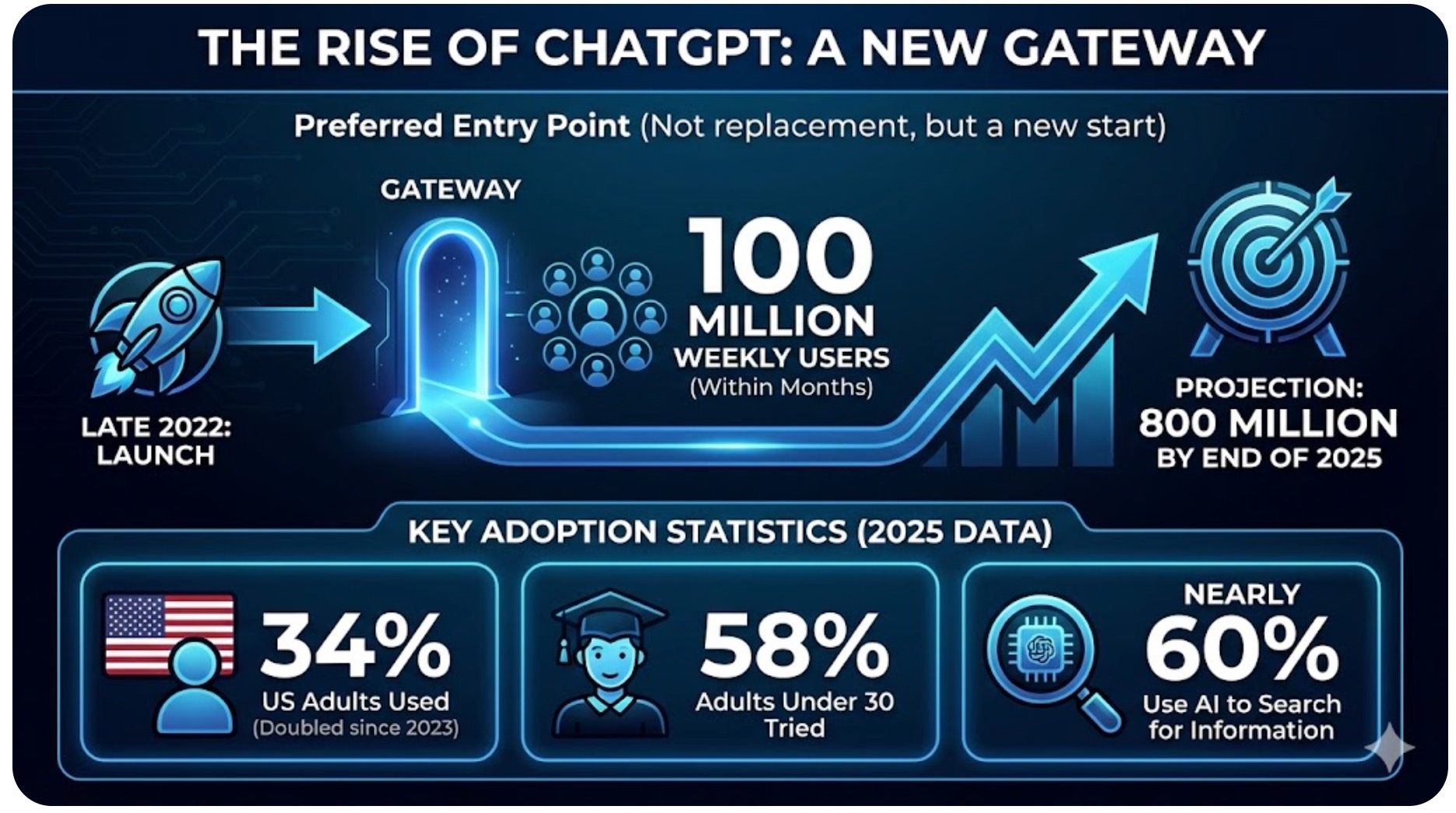
The primary shift isn't the extinction of traditional tools but the emergence of ChatGPT as a preferred entry point. Since its launch in late 2022, ChatGPT acquired 100 million weekly active users within months, with projections hitting 800 million by the end of 2025.
📈 Key Adoption Statistics (2025 Data)
- 34% of American adults have used ChatGPT (doubling 2023 figures).
- 58% of adults under 30 have actively tried the technology.
- Nearly 60% of adults now use AI specifically to search for information.
Redefining Search Behavior: Answers vs. Links
For decades, Google was the default for queries ranging from router resets to financial questions. However, users are increasingly seeking direct answers rather than lists of links. Generative AI offers conversational, authoritative, and fast responses to questions like "What does this mean?"
Data suggests a massive migration in user intent. Approximately 13 million US adults now consider generative AI their preferred tool for online searching. Consequently, traffic from generative AI platforms is growing 165 times faster than traditional search engines.
💡 Google Search vs. ChatGPT
While Google integrates its own Gemini AI to combat this, the user experience differs:
- Google Search: Excels at deep data analysis, cross-checking multiple sources, and complex comparisons.
- ChatGPT: Prioritizes explanations over rankings, offering focused, conversational answers for immediate needs (e.g., policy updates, email scripts).
The "Zero-Click" Phenomenon
The rise of AI overviews and chatbots has led to a sharp increase in "zero-click searches"—where users get their answer without visiting a website. Visits to news sites dropped significantly in 2025, while zero-click searches for news queries rose to 69%.
Impact on Voice Assistants, YouTube, and Coding
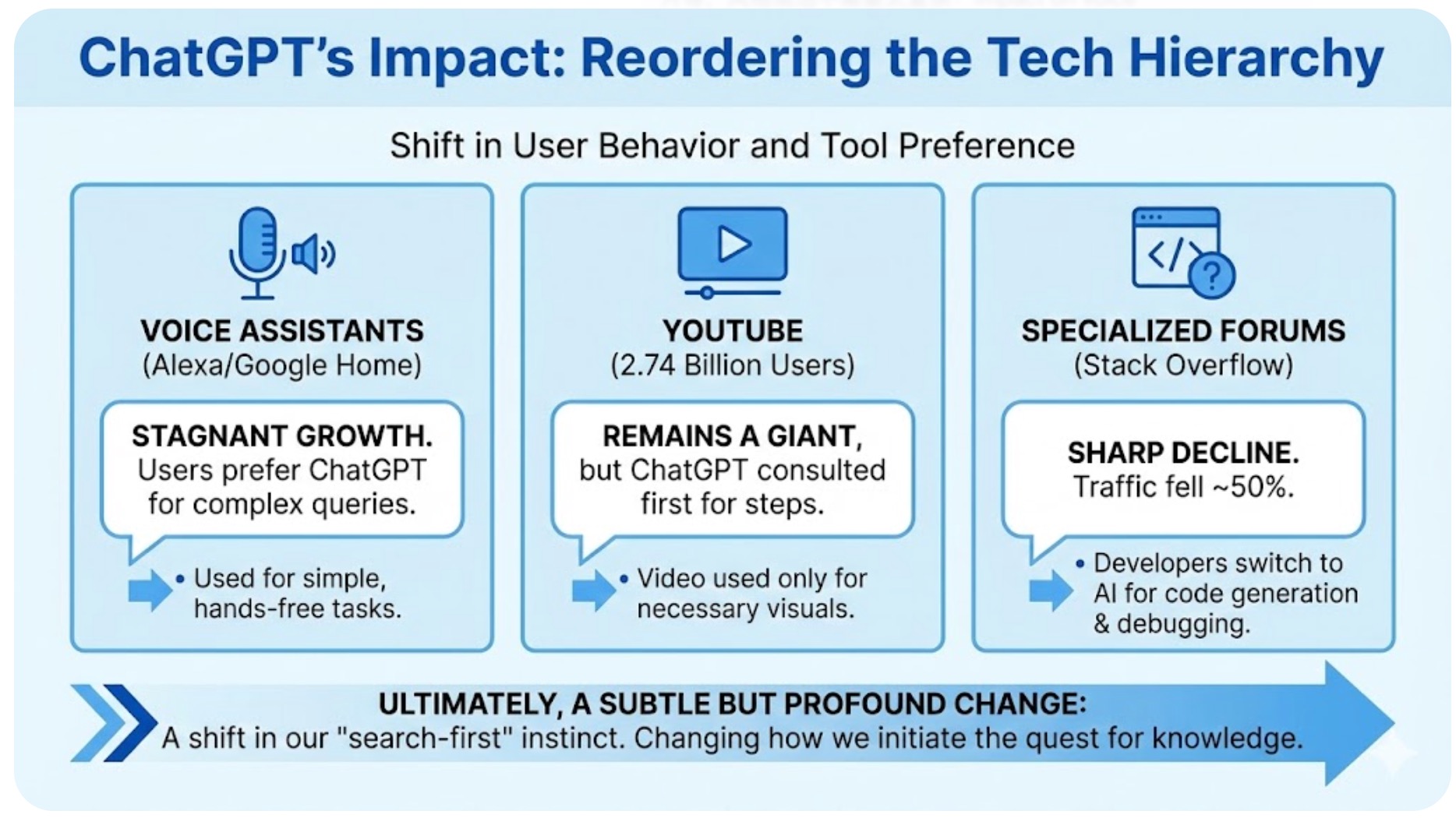
ChatGPT has not replaced the entire tech stack but has reordered the hierarchy of tools we use.
| Platform | Current Trend |
|---|---|
| Voice Assistants (Alexa/Google Home) | Stagnant growth. Users prefer ChatGPT for complex queries, leaving voice assistants for simple hands-free tasks. |
| YouTube | Remains a giant (2.74 billion users), but users now consult ChatGPT for steps first, using video only when visual demonstration is strictly necessary. |
| Specialized Forums (Stack Overflow) | Sharp Decline. Traffic fell ~50% as developers switch to AI for code generation and debugging. |
Ultimately, ChatGPT represents a subtle but profound change in our "search-first" instinct. It hasn't just added an app to our phones; it has changed how we initiate the quest for knowledge.
Frequently Asked Questions (FAQ)
Has ChatGPT replaced Google Search?
Not entirely. While ChatGPT is becoming the preferred tool for conversational answers and simple explanations, Google Search remains superior for deep research, current events, and verifying data across multiple sources.
Why are "zero-click" searches increasing?
Zero-click searches are rising because AI tools (like ChatGPT and Google's AI Overview) provide direct answers on the results page or chat interface, removing the need for users to click through to third-party websites.
Is ChatGPT accurate compared to traditional search?
Both have limitations. Google creates accuracy by aggregating multiple sources, whereas ChatGPT's accuracy depends on its training data. ChatGPT prioritizes conversational clarity, which can sometimes come at the cost of transparency or depth.
How has AI affected sites like Stack Overflow?
Sites like Stack Overflow have seen a traffic decline of approximately 50% between 2022 and 2024, as programmers prefer the instant code generation and debugging capabilities of AI chatbots over waiting for community responses.