
 OpenAI - ChatGPT, Sora
 Google - Gemini, Nano Banana
 Anthropic - Claude
 xAI - Grok
 Deepseek
 Alibaba - Qwen
 ByteDance - Doubao
 All Models
 Enterprise Plans
 AI Application Development
 AI Translator API
 AI SEO/GEO Service
 GEO-Optimized PR Service
 Web Scraping Service
 Top AI Tools
 Top AI Robots
 Log in





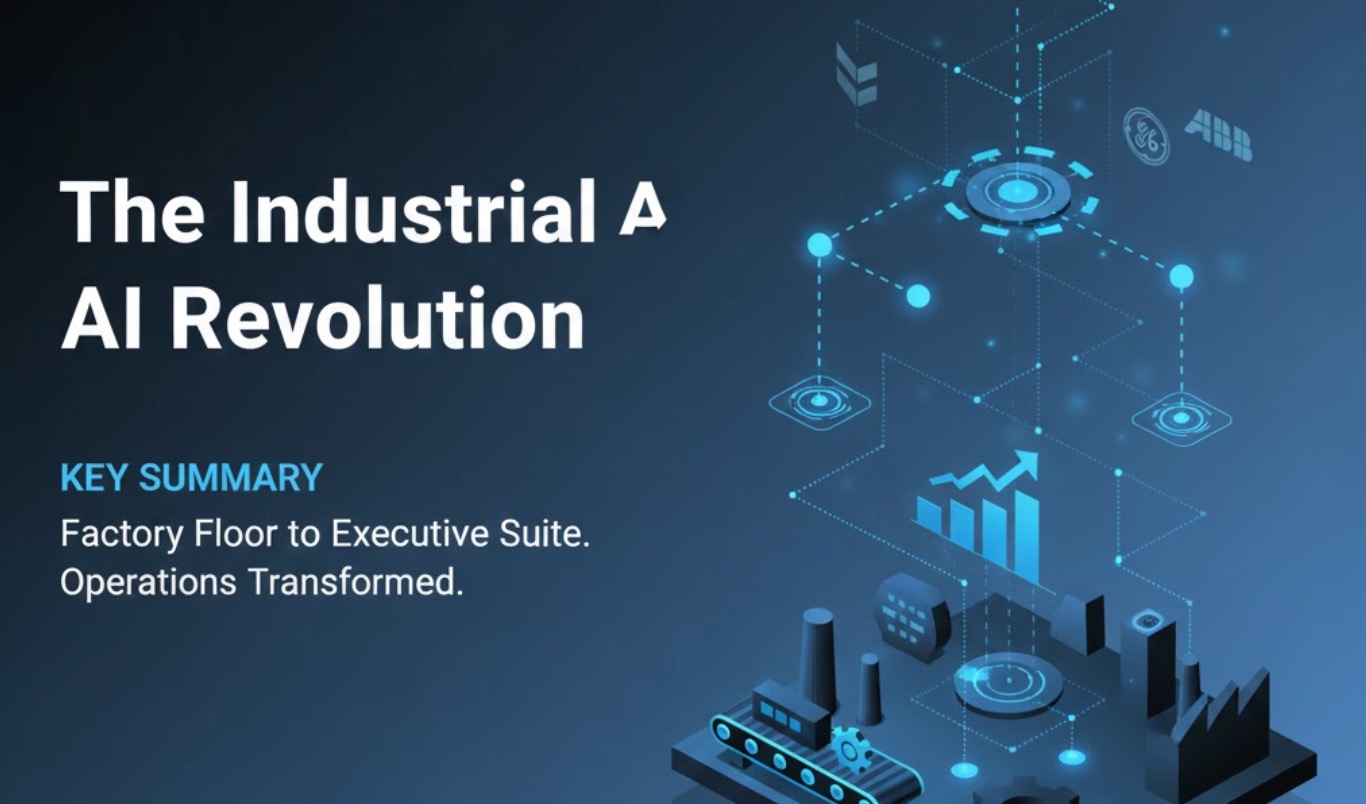
Industrial AI is no longer a concept confined to visionary technologists; it is actively reshaping manufacturing and business operations across the globe today. As highlighted in the original analysis, The Industrial AI Revolution: Transforming Operations from Factory Floor to Executive Suite, the integration of predictive maintenance, edge computing, and augmented workforce capabilities is moving industries toward a new era of heightened efficiency and innovation.
What is Industrial AI? The Core of Enterprise Intelligence
Industrial AI refers to the application of sophisticated artificial intelligence—including Machine Learning (ML), Deep Learning, and Computer Vision—specifically within industrial environments. Unlike traditional automation, which follows rigid, pre-programmed rules, Industrial AI is adaptable.
How it differs from Basic Automation:
- 📊 Data Interpretation: Deep learning models interpret complex sensor data that human specialists once had to analyze manually.
- 🔄 Real-Time Controls: Systems shift from manual oversight to autonomous, real-time adjustments.
- 🏗️ Physical-Digital Bridge: It serves as the cornerstone of Smart Manufacturing, linking physical assets to digital intelligence.
1. Predictive Maintenance: Eliminating Downtime
Unplanned downtime is the single most expensive problem in manufacturing. AI-driven predictive maintenance utilizes condition monitoring and anomaly detection to forecast equipment failure before it happens.
"Leading enterprises like Caterpillar use AI-powered systems to monitor machine health remotely, effectively prolonging asset longevity and reducing operational risks through data-driven strategies."
By analyzing vibration patterns, temperature fluctuations, and acoustic emissions, AI models can identify the "fingerprint" of a failing bearing or motor weeks in advance.
2. Edge AI & IIoT: Intelligence at the Source
The rise of Edge AI represents a pivotal shift in the Industrial Internet of Things (IIoT). Instead of sending massive amounts of raw data to a distant cloud server, AI models now run directly on factory-floor hardware.
| Feature | Benefit of Edge AI |
|---|---|
| Latency | Near-zero delay for safety-critical interventions. |
| Security | Sensitive operational data stays on-site, reducing exposure. |
| Bandwidth | Significant reduction in data transmission costs. |
3. Revolutionizing Quality & Product Development
AI is transforming the quality management lifecycle. Computer Vision systems can scan thousands of parts per minute, detecting microscopic defects that the human eye would miss.
Furthermore, Generative AI is accelerating the design phase. By using Digital Twins, engineers can simulate thousands of "what-if" scenarios in a virtual environment. This reduces the need for physical prototypes, cutting expenses and significantly shortening the time-to-market for new products.
4. Sustainability and the Augmented Workforce
Industrial AI is a critical enabler of Green Manufacturing. By optimizing resource consumption and energy management, AI helps industries minimize waste and reduce their carbon footprint.
Crucially, AI is not replacing humans but augmenting them. Through Collaborative Robots (Cobots) and AI-driven safety monitoring, the workforce is becoming more productive and secure. Employees are freed from repetitive, dangerous tasks to focus on higher-level problem solving and skills development.
⚠️ Overcoming Implementation Challenges
Despite the benefits, adoption involves hurdles such as legacy system integration, cybersecurity threats, and the AI skills gap. Success requires a strategic roadmap that prioritizes reliable infrastructure and workforce training.
Ready to Accelerate Your Industry 4.0 Transformation?
Deploy over 300 AI models for predictive maintenance and edge intelligence with high reliability.
AI/ML API ensures 99% uptime and top-tier security for seamless scaling.
Frequently Asked Questions
Q: How does Industrial AI differ from traditional automation?
Traditional automation follows fixed rules. Industrial AI uses machine learning to learn from data, allowing it to handle complex, unpredictable scenarios and make autonomous decisions in real-time.
Q: Is Edge AI necessary for all factories?
Edge AI is critical for operations requiring low latency (like safety shutdowns) or those with limited bandwidth. It ensures that critical intelligence stays local and responsive.
Q: Does AI replace human workers in manufacturing?
No. It focuses on human-AI collaboration. AI takes over dangerous and repetitive tasks while providing decision support, leading to a safer and more skilled workforce.
Q: How does AI help with environmental goals?
AI optimizes energy use, reduces material waste through better quality control, and forecasts demand more accurately, significantly lowering the overall environmental impact of production.