
 OpenAI - ChatGPT, Sora
 Google - Gemini, Nano Banana
 Anthropic - Claude
 xAI - Grok
 Deepseek
 Alibaba - Qwen
 ByteDance - Doubao
 All Models
 Enterprise Plans
 AI Application Development
 AI Translator API
 AI SEO/GEO Service
 GEO-Optimized PR Service
 Web Scraping Service
 OpenClaw
 Top AI Tools
 Top AI Robots
 Log in








How to Write Better AI Prompts for Best Results
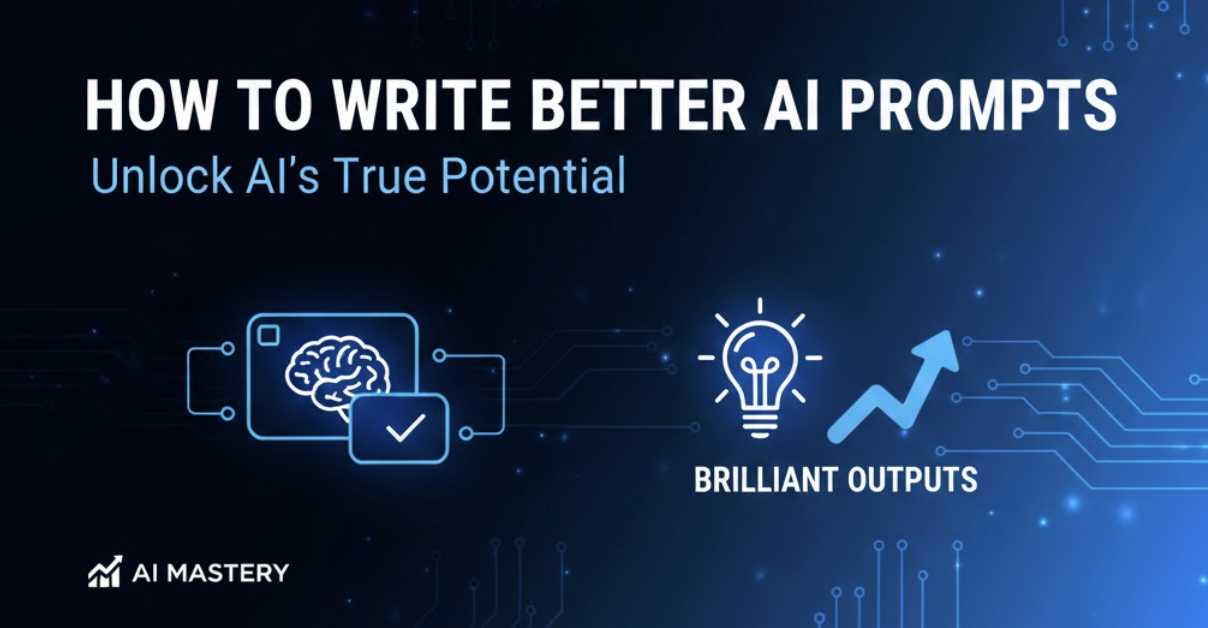
Why do AI prompts like "Write about cybersecurity" often fail? A lack of specificity leads to wasted time and effort. The solution lies in Prompt Engineering: the practice of designing detailed, context-driven commands. By flipping the "Garbage In, Garbage Out" rule on its head, you can reliably extract high-value insights from large language models.
Mastering the Art of Clarity
To move beyond vague outputs, you must transition from simple requests to structured instructions. According to the original guide "Craft Prompts That Work", the secret to precision is a multi-layered approach:
- • Precision Targets: Instead of "write a summary," use "Give me a 3-bullet summary focusing on X, Y, and Z."
- • Persona Assignment: Assign a role like "Senior Cybersecurity Analyst" to shift the AI's tone and technical depth.
- • Format Dictation: Explicitly request outputs in JSON, Markdown tables, or specific word counts to eliminate manual reformatting.
The CRISPA Framework
Using a structured framework ensures no critical information is missing from your command. The CRISPA model is a gold standard for professional prompting:
| Element | Purpose |
|---|---|
| Context | Background info and source material. |
| Role | The expertise the AI should embody. |
| Instructions | The specific actions to take. |
| Steps | The reasoning sequence to follow. |
| Purpose | The end goal and target audience. |
Advanced Prompting Techniques
For complex logic or creative tasks, these sophisticated methods bridge the gap between AI and human-level nuance:
Few-Shot Prompting
Provide 2-3 examples of the desired input-output pair. This acts as a template for the AI to follow, ensuring stylistic consistency.
Chain-of-Thought
Ask the model to "think step-by-step." This forces the AI to break down complex logic, drastically reducing errors in math and reasoning.
Multimodal Optimization
Communication styles change depending on whether you are generating text, images, or audio.
📝 For Text: Focus on Tone and Structure. (e.g., "Act as a passionate barista...")
📷 For Images: Focus on Composition and Lighting. (e.g., "Cinematic lighting, shallow depth of field...")
🎵 For Audio: Focus on Pacing and Instrumentation. (e.g., "Upbeat jingle with acoustic guitar...")
Common Pitfalls to Avoid
Even expert prompt engineers face hurdles. Watch out for these three efficiency killers:
- Conflicting Instructions: Avoid asking the AI to be "concise but highly detailed." Choose one priority.
- Ignoring Model Context Windows: AI has a limited "memory" of the current conversation. Remind it of key facts in long threads.
- Prompt Injection: In application development, ensure user inputs cannot override your core system instructions.
Frequently Asked Questions
1. What is the single most important part of a prompt?
Clarity of the objective. Without a specific goal, the AI defaults to generic patterns. Always define the exact "output" you want before writing the context.
2. How does "Role Play" improve AI responses?
Assigning a persona (e.g., "Act as a lawyer") triggers the model to prioritize a specific subset of its training data, resulting in more professional vocabulary and relevant nuances.
3. Can I use the same prompt for different AI models?
Generally, yes, but different models (like GPT-4 vs. Claude vs. Llama) have different sensitivities. Testing and minor "tweaks" to temperature or wording are often necessary for peak performance.
4. What is "Zero-Shot" vs "Few-Shot" prompting?
Zero-shot is a direct command without examples. Few-shot includes examples of the task. Few-shot is significantly more effective for complex formatting or unique brand voices.