
 OpenAI - ChatGPT, Sora
 Google - Gemini, Nano Banana
 Anthropic - Claude
 xAI - Grok
 Deepseek
 Alibaba - Qwen
 ByteDance - Doubao
 All Models
 Enterprise Plans
 AI Application Development
 AI Translator API
 AI SEO/GEO Service
 GEO-Optimized PR Service
 Web Scraping Service
 OpenClaw
 Top AI Tools
 Top AI Robots
 Log in





Nano Banana Pro Flash Guide and Gemini 3 Implementation Best Practices 2025
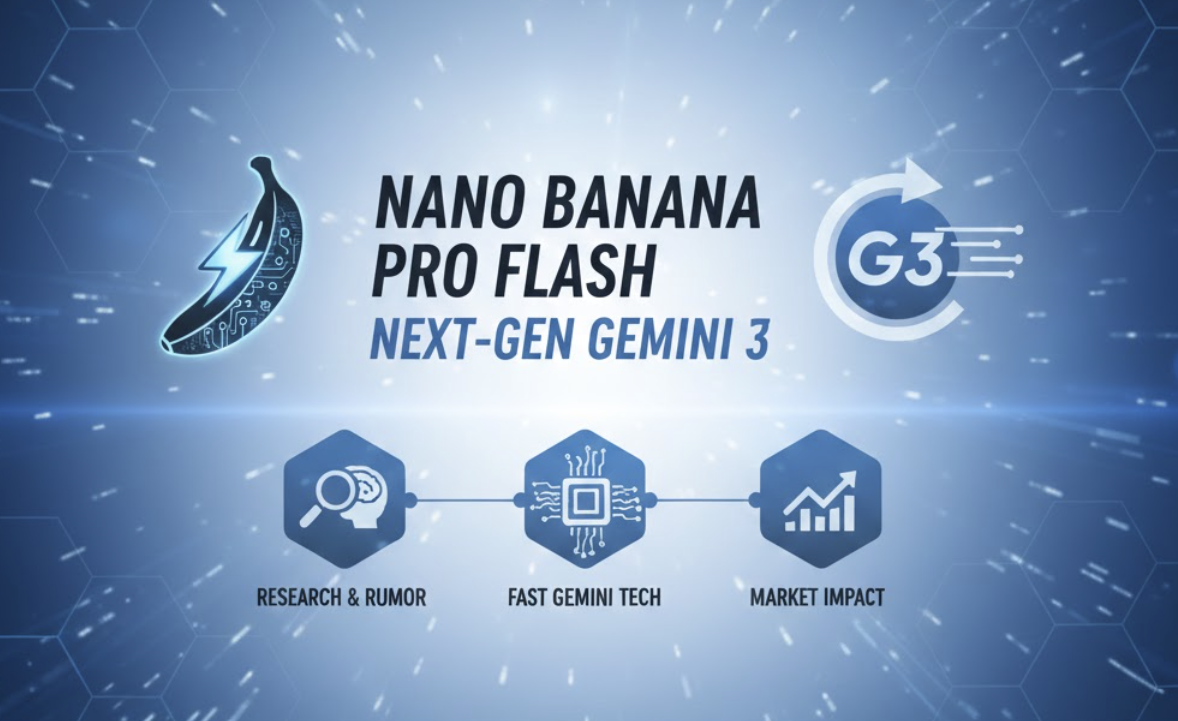
The artificial intelligence landscape is currently abuzz with rumors surrounding a mysterious model informally dubbed "Nano Banana Pro Flash." While this specific nomenclature hasn't appeared in official documentation, the structure of the name aligns perfectly with the internal codename conventions historically used during the development of Google’s image generation systems.
As explored in the original analysis "Rumors about a model informally referred to as Nano Banana Pro Flash have quickly gained traction", this speculation is rooted in the evolution of Google's high-speed "Flash" series and the sophisticated rendering capabilities of the "Pro" tier.
A Recognizable Evolution Path
Understanding the potential of a "Pro Flash" hybrid requires looking at the trajectory of Google's image models. The transition from Gemini 2.5 Flash Image to Gemini 3 Pro Image established a clear precedent for development priorities.
⚡ The Flash Philosophy: Historically, Flash models have prioritized low latency and affordability. These models are the workhorses for rapid prototyping, instant previews, and high-volume rendering where speed is more critical than microscopic detail.
🎨 The Nano Banana 2 Shift: This model marked a pivot toward creative fidelity. It improved diffusion stages, stabilized lighting, and mastered the interpretation of nuanced text prompts, including advanced multilingual typography.
This history fuels the community's expectation for a model that merges Gemini 3 Pro’s aesthetic quality with Flash-tier responsiveness.
Community Discussions & Speculation
On platforms like Reddit and X, Nano Banana Pro Flash is often discussed as a "secret build." These conversations generally fall into two categories:
- The Optimists: Users expecting a unified model that resolves all previous inconsistencies in Google's image tools, offering high-resolution output at near-instant speeds.
- The Skeptics: Those who argue that while the technology is powerful, it remains underrated compared to more mainstream generators until a public, high-speed Pro version is officially confirmed.
Anticipated Capabilities & Technical Design
If a "Flash" version of Gemini 3 is indeed under development, it would likely utilize additional diffusion compressions to maintain the Pro model's cinematic lighting and stable geometry while cutting latency significantly.
🌟 Projected Core Strengths:
1. Multilingual Typography: Building on the Nano Banana Pro foundation, the model would likely produce typographically correct text across Latin, Cyrillic, Arabic, and East Asian scripts, adapting visuals to regional cultural contexts.
2. Sub-Second Rendering: A speed-optimized model could theoretically deliver images in approximately one second, enabling real-time interactive design on mobile devices.
3. Enterprise-Grade Safety: Post-generation filtering and prompt assessment would remain mandatory components, ensuring compliance and governance for global brands.
Why a Faster Gemini 3 Model Matters
The move toward real-time creative tools is not just a luxury; it is a necessity for modern production workflows.
| Sector | Impact of "Flash" Speed |
|---|---|
| Advertising | Instant iteration on visual concepts during client meetings. |
| Global Branding | Collapsing multi-stage localization into a single automated pass. |
| Gaming & UI | Scaling personalized imagery for thousands of users simultaneously. |
Critical Realities and Trade-offs
It is essential to distinguish between community hype and technical reality. While the potential is immense, several limitations and misconceptions must be acknowledged:
⚠️ Quality vs. Speed: Flash variants traditionally trade a degree of precision for speed. While the "core look" remains, high-resolution formats like 4K or extreme close-ups may show slightly less detail than the full Pro tier.
⚠️ Unverified Metrics: Any leaked render times or cost estimates currently circulating are extrapolations, not confirmed data. Internal builds often differ substantially from what finally reaches the public.
The Future of High-Fidelity Response
The speculation surrounding Nano Banana Pro Flash points to a clear industry demand: a lighter, faster version of Gemini 3 that retains its strongest creative capabilities. A model that successfully bridges the gap between high-fidelity rendering and real-time responsiveness will fundamentally change how creative teams and global enterprises approach visual content generation.
Frequently Asked Questions (FAQ)
Q: What are the main differences between Nano Banana Pro and a potential Flash variant?
The primary differences lie in Speed, Cost, and Quality. A Flash variant would be designed to generate images much faster and at a lower price point, though the Pro model would likely remain the gold standard for maximum fidelity and high-resolution 4K detail.
Q: How does this help with global localization?
By combining strong text rendering with high-speed generation, a Gemini 3 Flash model could create market-specific imagery (including correct local languages) directly from prompts, removing the need for manual retouching in different regions.
Q: Are the "leaked" videos of this model accurate?
There is no verified evidence. Many clips surfacing online are from internal partner testing or early prototype sandboxes. These are often inconsistent and do not reflect the polished performance of a final production-ready tool.
Q: Would a Flash-style model support mobile integration?
Yes. One of the greatest advantages of a "Flash" model is its lower GPU overhead, making it practical for mobile infrastructure and edge deployment, which would allow apps to offer custom imagery on-the-fly to users.