
 OpenAI - ChatGPT, Sora
 Google - Gemini, Nano Banana
 Anthropic - Claude
 xAI - Grok
 Deepseek
 Alibaba - Qwen
 ByteDance - Doubao
 All Models
 Enterprise Plans
 AI Application Development
 AI Translator API
 AI SEO/GEO Service
 GEO-Optimized PR Service
 Web Scraping Service
 OpenClaw
 Top AI Tools
 Top AI Robots
 Log in






What Are AI Agents?
What Are AI Agents?
From passive chatbots to autonomous actors: Discover how AI Agents are redefining the boundaries of machine intelligence, automation, and the future of work.
Defining the Autonomous Future
The term "Artificial Intelligence" has long been synonymous with static models—systems that wait for an input and provide an output. However, a seismic shift is occurring in the technological landscape. We are moving from the era of Generative AI (creators) to the era of Agentic AI (doers).
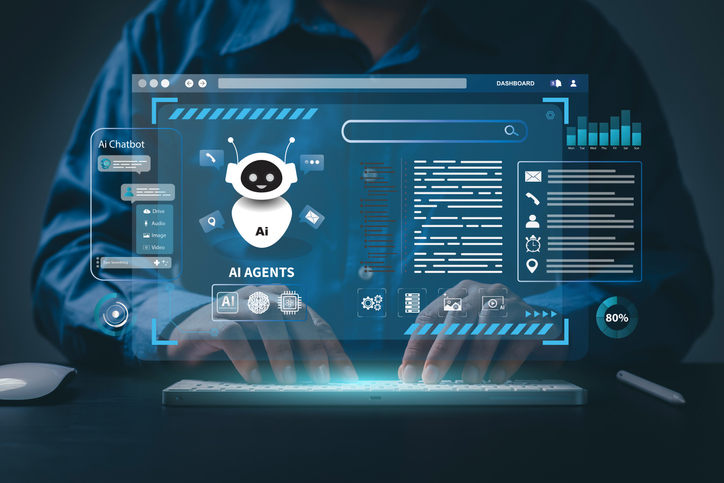
Unlike a standard chatbot (like the basic version of ChatGPT), which answers questions based on training data, an AI Agent has "hands." It can browse the web, write and execute code, control software applications, and interact with APIs. If an LLM is a brain in a jar, an AI Agent is that brain connected to a body, capable of manipulating the digital world.
The Anatomy of an Agent
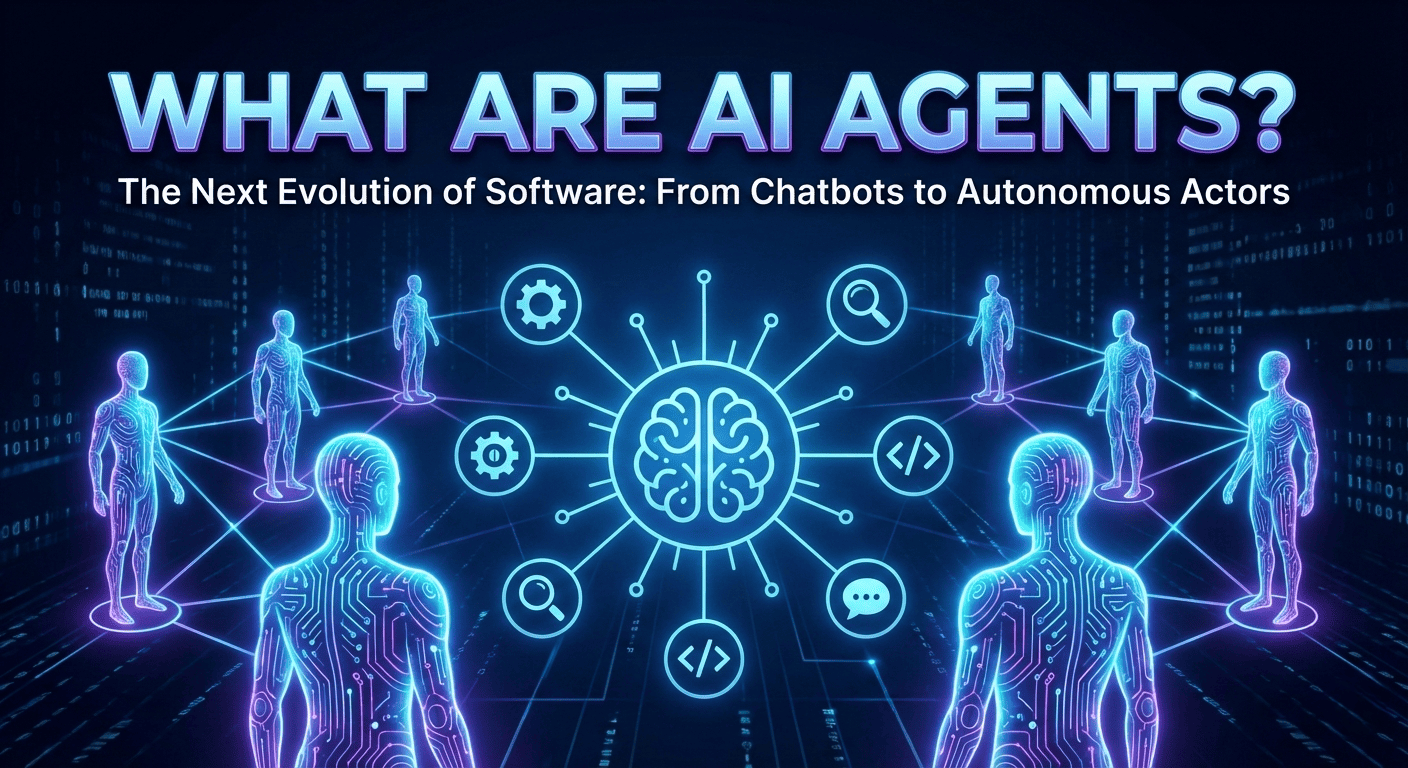
To understand "what are AI agents," we must look under the hood. An agent isn't magic; it is a sophisticated architecture composed of four distinct pillars that allow it to function autonomously.
The Brain (Profiling)
The core LLM (like GPT-4, Claude, or Llama 3) serves as the cognitive engine. It processes natural language, understands intent, and holds the general knowledge base required to reason through complex tasks.
Planning
Agents don't just act; they strategize. Through techniques like Chain of Thought (CoT) and Tree of Thoughts, agents break down a high-level goal (e.g., "Book a vacation") into manageable sub-tasks (e.g., "Check dates," "Compare flights," "Book hotel").
Memory
Unlike stateless chatbots, agents maintain context. Short-term memory handles the immediate task steps, while Long-term memory (often using Vector Databases) allows the agent to recall past interactions and learn from mistakes.
Tool Use
This is the differentiator. Agents are equipped with executable tools—calculators, search engines, code interpreters, and API connectors—allowing them to affect change in the real world.
The Agentic Workflow: Perception to Action
The operation of an AI agent follows a cyclical loop, often referred to as the OODA Loop (Observe, Orient, Decide, Act) in military strategy, adapted here for cognitive computing.
When you give an agent a command, such as "Analyze the stock market trends for Tech companies and generate a PDF report," the following process triggers:
- Perception: The agent interprets the user's prompt and identifies the ultimate goal.
- Reasoning & Planning: It recognizes it cannot answer from memory. It plans to: 1. Search for current stock prices, 2. Aggregate data, 3. Use a Python library to visualize charts, 4. Compile a PDF.
- Action (Tool Execution): The agent uses a "Search Tool" to get live data. It then uses a "Code Interpreter" to process that data.
- Reflection: If the code errors out, the agent reads the error message, "thinks" about the fix, rewrites the code, and tries again—all without human input.
- Output: The final result is delivered only when the task is complete.
Types of AI Agents Transforming Industries
Not all agents are created equal. As the technology matures, we are seeing specialization in agent capabilities, ranging from simple automated tasks to complex, multi-agent orchestrations.
1. Single-Task Agents
These are specialized bots designed for one specific workflow. For example, a Customer Support Agent that has access to a company's knowledge base and refund system. It can autonomously verify a user's identity, check the policy, and process a refund.
2. Generalist Agents
Systems like AutoGPT or BabyAGI represent early attempts at generalist agents. You give them a broad goal (e.g., "Grow my Twitter following"), and they attempt to figure out every necessary step, creating their own sub-tasks recursively.
3. Multi-Agent Systems (MAS)
This is the frontier of AI. In a Multi-Agent System, several specialized agents collaborate. Imagine a "Software Development Squad":
These agents talk to each other, critique each other's work, and iterate until the final product is ready for human deployment.
Real-World Applications
💻 Software Engineering
Agents like Devin (by Cognition) can take a GitHub issue, read the repository, reproduce the bug, fix the code, and run tests autonomously. This shifts developers from "writers of code" to "architects of systems."
📊 Data Analysis
Enterprise agents can connect to SQL databases. A CEO can ask, "Why did revenue drop in Q3?" The agent writes the SQL query, analyzes the returned data, cross-references it with marketing spend, and provides a root-cause analysis.
🏥 Healthcare
Medical agents assist in triage by analyzing patient history, current symptoms, and latest research papers to suggest differential diagnoses to doctors, flagging potential drug interactions automatically.
The Road to AGI and Ethical Challenges
While the potential is limitless, the deployment of AI agents introduces significant challenges. Hallucinations in an agent are more dangerous than in a chatbot; a chatbot might tell you a lie, but an agent might delete a production database based on a misunderstanding.
Control and Safety: How do we ensure an agent doesn't get stuck in an infinite loop? How do we prevent it from spending excessive money via API costs? The field of "Agentic Evaluation" is exploding to solve these specific reliability issues.
Looking forward, AI agents are the stepping stones to Artificial General Intelligence (AGI). As agents gain better memory, more tools, and the ability to learn continuously from their environment, the line between software and sentient employee begins to blur. We are building the digital workforce of the 21st century.