
 OpenAI - ChatGPT, Sora
 Google - Gemini, Nano Banana
 Anthropic - Claude
 xAI - Grok
 Deepseek
 Alibaba - Qwen
 ByteDance - Doubao
 All Models
 Enterprise Plans
 AI Application Development
 AI Translator API
 AI SEO/GEO Service
 GEO-Optimized PR Service
 Web Scraping Service
 OpenClaw
 Top AI Tools
 Top AI Robots
 Log in








What are AI Tokens and How They Work in Large Language Models
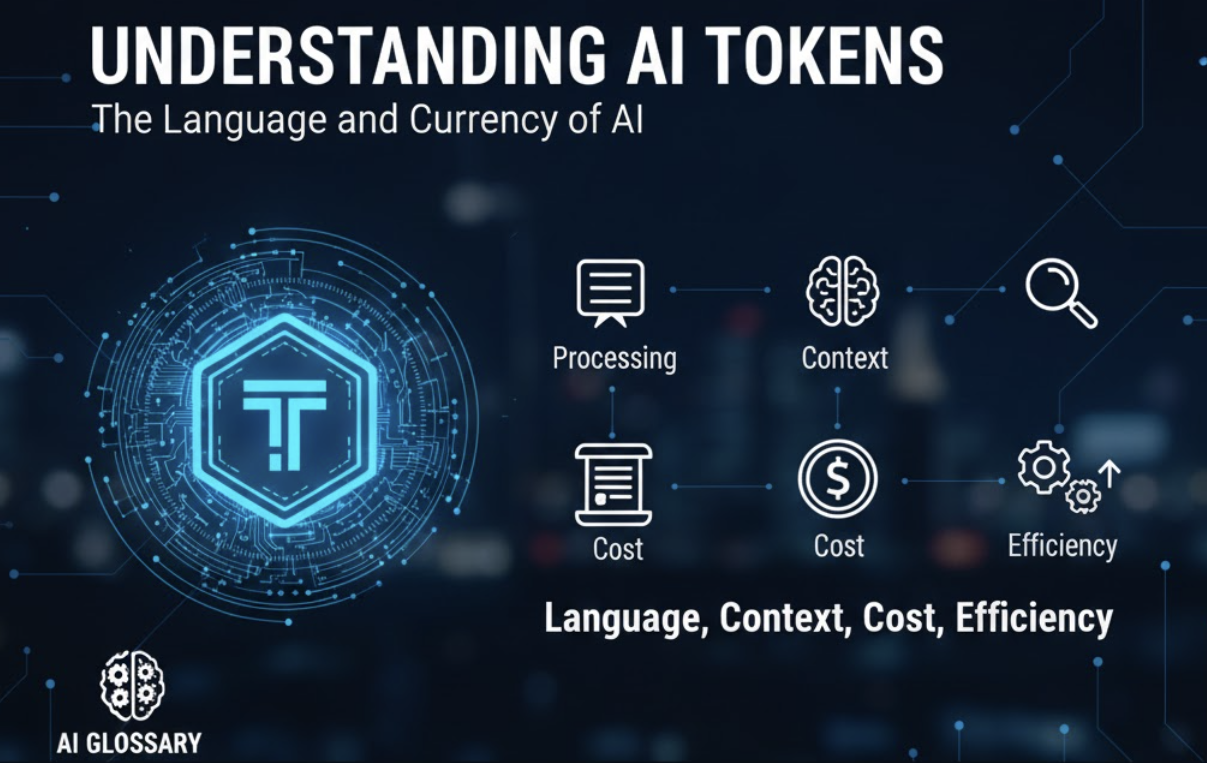
In the rapidly evolving landscape of artificial intelligence, understanding tokens is essential for anyone looking to master Large Language Models (LLMs). As highlighted in the original guide "What Are Tokens in AI?", tokens are the fundamental units of data that AI models use to process, interpret, and generate human-like language.
Think of tokens as the atomic building blocks of information. Whether it is a single word, a fragment of a word, a punctuation mark, or even a pixel in an image, AI systems do not "read" sentences like humans do. Instead, they perform tokenization—a process that chops raw input into discrete mathematical vectors that the model can analyze efficiently.
💡 Pro-Tip: 1,000 tokens is approximately equivalent to 750 words.
For example, a common English word like "apple" might be one token, but a complex or rare word like "tokenization" might be split into several tokens (e.g., "token", "iz", "ation").
The Critical Role of AI Tokens
Tokens serve three primary functions in modern AI systems:
1. The Context Window
This determines the model's "memory." A model with a 128k context window can process roughly 300 pages of text in one go, while smaller models may forget earlier parts of a conversation.
2. Internal Reasoning
Advanced models generate "thought tokens" or reasoning tokens. These allow the AI to work through multi-step logic before providing the final visible output.
Beyond Text: Multimodal Tokenization
While most people associate tokens with text, modern multimodal models treat different types of data as tokens to enable cross-media understanding:
| Token Type | Description |
|---|---|
| Text Tokens | Sub-words and characters; the standard for LLMs. |
| Visual Tokens | Image segments or patches used in DALL-E or Midjourney. |
| Acoustic Tokens | Sound snippets for real-time voice translation and generation. |
Why Tokens Determine AI Economics
Understanding token usage is not just technical—it is financial. In the world of AI APIs, tokens are the currency. Here is why they matter for your business operations:
- ✔ Cost Optimization: Every API call is billed per 1k or 1M tokens. Reducing prompt length directly reduces operational overhead.
- ✔ Performance Speed: More tokens require more compute time. Strategic tokenization leads to faster response times for chatbots and real-time agents.
- ✔ Language Sensitivity: Different languages tokenize differently. English is very efficient, whereas languages like Japanese or Arabic often consume more tokens for the same amount of information.
Practical Benchmarks for Developers
To help you estimate usage and costs, consider these typical token counts:
Broad Applications of Tokenization
Beyond simple text generation, tokens power specialized industries:
- Digital Publishing: Structured tokens (H1, H2 tags) help AI summarize news articles for search engine snippets.
- UX and Customer Journeys: E-commerce bots use tokens to match user queries with structured product catalogs.
- Scientific Research: Tokenization of chemical structures or protein sequences allows AI to discover new medicines.
Mastering tokens means mastering the fundamental economics of modern AI.
By understanding how inputs are segmented and processed, developers can build more efficient, context-aware, and cost-effective AI solutions. Whether you are managing API expenses or engineering complex prompts, strategic token awareness is your most powerful tool.
Frequently Asked Questions (FAQ)
Q1: Does one token always equal one word?
No. While short words are often one token, long or uncommon words are broken into sub-words. On average, 1,000 tokens represent about 750 words in English.
Q2: How do tokens affect my AI costs?
Most AI providers charge based on the number of tokens processed (input + output). Efficiently structured prompts use fewer tokens, directly lowering your API bill.
Q3: What happens when I exceed the token limit (Context Window)?
When a conversation exceeds the model's context window, the AI will "forget" the oldest information in the thread to make room for new tokens, which can lead to loss of context.
Q4: Can tokens represent things like code or images?
Yes. Programming code is tokenized similarly to text, and vision models convert image pixels into specialized visual tokens so the AI can "see" patterns in the data.