
 OpenAI - ChatGPT, Sora
 Google - Gemini, Nano Banana
 Anthropic - Claude
 xAI - Grok
 Deepseek
 Alibaba - Qwen
 ByteDance - Doubao
 All Models
 Enterprise Plans
 AI Application Development
 AI Translator API
 AI SEO/GEO Service
 GEO-Optimized PR Service
 Web Scraping Service
 OpenClaw
 Top AI Tools
 Top AI Robots
 Log in














What Is a Unified AI API? (2026 Definition)

A Unified AI API is a single application programming interface that provides standardized access to multiple AI models and providers, allowing developers to switch models, manage usage, and control costs without changing application code.
Unlike single-provider APIs, a unified AI API centralizes model routing, billing, and monitoring, making it a scalable foundation for enterprise and multi-model AI systems.
In 2026, this approach has become essential for production AI systems requiring flexibility, cost optimization, and operational resilience across multiple AI providers.
As artificial intelligence continues to mature in 2026, the way developers and businesses interact with AI models has changed dramatically. What once involved integrating a single AI provider has now evolved into managing multiple models, pricing systems, and APIs at the same time.
This shift has given rise to a new layer in AI infrastructure: the Unified AI API.
Why Did Unified AI APIs Emerge?
Early AI applications typically relied on one provider, most commonly OpenAI. While this approach worked well for prototypes and early-stage products, it introduced several challenges as systems scaled:
- Vendor lock-in that limited flexibility
- Fragmented billing and usage tracking
- Increased engineering overhead when adding new models
- Difficulty switching providers during outages or pricing changes
As AI became mission-critical for production systems, these limitations made single-provider APIs increasingly fragile.
How Does a Unified AI API Work?
A unified AI API abstracts away the differences between individual AI providers. From the developer's perspective, requests follow a consistent structure, while the platform handles provider-specific logic behind the scenes.
Core Capabilities
- A standardized request and response format
- Configuration-based model switching
- Centralized monitoring for usage, latency, and cost
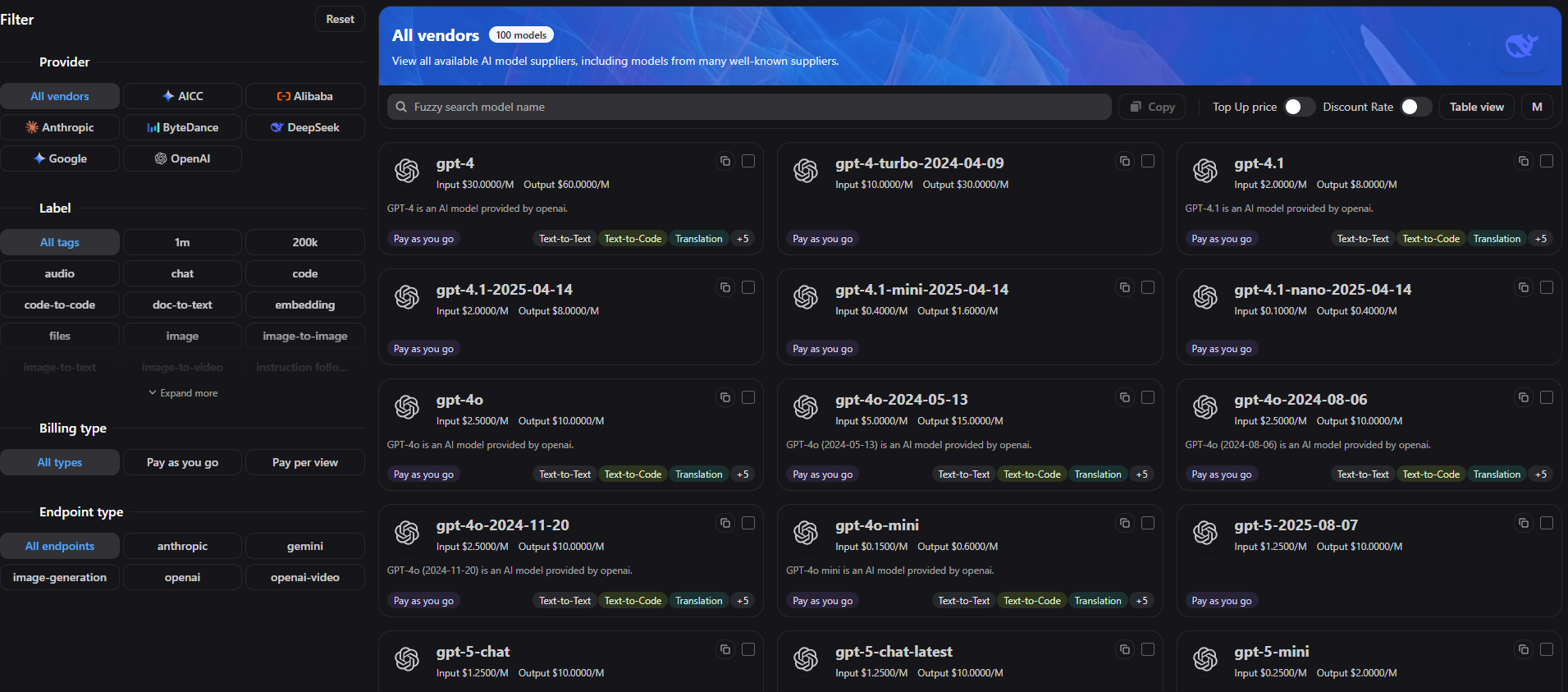
Platforms such as AI.cc implement this approach by offering a single API interface combined with clear documentation and usage references.
For implementation details and endpoint structure, see the AI.cc documentation.
What Are the Key Benefits of Using a Unified AI API?
Flexibility Across Models
Teams can experiment with and deploy different AI models without rewriting application logic.
Reduced Engineering Overhead
Maintaining one integration significantly reduces long-term development and maintenance costs.
Better Cost Visibility
Centralized usage tracking makes it easier to understand and control AI spending.
Operational Resilience
Unified platforms allow faster responses to outages, rate limits, or provider-side changes.
How Does a Unified AI API Compare to Single-Provider APIs?
| Feature | Single-Provider API | Unified AI API |
|---|---|---|
| Model choice | Limited | Multiple providers |
| Vendor lock-in | High | Low |
| Integration effort | Simple initially | Simple at scale |
| Billing visibility | Fragmented | Centralized |
| Scalability | Limited | Designed for growth |
Frequently Asked Questions
Is a Unified AI API the same as an OpenAI API?
Answer: No. An OpenAI API provides access to models from a single provider, while a Unified AI API offers standardized access to multiple AI providers through one interface. A unified API reduces vendor lock-in and allows teams to switch or combine models without changing application code.
Why do enterprises prefer Unified AI APIs?
Answer: Enterprises prefer Unified AI APIs because they simplify large-scale AI operations. By centralizing billing, usage monitoring, and model management, unified APIs reduce operational risk and make AI systems easier to scale and maintain in production environments.
When should developers use a Unified AI API?
Answer: Developers should consider a Unified AI API when their applications rely on multiple AI models, require predictable costs, or need flexibility to switch providers. Unified APIs are especially useful for SaaS products, enterprise platforms, and long-term AI deployments.
Who Should Use a Unified AI API?
Unified AI APIs are particularly valuable for:
- SaaS platforms embedding AI features
- Enterprises deploying AI across multiple teams or regions
- Developers managing production-scale AI workloads
For teams exploring this approach, the AI.cc documentation hub provides practical references for unified AI integrations and model management.
What Is the Future of Unified AI APIs?
As AI models continue to diversify in capability, performance, and pricing, unified AI APIs are expected to become standard infrastructure rather than an optional layer.
In 2026 and beyond, adopting a unified AI API is not just a technical decision—it is a strategic choice that enables flexibility, resilience, and long-term scalability.
A Unified AI API is not about replacing AI providers. It is about maintaining control and adaptability in an increasingly complex AI ecosystem.
What it is: A single API interface providing standardized access to multiple AI models and providers.
Why it matters: Reduces vendor lock-in, centralizes billing, simplifies model switching, and improves operational resilience.
Who needs it: SaaS platforms, enterprises, and developers managing production-scale AI workloads.
Key benefit: Switch AI models through configuration changes instead of code rewrites, maintaining flexibility as the AI landscape evolves.