 OpenAI - ChatGPT, Sora
 Google - Gemini, Nano Banana
 Anthropic - Claude
 xAI - Grok
 Deepseek
 Alibaba - Qwen
 ByteDance - Doubao
 All Models
 Enterprise Plans
 AI Application Development
 AI Translator API
 AI SEO/GEO Service
 GEO-Optimized PR Service
 Web Scraping Service
 OpenClaw
 Top AI Tools
 Top AI Robots
 Log in


                                        const Anthropic = require('@anthropic-ai/sdk');

const api = new Anthropic({
  baseURL: 'https://api.ai.cc/',
  authToken: '',
});

const main = async () => {
  const message = await api.messages.create({
    model: 'claude-3-7-sonnet-20250219',
    max_tokens: 2048,
    system: 'You are an AI assistant who knows everything.',
    messages: [
      {
        role: 'user',
        content: 'Tell me, why is the sky blue?',
      },
    ],
  });

  console.log('Message:', message);
};

main();
                                        import asyncio
from anthropic import Anthropic

client = Anthropic(
    base_url="https://api.ai.cc/",
    auth_token="",
)


def main():
    message = client.messages.create(
        model="claude-3-7-sonnet-20250219",
        max_tokens=2048,
        system="You are an AI assistant who knows everything.",
        messages=[
            {
                "role": "user",
                "content": "Hello, Claude",
            }
        ],
    )

    print("Message:", message.content)


if __name__ == "__main__":
    main()


Product Detail
Introducing Claude 3.7 Sonnet: Anthropic's Latest AI Breakthrough
Discover the power of Claude 3.7 Sonnet, Anthropic's pioneering hybrid reasoning model. Engineered for complex challenges, this Large Language Model (LLM) masterfully blends rapid inference with in-depth problem-solving capabilities, setting a new standard in AI performance.
Developed by Anthropic and slated for release on February 24, 2025 as Version 3.7, Claude 3.7 Sonnet is designed to transform how we interact with and leverage artificial intelligence.
Key Capabilities & Features
- ✨ Dual-Mode Operation: Navigate effortlessly between Standard and Extended Thinking modes to optimize performance for diverse tasks.
- 📈 Expanded Output Capacity: Boasting an impressive output capacity of up to 200K tokens, Claude 3.7 Sonnet excels in managing and generating extensive content.
- 💻 State-of-the-Art Coding: Achieves benchmark performance in intricate coding tasks, enhancing software development workflows.
- ⚙️ Advanced Action Scaling: Facilitates sophisticated iterative function calls and dynamic environmental interactions for more autonomous AI agents.
Versatile Applications of Claude 3.7 Sonnet
Claude 3.7 Sonnet is engineered for a wide array of high-impact applications, enabling users across various professional and creative fields:
- • Complex Coding & Software Development: From generating code to debugging and refactoring.
- • Advanced Mathematical Problem-Solving: Tackling intricate equations and logical challenges.
- • Detailed Analysis & Research: Processing, synthesizing, and extracting insights from vast datasets.
- • Creative Writing & Content Generation: Producing high-quality articles, scripts, and marketing copy.
- • AI-Powered Agents & Workflows: Building intelligent agents capable of complex decision-making and interaction.
With its extensive multi-language support, Claude 3.7 Sonnet ensures broad usability and accessibility across diverse global demographics.
Technical Specifications
Claude 3.7 Sonnet is founded on a sophisticated transformer-based architecture, integrating cutting-edge hybrid reasoning and extended thinking paradigms. Its core innovation lies in a dual-mode operation system, allowing the model to dynamically switch between standard language processing and more resource-intensive analytical reasoning.
The model's extensive knowledge base is current up to November 2024.
Performance Overview
Benchmarking results consistently highlight Claude 3.7 Sonnet's impressive performance metrics across a variety of demanding tasks.

A visual representation illustrating Claude 3.7 Sonnet's performance across key metrics.
Seamless Integration: How to Use Claude 3.7 Sonnet
Accessing Claude 3.7 Sonnet is streamlined through the comprehensive AI/ML API platform, where it is identified as "Claude 3.7 Sonnet".
Code Samples
Integrate Claude 3.7 Sonnet into your applications using the intuitive code examples and snippets provided:
<snippet data-name="anthropic.messages" data-model="claude-3-7-sonnet-20250219"></snippet> (This area would typically display example code for API calls.)
Comprehensive API Documentation
For in-depth information on integration, available endpoints, and advanced functionalities, consult the official and detailed API Documentation.
Ethical AI & Licensing Information
Commitment to Ethical AI Development
Anthropic is deeply committed to responsible AI. Claude 3.7 Sonnet is equipped with robust safeguards, including automatic encryption for sensitive information processed within the model's internal thought processes, ensuring both privacy and secure data handling.
Flexible Licensing
Claude 3.7 Sonnet is released under a versatile commercial license. This allows for both commercial and non-commercial usage rights, ensuring wide accessibility while strictly adhering to established ethical standards.
Ready to elevate your projects with the advanced capabilities of Claude 3.7 Sonnet?
🚀 Try Claude 3.7 Sonnet API Now!Frequently Asked Questions (FAQ)
Q1: What is Claude 3.7 Sonnet?
Claude 3.7 Sonnet is Anthropic's advanced Large Language Model (LLM) featuring a unique hybrid reasoning architecture. It operates in dual modes (Standard and Extended Thinking) to deliver superior performance in complex problem-solving and rapid inference tasks.
Q2: What are the main applications of Claude 3.7 Sonnet?
It is primarily designed for complex coding tasks, mathematical problem-solving, detailed analysis and research, creative content generation, and building sophisticated AI-powered agents and automated workflows.
Q3: What is the knowledge cutoff date for Claude 3.7 Sonnet?
Claude 3.7 Sonnet's knowledge base is current up to November 2024, ensuring its ability to process information up to that period.
Q4: How can developers access and integrate Claude 3.7 Sonnet?
The model is accessible via the AI/ML API platform. Comprehensive API documentation and code samples are provided to facilitate easy integration into various applications and systems.
Q5: What ethical considerations has Anthropic implemented for Claude 3.7 Sonnet?
Anthropic has built in robust ethical safeguards, including automatic encryption of sensitive information within the model's internal thought processes, to ensure privacy, security, and responsible AI deployment.
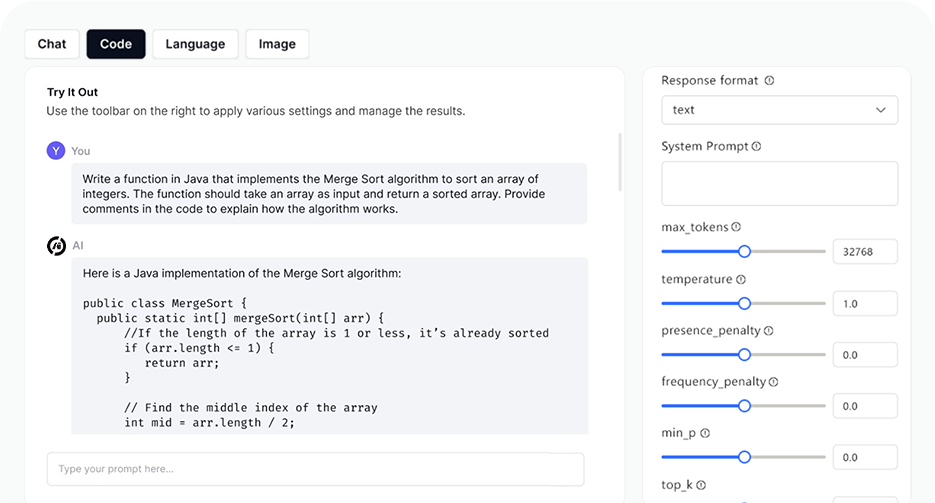
AI Playground