 OpenAI - ChatGPT, Sora
 Google - Gemini, Nano Banana
 Anthropic - Claude
 xAI - Grok
 Deepseek
 Alibaba - Qwen
 ByteDance - Doubao
 All Models
 Enterprise Plans
 AI Application Development
 AI Translator API
 AI SEO/GEO Service
 GEO-Optimized PR Service
 Web Scraping Service
 OpenClaw
 Top AI Tools
 Top AI Robots
 Log in


                                        const Anthropic = require('@anthropic-ai/sdk');

const api = new Anthropic({
  baseURL: 'https://api.ai.cc/',
  authToken: '',
});

const main = async () => {
  const message = await api.messages.create({
    model: 'anthropic/claude-opus-4',
    max_tokens: 2048,
    system: 'You are an AI assistant who knows everything.',
    messages: [
      {
        role: 'user',
        content: 'Tell me, why is the sky blue?',
      },
    ],
  });

  console.log('Message:', message);
};

main();
                                        import asyncio
from anthropic import Anthropic

client = Anthropic(
    base_url="https://api.ai.cc/",
    auth_token="",
)


def main():
    message = client.messages.create(
        model="anthropic/claude-opus-4",
        max_tokens=2048,
        system="You are an AI assistant who knows everything.",
        messages=[
            {
                "role": "user",
                "content": "Hello, Claude",
            }
        ],
    )

    print("Message:", message.content)


if __name__ == "__main__":
    main()


Product Detail
Claude 4 Opus Description
Anthropic's Claude Opus 4 is a highly advanced AI model, meticulously engineered for complex coding, sophisticated reasoning, and in-depth analytics. With an impressive 200K-token context window, it delivers unmatched precision and understanding for processing vast amounts of information, making it ideal for demanding tasks.
Technical Specifications
Performance Benchmarks
Claude Opus 4 is meticulously optimized for high performance in coding, reasoning, and text-based analytics.
- ✅ Context Window: 200K tokens – offering extensive capacity for complex tasks.
- ✅ Output Capacity: Up to 32K tokens per response.
- ✅ Key Benchmarks:
- SWE-bench: 72.5%
- Terminal-bench: 43.2%
API Pricing
Understand the cost structure for integrating Claude Opus 4 into your applications.
- 💸 Input Tokens: $15.75 per million tokens.
- 💸 Output Tokens: $78.75 per million tokens.
- 💸 Cost for 1,000 Tokens (approx.): $0.01575 (input) + $0.07875 (output) = $0.0945 total.

Key Capabilities
Claude Opus 4 delivers precise and reliable outputs for even the most complex workflows.
- 💻 Advanced Coding: Excels in multi-file code refactoring and autonomous coding tasks, significantly boosting development efficiency and quality.
- 🧠 Advanced Reasoning: Offers superior multi-step reasoning capabilities, critical for complex analytics and robust problem-solving scenarios.
- 🔧 Tool Utilization: Seamlessly supports function calling and JSON structuring, enabling powerful API automation and integration.
- 🚀 API Features: Provides high-performance streaming and versatile function calling, essential for building scalable and responsive applications.
Optimal Use Cases
Leverage Claude Opus 4 across a variety of demanding applications:
- 📁 Coding & Software Development: Ideal for large-scale code refactoring, autonomous PR generation, and managing intricate multi-file changes.
- 📊 Data Analysis: Proficient in processing complex business datasets, extracting insights, and performing in-depth analysis.
- 🔊 Business Automation: Streamlining workflows and enhancing operational efficiency through robust API integration.
- 🧐 Complex Problem-Solving: Tackling multi-step reasoning tasks and intricate challenges across various domains.
Code Samples
Below is an embedded code sample demonstrating the use of Claude Opus 4.
Comparison with Other Leading AI Models
Claude Opus 4 stands out against competitors in critical performance areas:
- ⭐ Vs. Gemini 2.5 Flash: Claude Opus 4 offers superior coding accuracy (72.5% vs. 63.8% on SWE-bench), making it the preferred choice for complex software engineering projects.
- ⭐ Vs. OpenAI o3-mini: Demonstrates stronger overall coding performance (72.5% vs. 69.1% on SWE-bench), providing a significant advantage for autonomous workflow implementations.
- ⭐ Vs. Qwen3-235B-A22B: Achieves higher coding precision (72.5% vs. ~60% SWE-bench, estimated), specifically optimized for intricate multi-file coding tasks.
Current Limitations
While powerful, Claude Opus 4 has specific limitations:
- ❌ No Vision Capabilities: Limited to text-based analysis, it does not process images or videos.
- ❌ No Fine-tuning Support: Does not currently support fine-tuning for highly specialized domain adaptation.
- ❌ Text-Based Tasks Only: Primarily designed for textual interactions, without multimodal input support.
API Integration
Claude Opus 4 is seamlessly accessible via a comprehensive AI/ML API. For detailed implementation guides and reference materials, please refer to the official documentation:
📄 Documentation: Anthropic Claude 4 Opus API Documentation
Frequently Asked Questions (FAQs)
Q1: What makes Claude Opus 4 stand out from other AI models?
A: Claude Opus 4 distinguishes itself with an industry-leading 200K-token context window, unparalleled precision in coding (72.5% on SWE-bench), and superior multi-step reasoning capabilities, making it ideal for complex analytical and development tasks.
Q2: Can Claude Opus 4 handle large-scale coding projects?
A: Absolutely. Its advanced coding capabilities are optimized for large-scale code refactoring, managing multi-file changes, and even generating autonomous pull requests, significantly enhancing development workflows.
Q3: Does Claude Opus 4 support multimodal inputs like images or videos?
A: Currently, Claude Opus 4 is primarily designed for text-based tasks and does not possess vision capabilities or support multimodal inputs. It excels in processing and generating text-based information.
Q4: How does the API pricing work for Claude Opus 4?
A: Pricing is based on input and output tokens. Input tokens cost $15.75 per million, and output tokens are $78.75 per million. For instance, 1,000 tokens (input + output) would cost approximately $0.0945.
Q5: Is fine-tuning available for Claude Opus 4 to adapt it to specific tasks?
A: No, Claude Opus 4 does not currently offer fine-tuning support. However, its robust pre-trained capabilities and extensive context window allow it to perform exceptionally well across a wide range of tasks without the need for additional fine-tuning.
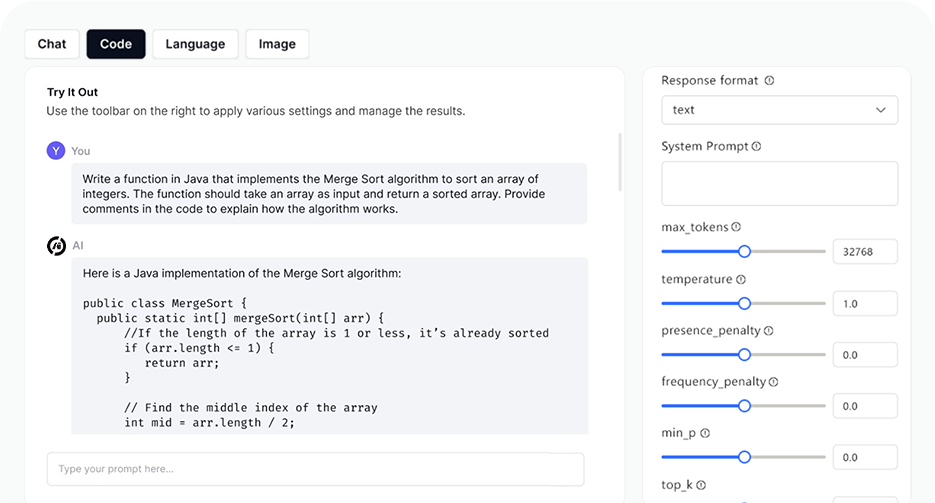
AI Playground