 OpenAI - ChatGPT, Sora
 Google - Gemini, Nano Banana
 Anthropic - Claude
 xAI - Grok
 Deepseek
 Alibaba - Qwen
 ByteDance - Doubao
 All Models
 Enterprise Plans
 AI Application Development
 AI Translator API
 AI SEO/GEO Service
 GEO-Optimized PR Service
 Web Scraping Service
 OpenClaw
 Top AI Tools
 Top AI Robots
 Log in




Product Detail
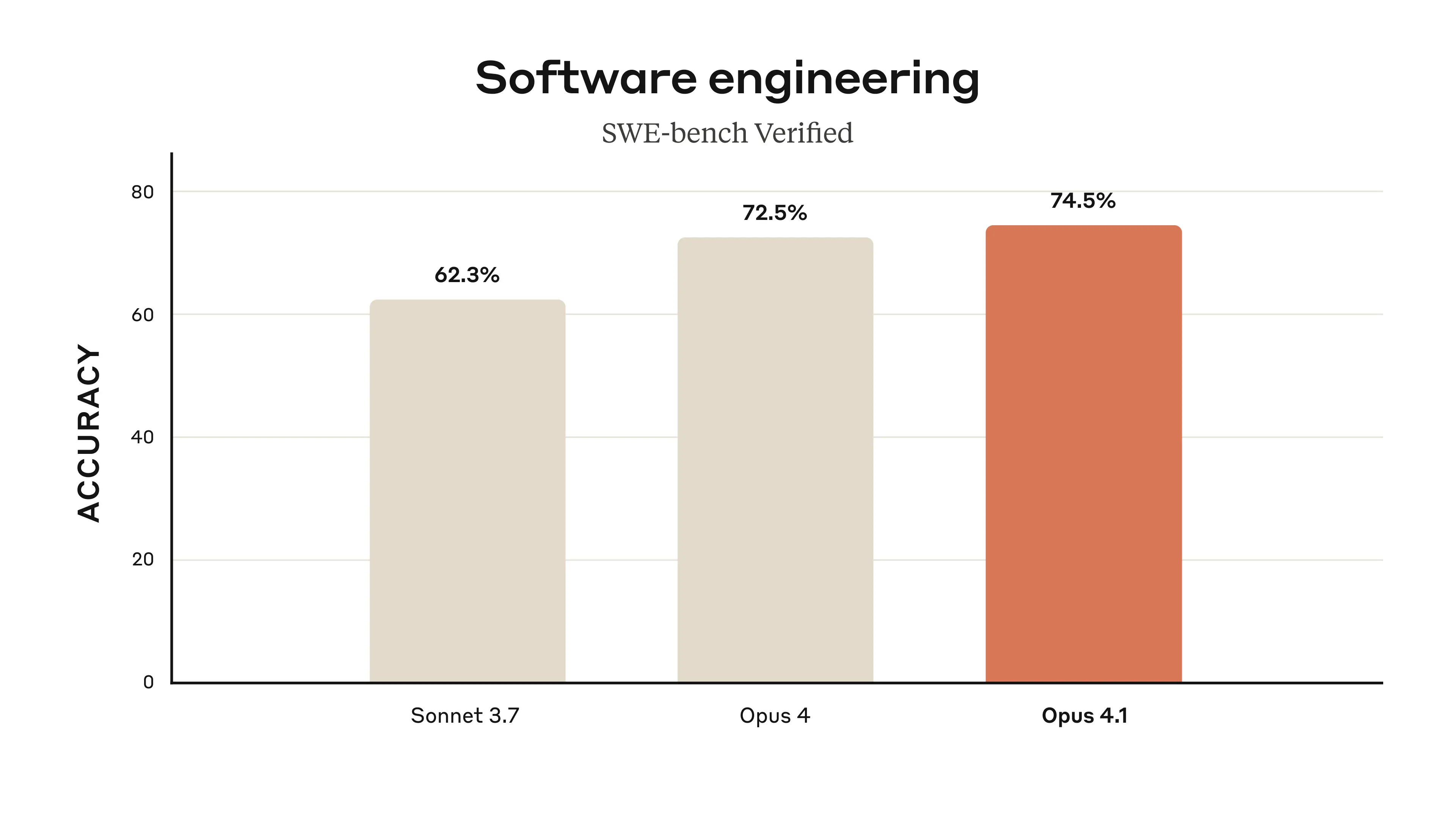
Claude Opus 4.1 by Anthropic represents a significant leap forward, upgrading the flagship Claude Opus 4 model. It is meticulously engineered for advanced coding, complex reasoning, and sophisticated agentic tasks, consistently delivering outstanding precision. With an impressive 200,000-token context window, it enables deep, large-scale data analysis and supports up to 32,000 tokens in responses. Achieving a leading 74.5% on the SWE-bench Verified benchmark, Opus 4.1 demonstrates superior performance in multi-file code refactoring and debugging extensive codebases.
Technical Specifications & Features
- ✅ 200,000-token context window: Facilitates deep, large-scale data analysis.
- 📝 Up to 32,000 tokens output per response: Enables complex, multi-step tasks.
- 💻 Improved SWE-bench coding performance: Achieves 74.5% Verified (up from 72.5% in Opus 4).
- 🧠 Hybrid reasoning mode: Offers instant answers or extended, detailed step-by-step analysis.
- 🚀 Enhanced advanced coding capabilities: Supports autonomous planning and execution of large-scale code projects.
- ✨ Superior reasoning & data synthesis: Across structured and unstructured datasets, including patent and research documents.
- ✍️ Rich, natural language content generation: With improved prose and tone.
Performance Metrics
Claude Opus 4.1 demonstrates significant improvements across a broad range of capabilities compared to Opus 4, with especially strong gains in handling complex multi-file code refactoring.
API Pricing
- 💰 Input: $15.75 / MTok
- 💸 Output: $78.75 / MTok
Key Use Cases
- 🛠️ Large-scale code refactoring: And precise bug fixing in expansive software projects.
- 💡 Autonomous multi-step reasoning tasks: And long-horizon AI agent workflows.
- 🔍 Comprehensive data analysis: And insight extraction from complex data sources.
- ✍️ High-quality content creation: With sophisticated, human-like text output.
Comparison with Other Models
vs. Claude Opus 4:
Claude Opus 4.1 offers improved precision and excels in multi-file refactoring with hybrid reasoning capabilities, marking a clear advancement over the already strong coding and reasoning performance of Opus 4.
vs. Gemini 2.5 Flash:
Claude Opus 4.1 significantly outperforms Gemini 2.5 Flash by delivering superior coding accuracy, making it much better suited for complex software engineering tasks.
vs. OpenAI o3-mini:
Compared to OpenAI o3-mini, Claude Opus 4.1 provides enhanced support for autonomous coding workflows and achieves higher benchmark scores, reflecting greater effectiveness in multi-step programming and reasoning.
Limitations
- 🚫 No multimodal or vision capabilities.
- 🚫 Fine-tuning is not supported.
- 🚫 Focused exclusively on text-based tasks.
Frequently Asked Questions (FAQ)
Q: What constitutional AI advancements distinguish Claude Opus 4.1's safety and capability balance?
A: Claude Opus 4.1 implements a revolutionary constitutional AI framework with multi-layered value alignment. It features dynamic harm prevention, sophisticated value learning, and transparent reasoning, achieving unprecedented safety without compromising its ability to engage with complex topics.
Q: How does Claude 4.1's reasoning architecture achieve its exceptional performance on complex analytical tasks?
A: The model employs a multi-scale reasoning engine that processes information at micro-detail and macro-conceptual levels. It uses specialized attention mechanisms for logical deduction, causal inference, and analogical reasoning, along with iterative refinement loops and contextual memory banks for depth and accuracy.
Q: What conversational capabilities make Claude 4.1 particularly effective for extended dialogues?
A: Claude 4.1 demonstrates advanced conversational intelligence through persistent context maintenance, nuanced understanding of user goals, adaptive communication style, and sophisticated topic tracking. It excels at collaborative problem-solving across extended interactions.
Q: How does the model handle specialized domain knowledge while maintaining general conversational ability?
A: The architecture features domain-adaptive processing pathways that automatically recognize specialized content. It accesses structured knowledge graphs for technical domains and employs associative reasoning for creative tasks, allowing flexible expert-level insights across diverse fields.
Q: What safety and alignment features ensure responsible deployment of Claude 4.1's advanced capabilities?
A: Claude 4.1 incorporates comprehensive safety measures, including real-time content evaluation, value alignment through constitutional AI principles, output verification, and capability-aware safety systems. It includes transparency features and continuous learning from human feedback for responsible deployment.
AI Playground