 OpenAI - ChatGPT, Sora
 Google - Gemini, Nano Banana
 Anthropic - Claude
 xAI - Grok
 Deepseek
 Alibaba - Qwen
 ByteDance - Doubao
 All Models
 Enterprise Plans
 AI Application Development
 AI Translator API
 AI SEO/GEO Service
 GEO-Optimized PR Service
 Web Scraping Service
 OpenClaw
 Top AI Tools
 Top AI Robots
 Log in


                                        const fs = require('fs');
const path = require('path');

const axios = require('axios').default;
const api = new axios.create({
  baseURL: 'https://api.ai.cc/v1',
  headers: { Authorization: 'Bearer ' },
});

const main = async () => {
  const response = await api.post(
    '/tts',
    {
      model: 'elevenlabs/eleven_turbo_v2_5',
      text: 'Hi! What are you doing today?',
      voice: 'Alice'
    },
    { responseType: 'stream' },
  );

  const dist = path.resolve(__dirname, './audio.wav');
  const writeStream = fs.createWriteStream(dist);

  response.data.pipe(writeStream);

  writeStream.on('close', () => console.log('Audio saved to:', dist));
};

main();
                                        import os
import requests


def main():
    url = "https://api.ai.cc/v1/tts"
    headers = {
        "Authorization": "Bearer ",
    }
    payload = {
        "model": "elevenlabs/eleven_turbo_v2_5",
        "text": "Hi! What are you doing today?",
        "voice": "Alice"
    }

    response = requests.post(url, headers=headers, json=payload, stream=True)
    dist = os.path.join(os.path.dirname(__file__), "audio.wav")

    with open(dist, "wb") as write_stream:
        for chunk in response.iter_content(chunk_size=8192):
            if chunk:
                write_stream.write(chunk)

    print("Audio saved to:", dist)


main()


Product Detail
Eleven Labs' Eleven Turbo v2.5 is a cutting-edge AI model specifically engineered for fast, high-quality text generation and natural language understanding. It delivers enhanced responsiveness and superior output fidelity, making it suitable for a wide array of versatile applications.
Technical Specifications
Performance Benchmarks
Eleven Turbo v2.5 truly shines in generating coherent, contextually rich text with remarkably low latency.
- ✅ Mean Opinion Score (MOS): 4.72/5.0 (on par with human-level speech)
- 🗣️ Word Error Rate (WER) in voice clarity: <3.1% on benchmark datasets.
- 🌐 Language Coverage: 127 languages and dialects with native speaker quality.
Key Capabilities
Eleven Turbo v2.5 delivers highly fluent and context-aware text generation, making it ideal for real-time applications.
- ⚡ Ultra-Low Latency: Perfect for real-time scenarios like live dubbing, interactive gaming NPCs, and responsive voice assistants.
- 🎤 Expressive Speech: Features advanced prosody control for dynamic intonation, emotion, and emphasis customization.
- 👤 Voice Cloning: Achieves high-fidelity voice replication from remarkably short audio samples (as little as 3 seconds).
- 🌍 Multilingual Mastery: Provides native-grade fluency across 127 languages, including support for low-resource dialects.
API Pricing
- 💰 Cost-Effective: $0.0945 per 1000 characters.
Optimal Use Cases
- 💬 Conversational AI: Real-time chatbots and virtual assistants that demand natural, fluid dialogue.
- ✍️ Content Creation: Rapid generation of high-quality articles, summaries, and creative writing pieces.
- 🔊 Voice Applications: Powering text-to-speech systems with highly natural and expressive outputs.
- 📞 Customer Support: Automating responses with accurate and context-aware knowledge delivery.
Code Sample
Integrate Eleven Turbo v2.5 easily with the provided code snippet:
Comparison with Other Leading Models
- ⚡ Vs. Google WaveNet (v3): Faster inference (200ms vs. 650ms P95), broader language support (127 vs. 50), with comparable MOS (4.72 vs. 4.75).
- ⭐ Vs. Amazon Polly Neural: Offers superior expressiveness and lower latency; supports 2x more languages and real-time streaming capabilities.
- 💡 Vs. Microsoft Azure Neural TTS: Achieves higher voice naturalness in edge cases (MOS 4.72 vs. 4.61), provides faster response times, and features better emotion modeling.
Limitations to Consider
- 🚫 Maximum Input Length: Eleven Turbo v2.5 currently has a maximum input length of 4,096 characters. This may present a limitation for very long-form content generation.
- 💬 Low-Resource Dialects: While supporting 127 languages, some low-resource dialects might exhibit slightly reduced clarity or naturalness compared to major global languages.
Frequently Asked Questions (FAQ)
Q: What is Eleven Turbo v2.5 and what makes it unique for real-time applications?
A: Eleven Turbo v2.5 is an optimized text-to-speech model specifically designed for low-latency, real-time applications. Its uniqueness lies in achieving near-instant speech generation with minimal computational overhead while maintaining high voice quality. This makes it ideal for interactive applications where response time is critical, such as live conversations, gaming, and real-time assistance.
Q: What performance advantages does the Turbo version offer over standard TTS models?
A: Eleven Turbo v2.5 provides significant performance advantages including: sub-100ms latency for most requests, reduced computational resource requirements, higher throughput for concurrent users, optimized streaming capabilities, and efficient memory usage. These improvements come while maintaining impressive voice quality that's remarkably close to the standard, more resource-intensive versions.
Q: What types of real-time applications benefit most from Eleven Turbo v2.5?
A: Applications that benefit most include: live conversational AI and chatbots, interactive gaming and virtual reality experiences, real-time translation services, voice-enabled customer support, educational tutoring systems, accessibility tools requiring instant feedback, and any scenario where near-instant speech response enhances user experience and engagement.
Q: How does Eleven Turbo v2.5 balance speed with voice quality?
A: The model balances speed and quality through: optimized neural architecture that prioritizes essential speech characteristics, efficient audio processing pipelines, smart caching of frequently used phonemes, and advanced streaming techniques that begin audio playback before full generation completes. While some ultra-fine details might be sacrificed, the overall voice naturalness remains excellent for real-time applications.
Q: What are the practical deployment considerations for Eleven Turbo v2.5?
A: Practical deployment considerations include: compatibility with real-time streaming protocols, efficient handling of concurrent user requests, integration with voice activity detection systems, optimization for various network conditions, and appropriate fallback mechanisms for edge cases. The model's efficiency makes it suitable for both cloud deployment and edge computing scenarios where low latency is paramount.
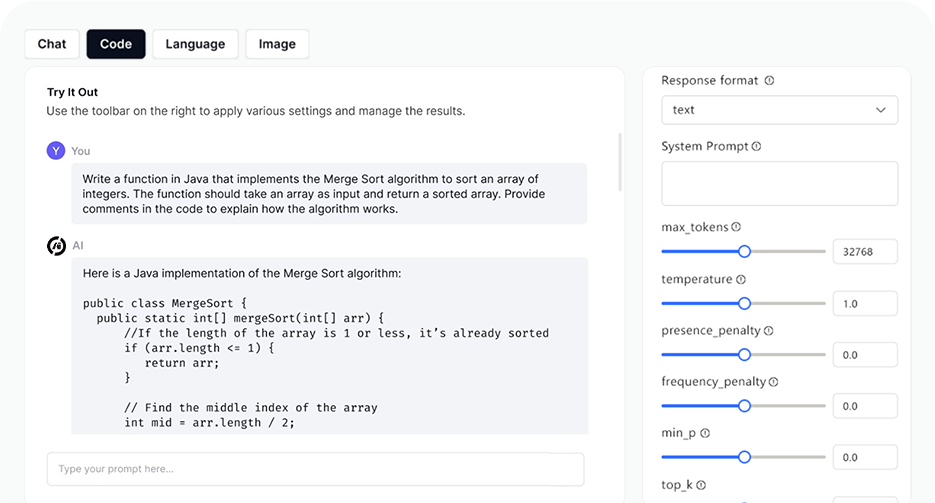
AI Playground