 OpenAI - ChatGPT, Sora
 Google - Gemini, Nano Banana
 Anthropic - Claude
 xAI - Grok
 Deepseek
 Alibaba - Qwen
 ByteDance - Doubao
 All Models
 Enterprise Plans
 AI Application Development
 AI Translator API
 AI SEO/GEO Service
 GEO-Optimized PR Service
 Web Scraping Service
 OpenClaw
 Top AI Tools
 Top AI Robots
 Log in


                                        const main = async () => {
  const response = await fetch('https://api.ai.cc/v1/images/generations', {
    method: 'POST',
    headers: {
      Authorization: 'Bearer ',
      'Content-Type': 'application/json',
    },
    body: JSON.stringify({
      model: 'google/gemini-2.5-flash-image',
      prompt: 'A jellyfish in the ocean',
    }),
  }).then((res) => res.json());

  console.log('Generation:', response);
};

main();
                                        import requests


def main():
    response = requests.post(
        "https://api.ai.cc/v1/images/generations",
        headers={
            "Authorization": "Bearer ",
            "Content-Type": "application/json",
        },
        json={
            "model": "google/gemini-2.5-flash-image",
            "prompt": "A jellyfish in the ocean",
        },
    )

    response.raise_for_status()
    data = response.json()

    print("Generation:", data)


if __name__ == "__main__":
    main()


Product Detail
Gemini 2.5 Flash Image, formerly known as Nano Banana, is Google's groundbreaking AI image editing model developed under the Gemini 3 initiative. It revolutionizes image modification by offering highly precise, controllable, and natural language-driven edits, eliminating the need for manual masking. This advanced model excels in text-to-image generation and editing, allowing users to effortlessly transform photographs using simple descriptive prompts. Gemini Native Image is particularly adept at maintaining character consistency, preserving intricate scene details, and generating photorealistic outputs with remarkable speed, making it an indispensable tool for creative design, marketing, and content creation workflows.
🚀 Technical Specifications
- Built on Google's Multimodal Diffusion Transformer (MMDiT) architecture.
- Model scales from 450 million to 8 billion parameters with 15 to 38 processing blocks.
- Native image resolution support at 1024x1024 pixels, expandable to 1024x1792 aspect ratios.
- Combines visual autoregressive modeling with diffusion for structured, iterative image refinement.
- Optimized for on-device processing, including flagship mobile TPU architectures.
- Supports mask-free inpainting, layout-aware outpainting, and multi-image context editing.
- Requires approximately 2.1GB GPU memory during inference.
- Generates high-quality photorealistic images with style transfer capabilities and batch processing support.
📈 Performance Metrics
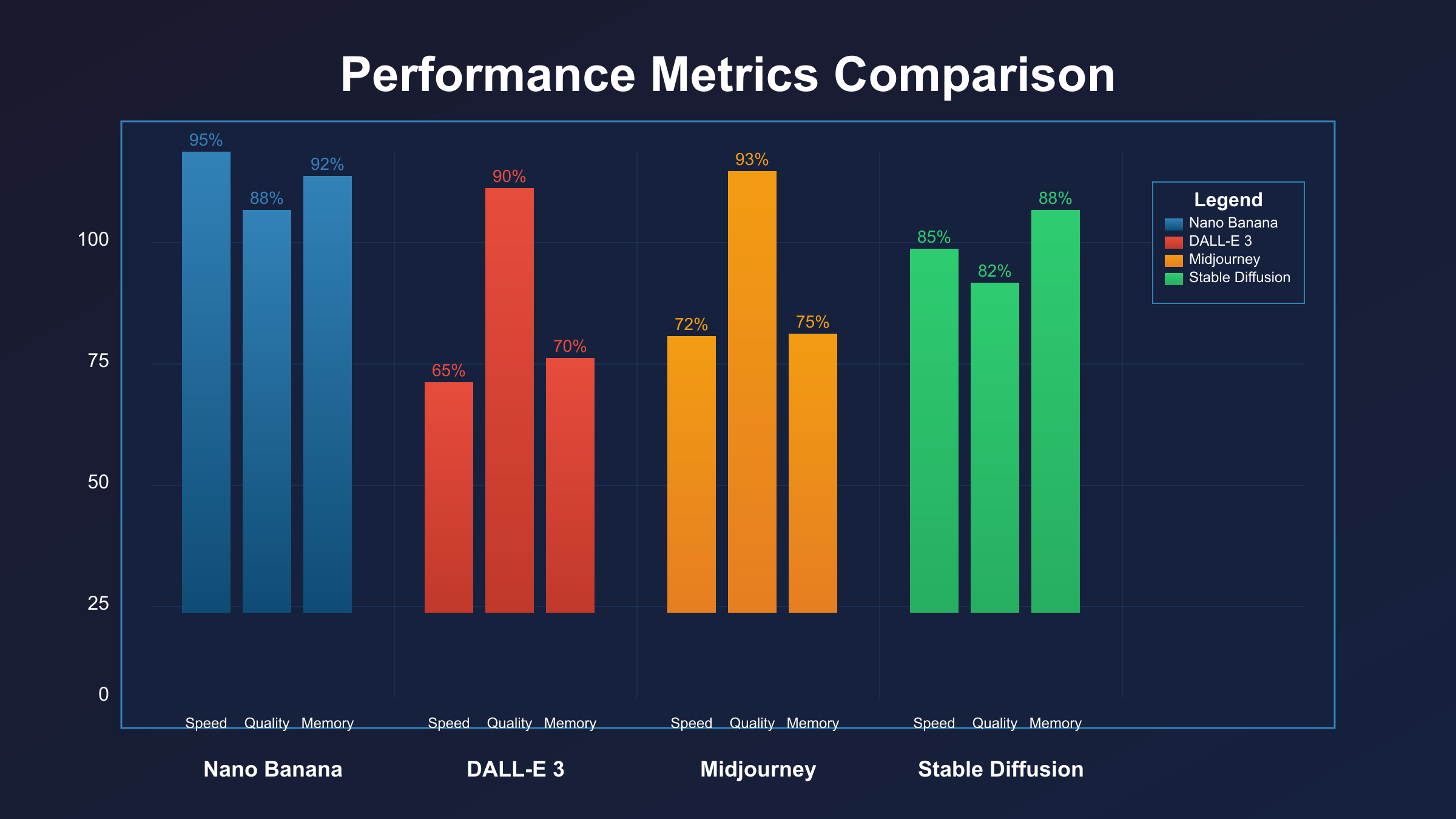
According to performance comparisons, Google Gemini Native Image (also known as Nano Banana) leads in speed with a 95% rating, significantly outpacing DALL-E 3, Midjourney, and Stable Diffusion. It also ranks highest in image quality at 88%, demonstrating superior photorealism compared to its competitors. Regarding memory efficiency, Gemini Native Image scores 92%, indicating lower resource consumption. These metrics highlight its balanced excellence across speed, quality, and memory efficiency, setting it apart as a high-performance AI image editing model.
💡 Use Cases
Nano Banana (Gemini Native Image) is designed for both professional and creative applications, including product photography enhancement, AI-generated influencer content, social media campaigns, and film or game post-production. Its ability to preserve facial features and identities across multiple edits makes it perfect for creating consistent branding assets and narrative visuals. The model supports sophisticated scene reconstruction, background replacement, object manipulation, and style transfer, all through intuitive text instructions, significantly streamlining workflows that traditionally required expert image editing skills.
✨ Key Features
- ✅ Prompt Accuracy: Gemini interprets complex, context-rich text instructions with greater fidelity, enabling more precise and relevant edits.
- 👤 Character Consistency: It preserves identity details more effectively than competitors, ensuring coherent faces and characters across edits.
- 🏞️ Scene Preservation & Fusion: Its scene blending technology produces natural, seamless backgrounds and smooth transitions between image elements.
- ⚡ One-Shot Editing: Nano Banana achieves high-quality results in a single editing pass, reducing iterative refinement steps.
- 🖼️ Multi-Image Context Processing: It handles simultaneous edits across multiple images, supporting consistent AI influencer generation and brand asset creation.
- 📏 Control Aspect Ratios: Supports a wide range of aspect ratios, including cinematic landscapes, square formats, and vertical social media sizes for versatile content creation.
💰 API Pricing
- $0.04095 per image
🎯 Tips for Maximizing Efficiency
To fully leverage Gemini’s advanced capabilities, users should provide detailed, context-rich natural language prompts. Clearly specify desired edits, including style, lighting, composition, and subject modifications. Integrating the model into workflows that demand high precision and consistency, such as professional marketing campaigns or creative productions, will maximize its impact. Its fast processing enables real-time iterations, ideal for rapid prototyping and interactive editing experiences.
For optimal outputs, text prompts should be explicit about the nature and location of changes without ambiguity, such as specifying "replace background with a neon cityscape" or "add soft shadow beneath the vase." Avoiding vague terms ensures the model understands the spatial and stylistic context, resulting in coherent and visually appealing edits. Utilizing iterative refinement capabilities also helps users perfect complex image transformations while maintaining high fidelity to the original scene.
💻 Code Sample
<snippet data-name="image.flux" data-model="google/gemini-2.5-flash-image"></snippet>🆚 Comparison with Other Models
- Vs. Flux Kontext: Nano Banana excels in maintaining character consistency and seamless scene blending, delivering more coherent and photorealistic edits in a single pass, whereas Flux Kontext often requires multiple attempts and struggles with facial details.
- Vs. DALL-E 3: Nano Banana achieves better prompt adherence and photorealism (lower FID score), with faster generation times and improved text rendering accuracy in images, outperforming DALL-E 3 in complex compositions and realistic style transfers.
- Vs. Midjourney v7: Nano Banana offers superior style consistency and layout-aware outpainting, enabling more natural scene extensions and better spatial preservation, whereas Midjourney may produce more stylized but less consistent edits for professional use.
- Vs. Stable Diffusion 3: Nano Banana delivers higher semantic accuracy and faster processing speeds with less GPU memory consumption, offering enhanced mobile optimization and iteration capabilities suitable for real-time commercial workflows.
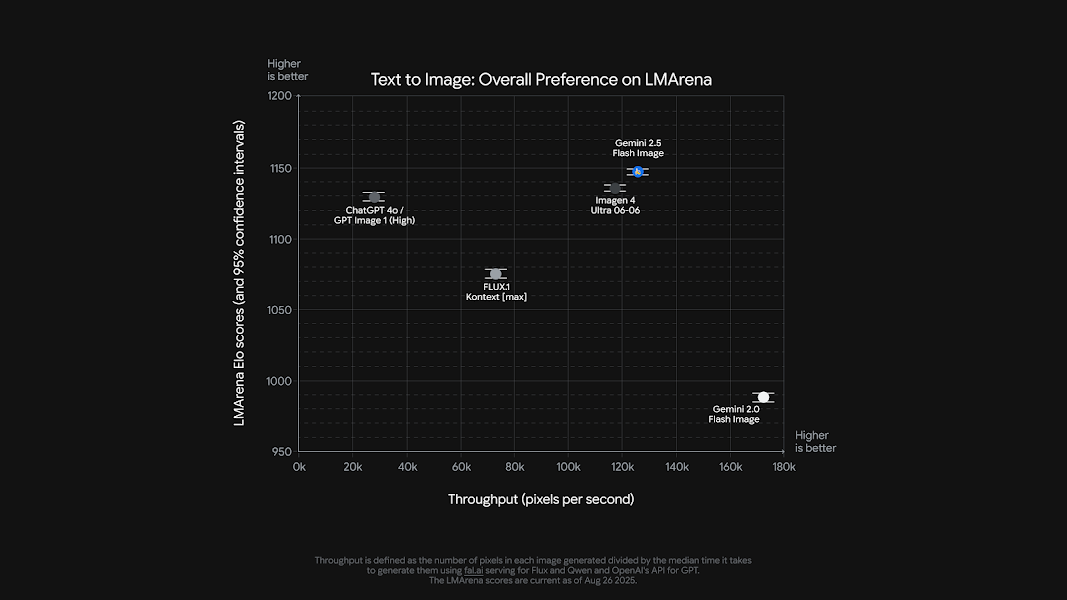
The Gemini Native Image model (formerly Nano Banana) represents a transformative leap in AI-driven image editing. By seamlessly blending natural language understanding, rapid processing, and superior visual fidelity, it redefines the creation and modification of photos. Its distinct advantages over competing models establish it as a powerful and user-friendly tool for creators aiming for both ease of use and professional-grade results.
❓ Frequently Asked Questions (FAQ)
What is Gemini 2.5 Flash Image?
Gemini 2.5 Flash Image, also known as Nano Banana, is Google's advanced AI image editing model that uses natural language prompts for highly precise and controllable image modifications without manual masking.
How does Gemini Native Image maintain character consistency across edits?
The model leverages its advanced architecture to effectively preserve identity details, ensuring faces and characters remain coherent and consistent across multiple image editing operations, a key advantage over many competitors.
What are the primary use cases for Gemini 2.5 Flash Image?
It's ideal for product photography enhancement, AI-generated influencer content, social media campaigns, and post-production in film/game development, enabling complex edits like background replacement and object manipulation with simple text prompts.
Is Gemini Native Image optimized for mobile devices?
Yes, it is optimized for on-device processing, including flagship mobile TPU architectures, making it highly efficient for mobile applications and real-time editing experiences.
How can users maximize efficiency with Gemini 2.5 Flash Image?
Users should provide detailed and unambiguous natural language prompts, specifying desired changes in style, lighting, composition, and location. Leveraging its fast processing for iterative refinement also helps achieve optimal results.
AI Playground