 OpenAI - ChatGPT, Sora
 Google - Gemini, Nano Banana
 Anthropic - Claude
 xAI - Grok
 Deepseek
 Alibaba - Qwen
 ByteDance - Doubao
 All Models
 Enterprise Plans
 AI Application Development
 AI Translator API
 AI SEO/GEO Service
 GEO-Optimized PR Service
 Web Scraping Service
 OpenClaw
 Top AI Tools
 Top AI Robots
 Log in


                                        const main = async () => {
  const response = await fetch('https://api.ai.cc/v2/video/generations', {
    method: 'POST',
    headers: {
      Authorization: 'Bearer ',
      'Content-Type': 'application/json',
    },
    body: JSON.stringify({
      model: 'klingai/video-o1-image-to-video',
      prompt: 'A jellyfish in the ocean',
      image_url: 'https://upload.wikimedia.org/wikipedia/commons/3/35/Maldivesfish2.jpg',
    }),
  }).then((res) => res.json());

  console.log('Generation:', response);
};

main()
                                        import requests


def main():
    url = "https://api.ai.cc/v2/video/generations"
    payload = {
        "model": "klingai/video-o1-image-to-video",
        "prompt": "A jellyfish in the ocean",
        "image_url": "https://upload.wikimedia.org/wikipedia/commons/3/35/Maldivesfish2.jpg",
    }
    headers = {"Authorization": "Bearer ", "Content-Type": "application/json"}

    response = requests.post(url, json=payload, headers=headers)
    print("Generation:", response.json())


if __name__ == "__main__":
    main()

-min-p-130x130q80.png)
Product Detail
💡Kling Video O1: Elevating Dynamic Video Generation
The Kling Video O1 API is a state-of-the-art solution engineered to transform static images into captivating, dynamic videos. It specializes in creating seamless transitions from specified start and end frames, masterfully blending image inputs with user-defined text prompts for unparalleled control over motion, artistic style, and narrative flow. This powerful, unified multi-modal model is optimized for sophisticated cinematic storytelling through advanced frame interpolation techniques.
⚙️Technical Specifications
- • Architecture: Built on the robust Kling O1 multi-modal video foundation model, incorporating Chain of Thought (CoT) reasoning for precise prompt analysis and significantly enhanced output fidelity.
- • Input Formats: Accepts a variety of image inputs including .png, .jpeg, .tiff, and .webp, alongside comprehensive text prompts to guide frame animation.
- • Output Formats: Generates high-quality MP4 video clips in durations of 5s or 10s, supporting flexible aspect ratios up to 16:9.
🚀Performance Benchmarks
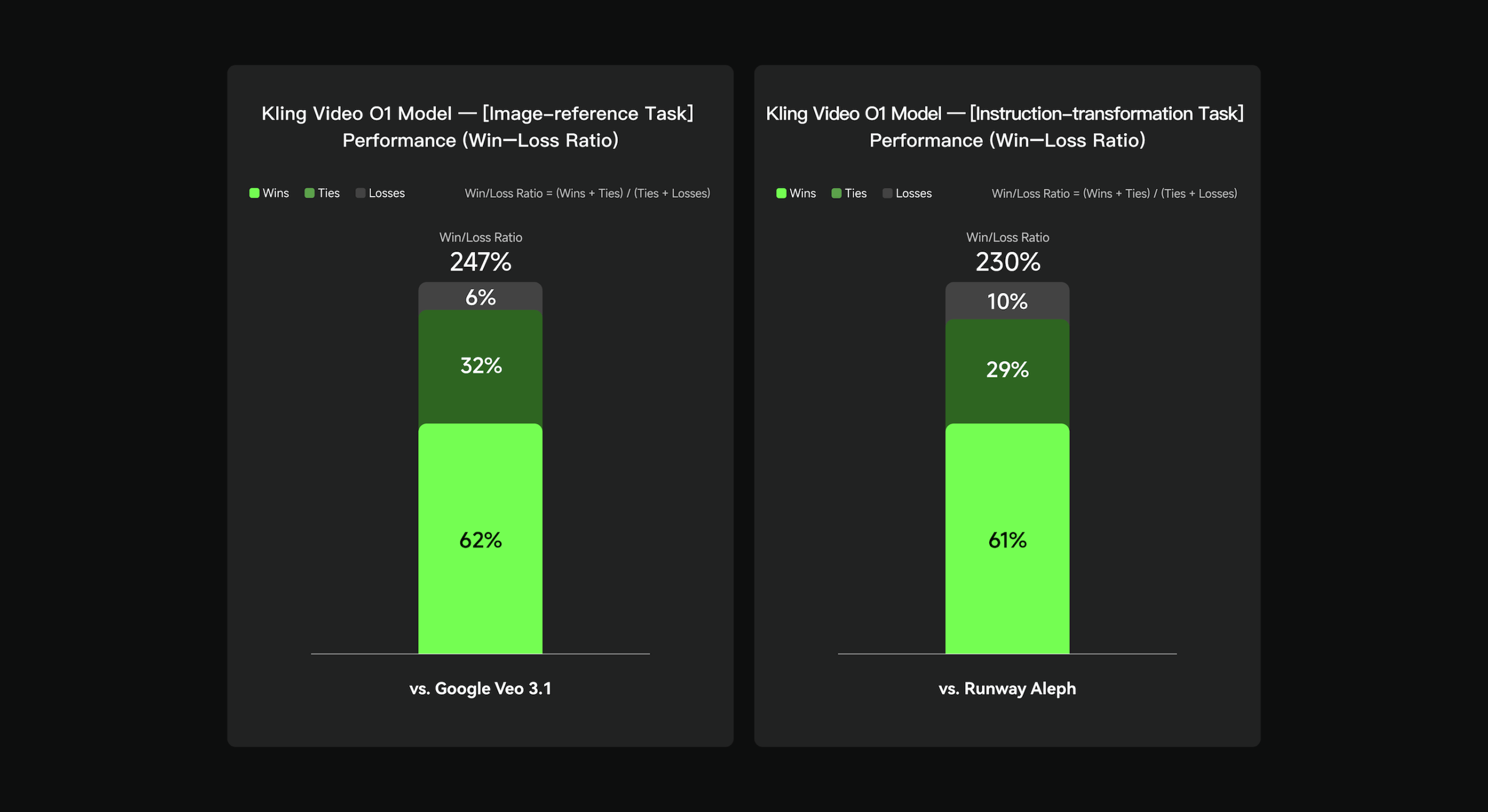
Kling O1 achieves industry-leading motion consistency, ensuring characters and objects flawlessly retain their properties without morphing. This represents a significant advancement over prior models in terms of frame-to-frame stability. The integrated reasoning step boosts overall quality, delivering realistic camera flows in 5-10 second clips at resolutions up to 2K. Benchmarks consistently underscore its superior handling of complex physics and multi-subject interactions, notably outperforming Kling 2.1.
✨Key Features of Kling Video O1
- • Multi-modal Engine: Processes images, video, and text inputs to achieve accurate style transfer, precise element preservation, and natural physics simulations, including fluid motion and fabric dynamics.
- • Advanced Frame Interpolation: Seamlessly animates smooth transitions between keyframes, consistently maintaining subject identity and intricate environmental details across the entire video sequence.
- • Sophisticated Camera Controls: Offers granular control over camera movements, enabling highly accurate pans, tilts, and tracking shots, which significantly reduces visual artifacts in dynamic scenes.
- • Reference-based Generation: Supports the integration of 1 to 7 reference images, ensuring robust multi-element consistency. This feature is ideal for maintaining character or object stability across varied angles and complex scenarios.
💲Kling O1 API Pricing
The Kling O1 API is competitively priced at $0.1176 per second of generated video output.
💻Code Sample
Integrate the Kling Video O1 image-to-video functionality with this simple snippet:
<snippet data-name="video.image-to-video" data-model="klingai/video-o1-image-to-video"></snippet>⚖️Model Comparisons
Kling O1 vs. Kling 2.1: Kling O1 introduces advanced CoT reasoning and supports multi-modal inputs, achieving approximately 2x greater motion accuracy and superior subject consistency. Kling 2.1, in contrast, focuses on cost-efficient standard image-to-video conversion without these advanced editing features.
Kling O1 vs. Runway Gen-4: O1 distinguishes itself with exceptional frame-specific interpolation and advanced physics realism, particularly for 5-10 second clips. While Gen-4 prioritizes longer text-to-video content, it exhibits limitations in multi-image reference stability compared to Kling O1.
Kling O1 vs. Google Veo 3.1: Kling O1 provides superior element preservation when animating between dual frames and enables sophisticated conversational edits for enhanced precision. Although Veo 3.1 might offer capabilities for longer raw video generation, Kling O1 is the preferred choice for commercial applications demanding high precision and offers a more cost-efficient per-second rate.
❓Frequently Asked Questions
Q1: What is the core functionality of Kling Video O1?
A: Kling Video O1 transforms static start and end image frames into dynamic videos, leveraging text prompts to control motion and style, specializing in cinematic storytelling via frame interpolation.
Q2: How does Kling O1 ensure high motion consistency?
A: It uses a unified multi-modal architecture with Chain of Thought (CoT) reasoning, which deeply analyzes prompts to ensure characters and objects retain their properties without morphing throughout the video, outperforming prior models in stability.
Q3: What are the key advantages of Kling O1 compared to Kling 2.1?
A: Kling O1 features CoT reasoning and multi-modal inputs, resulting in approximately 2x better motion accuracy and subject consistency, which are absent in Kling 2.1's more basic image-to-video capabilities.
Q4: Can Kling O1 handle complex camera movements?
A: Yes, it offers advanced camera controls for precise pans, tilts, and tracking shots, designed to minimize artifacts and ensure high motion accuracy in dynamic scenes.
Q5: What are the output specifications for Kling Video O1?
A: It outputs MP4 videos in 5-second or 10-second durations, supporting aspect ratios up to 16:9, with capabilities for resolutions up to 2K.
AI Playground