 OpenAI - ChatGPT, Sora
 Google - Gemini, Nano Banana
 Anthropic - Claude
 xAI - Grok
 Deepseek
 Alibaba - Qwen
 ByteDance - Doubao
 All Models
 Enterprise Plans
 AI Application Development
 AI Translator API
 AI SEO/GEO Service
 GEO-Optimized PR Service
 Web Scraping Service
 OpenClaw
 Top AI Tools
 Top AI Robots
 Log in


                                        const { OpenAI } = require('openai');

const api = new OpenAI({ apiKey: '', baseURL: 'https://api.ai.cc/v1' });

const main = async () => {
  const prompt = `
All of the states in the USA:
- Alabama, Mongomery;
- Arkansas, Little Rock;
`;
  const response = await api.completions.create({
    prompt,
    model: 'meta-llama/Meta-Llama-3-70B',
  });
  const text = response.choices[0].text;

  console.log('Completion:', text);
};

main();
                                        from openai import OpenAI

client = OpenAI(
    api_key="",
    base_url="https://api.ai.cc/v1",
)


def main():
    response = client.completions.create(
        model="meta-llama/Meta-Llama-3-70B",
        prompt="""
  All of the states in the USA:
  - Alabama, Mongomery;
  - Arkansas, Little Rock;
  """,
    )

    completion = response.choices[0].text
    print(f"Completion: {completion}")


main()

.png)
Product Detail
Introducing Llama-3 (70B): Meta's Advanced Open-Source LLM
Developed by Meta AI and released in April 2024, Llama-3 (70B) represents a significant leap in open-source large language models. This powerful 70-billion parameter model is engineered to deliver exceptional performance across diverse applications, excelling particularly in reasoning, coding, and multilingual tasks.
Key Model Specifications
- ✨ Model Name: Llama
- 👩💻 Developer/Creator: Meta
- 🗓️ Release Date: April 2024
- 🔢 Version: 3.0 (70B)
- 💡 Model Type: Large Language Model (LLM)
Key Differentiators & Features
- 💬 Instruction-Tuned for Dialogue: Llama-3 is meticulously instruction-tuned, enabling it to excel in dialogue and chat applications. It consistently surpasses many other open-source chat models on established benchmarks.
- 🧠 Enhanced Reasoning & Coding: Demonstrating robust capabilities, the model delivers strong performance in complex reasoning and coding tasks, making it a valuable tool for developers and researchers.
- 🌐 Extensive Multilingual Support: With over 5% of its massive pretraining dataset comprising high-quality non-English data spanning more than 30 languages, Llama-3 offers impressive multilingual understanding and generation.
Intended Applications & Use Cases
Llama-3 (70B) is designed for a broad spectrum of Natural Language Processing (NLP) tasks, empowering developers and businesses with advanced AI capabilities:
- ✍️ Text Generation: Produce coherent, contextually relevant, and creative text for various purposes.
- ❓ Question Answering: Deliver accurate and concise answers based on provided information or general knowledge.
- 😄 Sentiment Analysis: Analyze text to determine underlying sentiment (positive, negative, neutral).
- 🏷️ Text Classification: Efficiently categorize documents or snippets into predefined topics or classes.
- 🔍 Named Entity Recognition (NER): Automatically identify and extract key entities like names, organizations, and locations.
Under the Hood: Technical Architecture of Llama-3 (70B)
Core Architecture
Llama-3 (70B) employs an optimized Transformer architecture, featuring Grouped-Query Attention. This design choice significantly enhances inference scalability, allowing the model to process and generate text with high efficiency and performance.
Training Data & Scope
- 📚 Vast Pretraining Dataset: The model was extensively pretrained on over 15 trillion tokens sourced from publicly available datasets, including web pages, books, and various text corpora.
- 💻 Code-Rich Data: Notably, the training data for Llama-3 includes 4x more code than its predecessor, Llama-2, leading to superior coding capabilities.
- 🗓️ Knowledge Cutoff: Llama-3 (70B)'s knowledge is current up to December 2023. Information beyond this date may not be reflected in its responses.
- ⚖️ Diversity & Bias Considerations: While trained on a diverse dataset, it's important to acknowledge that, like all large language models, biases present in the training data could manifest in the model's outputs. Meta actively invests in tools to mitigate these risks.
Performance Benchmarks
Llama-3 (70B) has demonstrated exceptional performance across various industry benchmarks. It stands out by performing comparably to models like GPT-4o on specific tasks, while being remarkably 15 times more cost-effective. This makes it a highly competitive and accessible option for advanced AI development.
.webp)
Usage & Ethical Considerations
Utilizing Llama-3 (70B) involves adherence to specific guidelines and licensing terms set forth by Meta.
🔒 Ethical Guidelines & Safety
Meta has made significant investments in developing tools to enhance the safety of Llama-3 (70B) and proactively minimize the generation of harmful outputs. All usage of the model must comply with Meta's ethical guidelines and principles, ensuring responsible AI deployment.
📜 License Type
Llama-3 (70B) is distributed under a custom commercial license provided by Meta. Users should consult the official Meta documentation for detailed licensing terms and conditions.
Frequently Asked Questions (FAQ)
A1: Llama-3 (70B) is a cutting-edge, open-source large language model developed by Meta AI, featuring 70 billion parameters, designed for advanced reasoning, coding, and multilingual tasks.
A2: Key improvements include superior instruction-tuning for dialogue, enhanced reasoning and coding capabilities (with 4x more code in training data), and broader multilingual support.
A3: It's intended for a wide range of NLP tasks such as text generation, question answering, sentiment analysis, text classification, and named entity recognition.
A4: The model's knowledge is current up to December 2023. It will not have information about events or data after this date.
A5: While developed as an open model, Llama-3 (70B) is available under a custom commercial license from Meta. Users should refer to Meta's official documentation for specific terms.
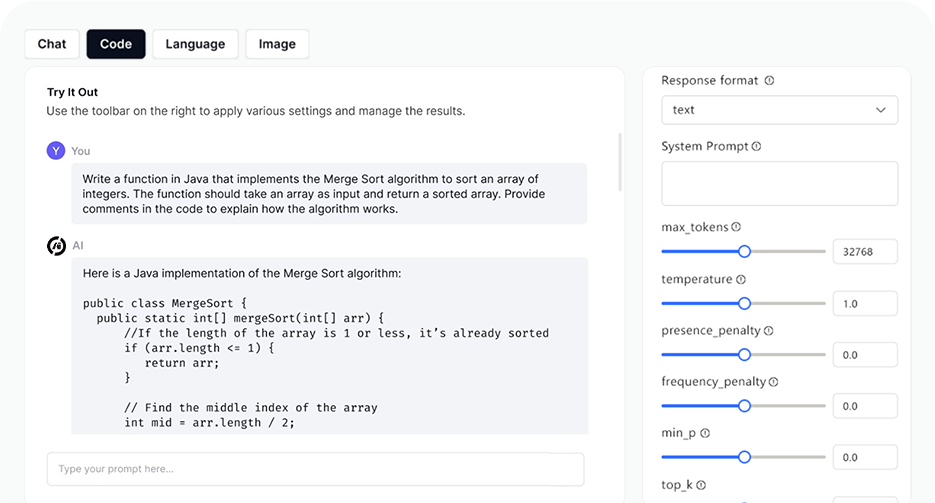
AI Playground