
 Enterprise Plans
 AI Application Development
 AI Translator API
 AI SEO/GEO Service
 GEO-Optimized PR Service
 Web Scraping Service
 Log in







OpenAI Introduces ChatGPT Health: A Secure, Personalized Space for Your Health Journey
INTRODUCTION: The Future of Personalized Care
OpenAI today announced the launch of ChatGPT Health, a dedicated experience designed to securely bring health information and ChatGPT’s intelligence together. Developed to help users feel more informed, prepared, and confident in navigating their healthcare, ChatGPT Health features layered privacy protections, data isolation, and clinical safety measures built in close collaboration with over 260 physicians worldwide.
This launch marks a pivotal moment in the history of digital health. We are moving beyond generic search engine results—which often lead to anxiety and misinformation—toward a context-aware, scientifically grounded AI companion. By integrating directly with medical records and wellness apps, ChatGPT Health acts not just as a chatbot, but as a central nervous system for your personal well-being.
I. Core Vision: A Health Assistant That Knows Your Context
Health is already one of the most common ways people use ChatGPT, with over 230 million people globally asking health and wellness questions every week. However, generic AI models lack the specific context of the individual's history. ChatGPT Health elevates these interactions by grounding responses in the user’s unique health context, transforming data into actionable wisdom.
A Unified Health Picture
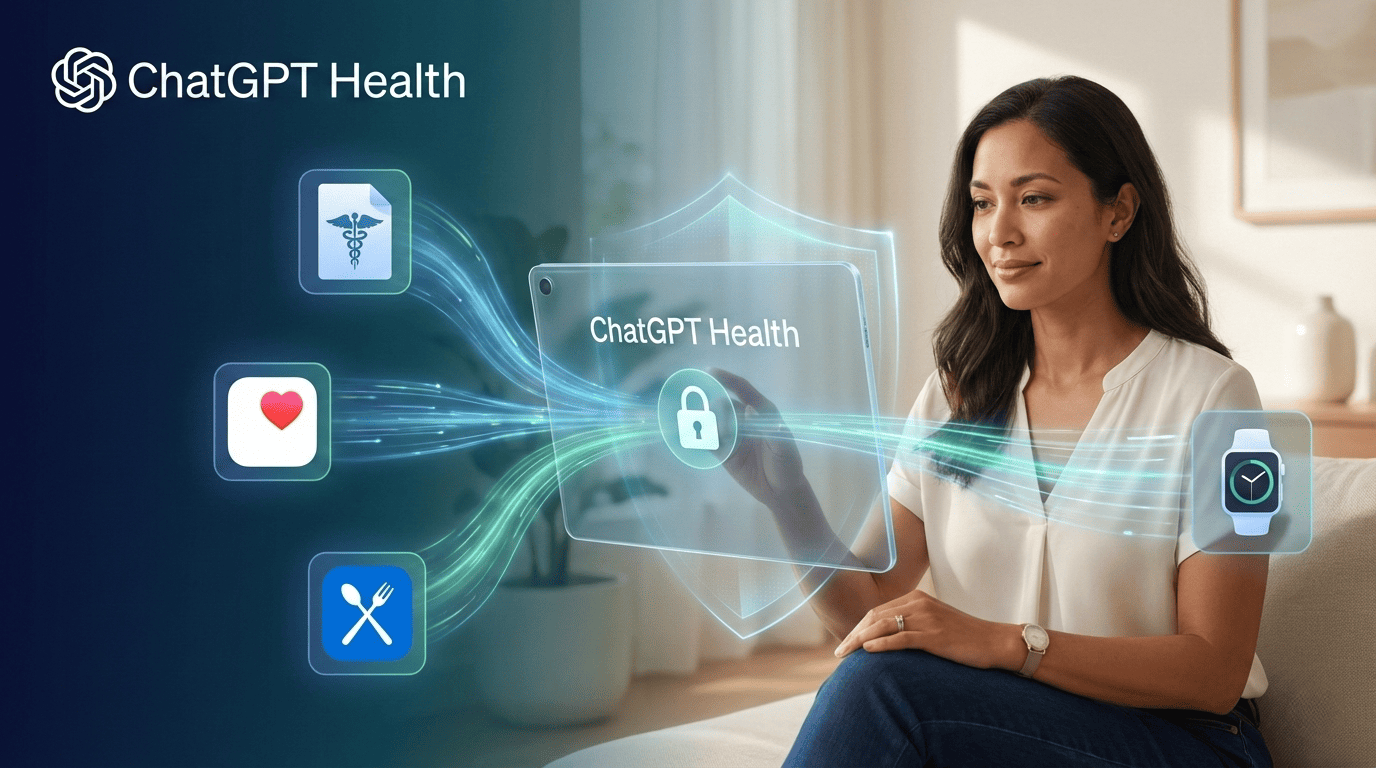
Historically, health data has been scattered across portals, apps, wearables, and PDFs. ChatGPT Health allows users to securely connect medical records and wellness apps—such as Apple Health, Function, and MyFitnessPal—to see the full picture in one place. Imagine an AI that knows your step count from yesterday, your blood test results from last month, and your sleep patterns from last week, all synthesizing to give you a holistic view of your vitality.
Empowered Decision-Making
Whether summarizing recent lab results before a doctor’s appointment or evaluating the pros and cons of insurance plans based on personal healthcare patterns, Health provides relevant, actionable insights. It bridges the gap between complex medical jargon and patient understanding, democratizing access to medical literacy.
Support, Not Replacement
OpenAI emphasizes that Health is designed to support, not replace, professional medical care. It is not intended for diagnosis or treatment but rather to help users understand patterns and prepare for important clinical conversations. It acts as a sophisticated triage nurse and a knowledgeable librarian combined.
Deep Dive: The AI Architecture Behind ChatGPT Health
To understand the significance of ChatGPT Health, one must look under the hood. This is not simply a "skin" over GPT-4 or GPT-5; it is a specialized instance utilizing Retrieval-Augmented Generation (RAG) specifically tuned for biomedical literature and clinical reasoning.
> STATUS: Active
> LOGIC: Unlike standard LLMs that predict the next likely word, ChatGPT Health prioritizes factual density and source verification. It cross-references user queries against a curated database of peer-reviewed medical journals and clinical guidelines before generating a response.
Context Windows and Longitudinal Data: One of the biggest challenges in AI healthcare has been "memory." A patient's health journey is continuous, not episodic. ChatGPT Health utilizes an expanded context window dedicated solely to your health "memories." This means if you mentioned a knee injury three months ago, the AI factors that into today's workout recommendations without you needing to remind it. This longitudinal understanding mimics the relationship one might have with a family doctor who has known them for years.
Furthermore, the system employs Semantic Interoperability. It translates the raw data from FHIR (Fast Healthcare Interoperability Resources) standards used by hospitals into natural language you can understand, and vice versa.
II. Privacy and Security: Clinical-Grade Protection
In the digital age, health data is more valuable—and vulnerable—than financial data. Recognizing this, OpenAI has built ChatGPT Health as a "Clean Room" environment.
Dedicated Health Space
Health conversations, connected apps, and files are stored separately from general chats. It maintains its own "memories" that stay within the Health environment. Your query about a rash will never influence a chat about coding or creative writing.
Unidirectional Data Flow
While Health may use context from non-Health chats (like a recent move to a pollen-heavy city) to increase relevance, health information and memories never flow back into non-Health chats. This ensures a strict quarantine of sensitive biological data.
No Model Training
Critically, conversations in the Health space are not used to train OpenAI's foundation models. Your symptoms and records remain yours; they do not become part of the collective intelligence used to answer other users' questions.
Layered Encryption
In addition to standard encryption at rest and in transit, Health utilizes purpose-built encryption and isolation to keep sensitive data protected, meeting and exceeding HIPAA and GDPR standards.
III. Built with Physicians: Setting Clinical Standards
The fear of AI "hallucinations" (inventing facts) is the primary barrier to adoption in medicine. To mitigate this, OpenAI followed a rigorous two-year, physician-led development process involving Reinforcement Learning from Expert Feedback (RLEF).
- Global Expert Network: More than 260 physicians practicing in 60 countries provided feedback on model outputs over 600,000 times across 30 medical focus areas. This ensures the model understands cultural nuances in medical treatment and diverse patient demographics.
- HealthBench Framework: Health is evaluated against clinical standards using HealthBench, an assessment framework developed by OpenAI. Instead of generic accuracy checks, it uses physician-written rubrics to prioritize safety, clarity, and appropriate escalation of care. If the AI is unsure, it is programmed to admit ignorance rather than guess—a critical safety feature in medicine.
IV. Ecosystem Integration and Compatibility
ChatGPT Health is not an island; it is a hub. Users can seamlessly integrate their existing health tools, creating a "Quantified Self" dashboard driven by AI analysis.
Medical Records (EHR)
Through a partnership with b.well, users can connect to a secure network of U.S. healthcare providers. This means your lab results, vaccination history, and radiology reports can be ingested by the AI, allowing you to ask, "Based on my last blood panel, what dietary changes should I consider?"
Wellness & Nutrition
Integrated support for Apple Health (iOS), Peloton, MyFitnessPal, and Weight Watchers. The AI can correlate your workout intensity from Peloton with your calorie intake from MyFitnessPal to offer real-time recovery advice.
Lifestyle & Logistics
Connectivity with AllTrails for fitness planning and Instacart to turn meal plans into shoppable lists. This closes the loop between advice ("Eat more leafy greens") and action ("Here is a shopping list delivered to your door").
The Broader Impact: AI and the Future of Medicine
The release of ChatGPT Health signals a shift from Reactive Medicine (treating sickness) to Proactive Preventative Care. By having an AI constantly monitoring connected data streams, subtle anomalies—a slight rise in resting heart rate, a gradual decline in sleep quality—can be flagged long before they become acute medical emergencies.
Moreover, this technology promises to reduce the administrative burden on human doctors. Patients arriving at appointments with AI-prepared summaries of their symptoms and history allow doctors to spend less time on data entry and more time on human connection and complex diagnostics. This is the symbiotic future of healthcare: AI handles the data; humans handle the care.
V. Availability and Rollout
- Waitlist: Starting today, users can sign up for the waitlist to request access as it becomes available. Due to the high sensitivity of the data, the rollout will be gradual to ensure system stability.
- Initial Access: Access is rolling out first to a small group of Free, Go, Plus, and Pro users outside of the European Economic Area (EEA), Switzerland, and the UK, as regulatory compliance in these regions requires further alignment.
- Future Expansion: Global access across Web and iOS is planned for the coming weeks. Note: Medical record integration is currently available in the U.S. only, with plans to expand to international healthcare standards (like NHS integration in the UK) in late 2026.