
 OpenAI - ChatGPT, Sora
 Google - Gemini, Nano Banana
 Anthropic - Claude
 xAI - Grok
 Deepseek
 Alibaba - Qwen
 ByteDance - Doubao
 All Models
 Enterprise Plans
 AI Application Development
 AI Translator API
 AI SEO/GEO Service
 GEO-Optimized PR Service
 Web Scraping Service
 OpenClaw
 Top AI Tools
 Top AI Robots
 Log in









OpenAI Cloud Strategy AWS Oracle Microsoft $600B AI Investment
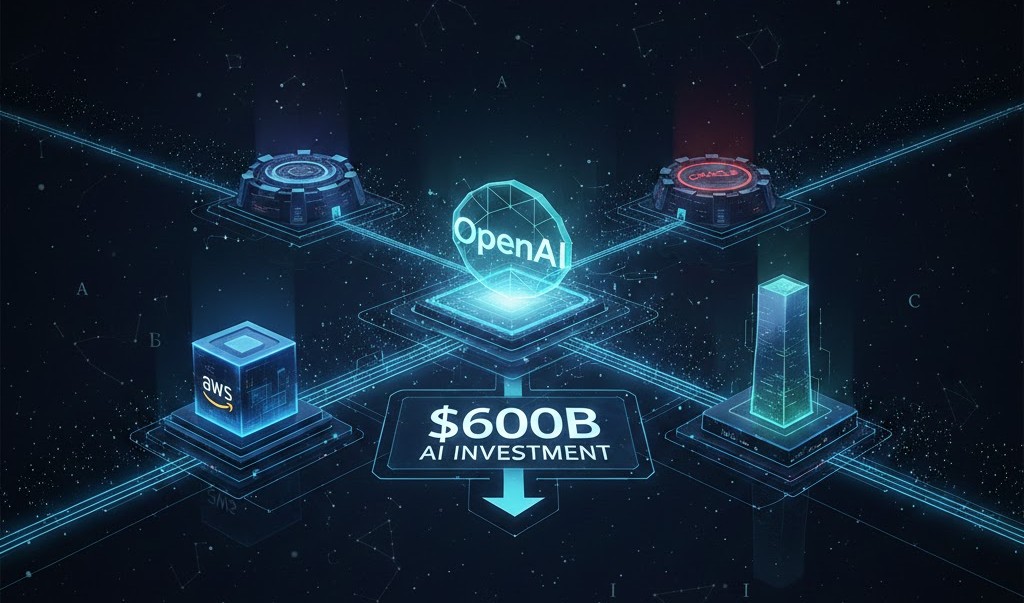
OpenAI has officially transitioned to a multi-cloud strategy, securing its AI compute supply chain through massive new agreements with major hyperscalers. According to the original report, "OpenAI spreads $600B cloud AI bet across AWS, Oracle, Microsoft," the company is diversifying its infrastructure to mitigate risk and ensure long-term availability of high-performance hardware.
The company recently shifted away from its exclusive cloud partnership with Microsoft, distributing a staggering $600 billion in capital commitments:
- • Microsoft: $250 billion allocated.
- • Oracle: $300 billion allocated.
- • Amazon Web Services (AWS): $38 billion multi-year pact.
Securing the GPU Supply Chain
For industry leaders, these deals highlight that high-performance GPUs are no longer on-demand commodities but scarce resources requiring long-term capital. The AWS agreement specifically grants OpenAI access to hundreds of thousands of NVIDIA GPUs, including the next-generation GB200 and GB300 chips, alongside tens of millions of CPUs.
This infrastructure is critical not only for training "frontier AI" models but also for sustaining the massive inference workloads generated by today's ChatGPT users. As CEO Sam Altman noted, scaling AI demands "massive, reliable compute."
Strategic Implications for Enterprises
The scale of OpenAI’s spending offers three vital lessons for enterprise leaders and CIOs:
- The "Build vs. Buy" Debate: With OpenAI spending hundreds of billions on rented hardware, the market is shifting toward managed platforms like Amazon Bedrock and Google Vertex AI, where cloud providers absorb the infrastructure risk.
- Multi-Cloud Sourcing: Single-cloud sourcing is increasingly viewed as a risk. OpenAI’s shift to multiple providers is a primary example of concentration risk mitigation.
- Capital Planning: AI budgeting has moved beyond departmental IT. Securing compute is now a long-term financial commitment, comparable to building a new factory.
Note on Deployment: Capacity from these latest deals is expected to be fully deployed by the end of 2026, underscoring the complexity of the global hardware supply chain.