
 OpenAI - ChatGPT, Sora
 Google - Gemini, Nano Banana
 Anthropic - Claude
 xAI - Grok
 Deepseek
 Alibaba - Qwen
 ByteDance - Doubao
 All Models
 Enterprise Plans
 AI Application Development
 AI Translator API
 AI SEO/GEO Service
 GEO-Optimized PR Service
 Web Scraping Service
 OpenClaw
 Top AI Tools
 Top AI Robots
 Log in





The "Merge" Begins: OpenAI Backs Sam Altman's BCI Startup in $250M Seed Round
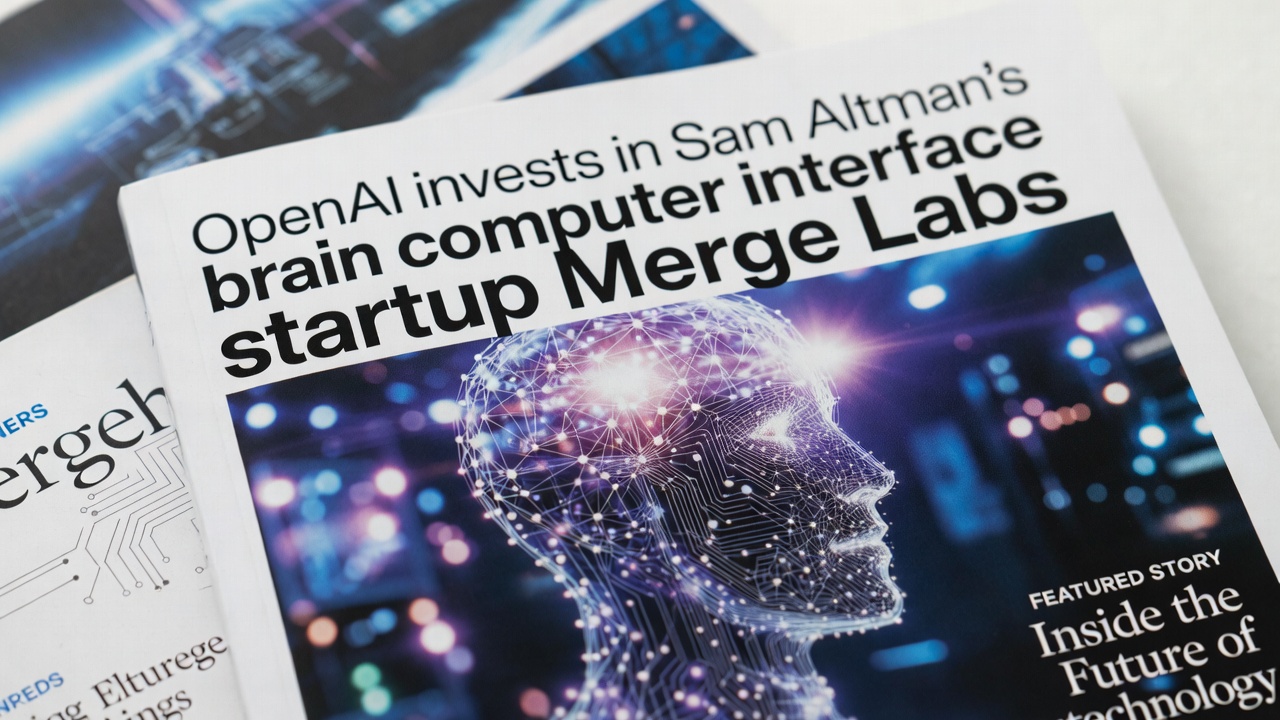
In a move that further intertwines the future of AI with human biology, OpenAI has made a significant investment in Merge Labs, a brain-computer interface (BCI) startup founded by none other than OpenAI CEO Sam Altman. Emerging from stealth mode this Thursday, Merge Labs secured a massive $250 million seed round, valuing the nascent company at an impressive $850 million.
This strategic investment represents the largest single check in the round, confirming the deep synergy between Altman's vision for Artificial General Intelligence (AGI) and the enhancement of human cognitive capabilities. The round also saw participation from heavyweights like Bain Capital, Interface Fund, Fifty Years, and video game industry legend Gabe Newell.
The deal highlights a recurring theme in Silicon Valley: the "circular" nature of Altman's ecosystem. OpenAI invests in a company Altman owns (Merge Labs), which in turn builds technology to control OpenAI's software. If successful, Merge Labs drives adoption of OpenAI's models, increasing the value of both entities simultaneously.
Bridging Biology and AI: The Technology
Unlike Elon Musk's Neuralink, which requires invasive robotic surgery to implant electrode threads into the brain, Merge Labs is pursuing a non-invasive approach. The company aims to connect with neurons using molecules and deep-reaching modalities like ultrasound, rather than physical wires.
According to a statement from Merge Labs:
The BCI Wars: Altman vs. Musk
This investment intensifies the rivalry between Sam Altman and Elon Musk. While Musk's Neuralink focuses heavily on medical applications for severe paralysis (raising a $650M Series E at a $9B valuation in 2025), Merge Labs appears to have a broader, more consumer-centric ambition: Human Augmentation.
Merge Labs isn't just about restoring function; it's about extending capability. The goal aligns with Silicon Valley's transhumanist fantasy—combining human biology with AI to achieve superhuman intelligence. OpenAI's blog post explicitly states:
"BCIs will create a natural, human-centered way for anyone to seamlessly interact with AI. This is why OpenAI is participating in Merge Labs’ seed round."
The "Merge" Philosophy
Altman has long speculated about "the merge"—the point where humans and machines become indistinguishable. In a 2017 blog post, he theorized this would happen between 2025 and 2075. He views this merger as humanity's "best-case scenario" for survival in an age of superintelligent AI, allowing us to remain relevant rather than becoming obsolete "biological bootloaders."
The All-Star Founding Team
Merge Labs boasts a founding team that reads like a "Who's Who" of frontier tech:
- Sam Altman: CEO of OpenAI.
- Alex Blania & Sandro Herbig: Leadership from Tools for Humanity (Worldcoin), bringing expertise in global identity and hardware.
- Tyson Aflalo & Sumner Norman: Co-founders of Forest Neurotech, specializing in implantable neural tech.
- Mikhail Shapiro: A renowned researcher at Caltech.
Notably, these founders will maintain their roles at their respective companies, suggesting a collaborative ecosystem rather than a traditional startup structure.
What This Means for the AI Industry
The partnership implies a future where OpenAI's models are not just accessed via keyboards or voice, but through direct neural intent. OpenAI will collaborate with Merge Labs on scientific foundation models to interpret noisy neural signals, effectively creating an AI Operating System for the Brain.
As AI hardware evolves—from Jony Ive's rumored screenless device to Merge Labs' neural interfaces—the boundary between user and device is dissolving. We are moving from "using" AI to "embodying" it.
Conclusion
The launch of Merge Labs marks a pivotal moment in the AI timeline. It signals a shift from building smarter chatbots to engineering the interface of human thought itself. With OpenAI's backing and Altman's vision, Merge Labs is poised to be a central player in the race to redefine what it means to be human in the age of artificial intelligence.