
 OpenAI - ChatGPT, Sora
 Google - Gemini, Nano Banana
 Anthropic - Claude
 xAI - Grok
 Deepseek
 Alibaba - Qwen
 ByteDance - Doubao
 All Models
 Enterprise Plans
 AI Application Development
 AI Translator API
 AI SEO/GEO Service
 GEO-Optimized PR Service
 Web Scraping Service
 OpenClaw
 Top AI Tools
 Top AI Robots
 Log in








SAP ANYbotics Partner to Accelerate Physical AI Adoption in Industrial Manufacturing
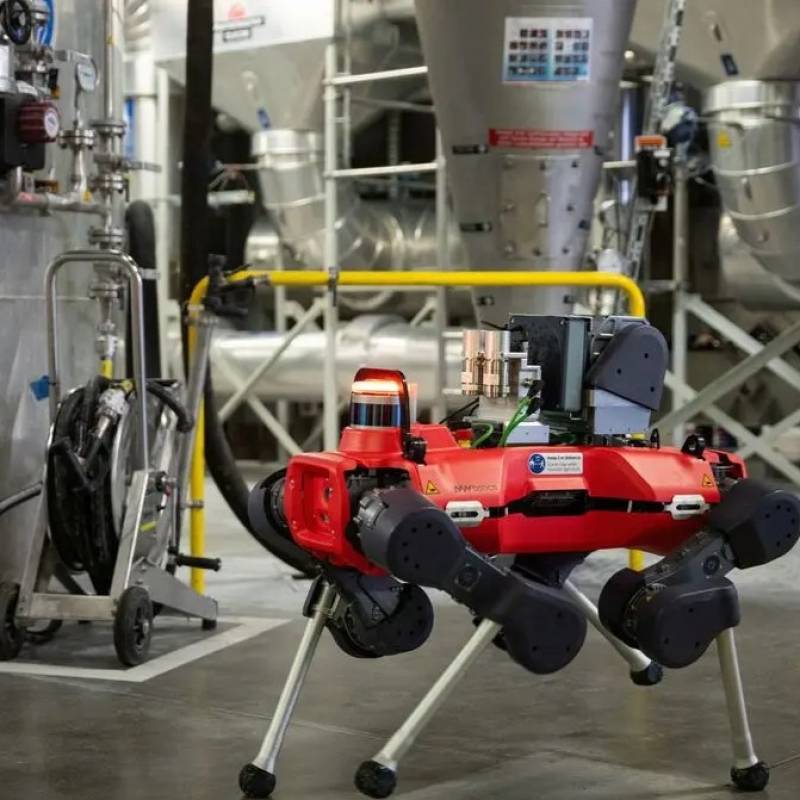
Heavy industry continues to depend on manual inspections of hazardous and contaminated facilities. This approach is not only costly but also poses significant safety risks to human workers. Swiss robotics manufacturer ANYbotics and enterprise software leader SAP are collaborating to revolutionize this industry practice.
ANYbotics' four-legged autonomous robots will integrate directly with SAP's backend enterprise resource planning (ERP) software. Rather than operating as isolated assets, these robots function as mobile data-gathering nodes within an industrial Internet of Things (IoT) ecosystem.
This partnership demonstrates how hardware innovation can seamlessly integrate with established enterprise workflows. Highlighting this industry trend, SAP is sponsoring the AI & Big Data Expo North America at the San Jose McEnery Convention Center, California, which is co-located with the IoT Tech Expo and Intelligent Automation & Physical AI Summit.
🔧 Addressing Critical Industrial Challenges
Equipment failures at chemical plants or offshore rigs result in substantial financial losses. While routine human inspections aim to identify issues early, they face inherent limitations—inspectors experience fatigue, and industrial facilities span vast areas. Conversely, robots can conduct continuous patrols, equipped with thermal imaging, acoustic sensors, and visual monitoring systems. When connected to SAP, an overheating pump automatically generates a maintenance request without human intervention.
⚡ Eliminating Reporting Delays
Traditionally, problem identification and work order creation are disconnected processes. A technician might detect an unusual compressor noise, document it manually, and enter it into the system hours later. By the time parts are approved, critical equipment may have sustained irreparable damage.
The ANYbotics-SAP integration eliminates this delay entirely. The robot's onboard AI processes sensory data in real-time, and upon detecting irregular motor frequencies, it communicates directly with SAP's asset management module via APIs.
The system immediately verifies spare parts availability, calculates potential downtime costs, and schedules engineering resources. This automation ensures machinery assessment is based on consistent, objective data rather than subjective human judgment.
🌐 Overcoming Infrastructure Limitations
Deploying robots in heavy industry differs significantly from office software installations—companies must navigate unreliable infrastructure. Industrial facilities typically suffer from poor internet connectivity due to thick concrete walls, metal scaffolding, and electromagnetic interference.
The solution relies on edge computing architecture. Continuously streaming high-definition thermal video and LiDAR data to cloud servers requires excessive bandwidth. Instead, robots process most data locally, with onboard processors distinguishing between normal operations and dangerous conditions like overheating. Only critical fault information and location data are transmitted to SAP.
To address network challenges, early adopters are deploying private 5G networks. This provides comprehensive coverage across expansive facilities where conventional Wi-Fi fails, while securing data transmission against interception.
🔒 Security Considerations
A mobile robot equipped with cameras represents a potential security vulnerability. Companies must implement zero-trust network protocols to continuously verify robot identity and restrict SAP module access. In the event of a security breach, the system must immediately sever connections to prevent lateral movement into corporate networks.
📊 Managing Unstructured Data
These robots generate vast amounts of unstructured data during operations. Converting raw audio and thermal imagery into structured SAP-compatible formats presents significant challenges.
Without proper management, maintenance teams face alert fatigue. Overly sensitive robots may generate hundreds of false warnings daily, causing teams to ignore SAP dashboards entirely. IT departments must establish precise thresholds before system activation, defining what constitutes genuine maintenance tickets versus situations requiring monitoring.
Implementations typically employ middleware solutions to translate robot telemetry into SAP-compatible data structures. This software filters noise, ensuring only legitimate issues reach the ERP system. The data lake storing this information must be organized for future machine learning initiatives. While immediate goals focus on equipment repair, the long-term objective is leveraging years of robot data to predict failures before they occur.
✅ Ensuring Successful Physical AI Deployment
The ANYbotics-SAP collaboration represents a significant advancement in industrial automation, transforming how facilities monitor critical infrastructure. By combining autonomous robotics with enterprise software integration, companies can achieve safer operations, reduced costs, and predictive maintenance capabilities that were previously unattainable.