 OpenAI - ChatGPT, Sora
 Google - Gemini, Nano Banana
 Anthropic - Claude
 xAI - Grok
 Deepseek
 Alibaba - Qwen
 ByteDance - Doubao
 All Models
 Enterprise Plans
 AI Application Development
 AI Translator API
 AI SEO/GEO Service
 GEO-Optimized PR Service
 Web Scraping Service
 OpenClaw
 Top AI Tools
 Top AI Robots
 Log in


                                        const { OpenAI } = require('openai');

const api = new OpenAI({
  baseURL: 'https://api.ai.cc/v1',
  apiKey: '',
});

const main = async () => {
  const result = await api.chat.completions.create({
    model: 'lmsys/vicuna-7b-v1.5',
    messages: [
      {
        role: 'system',
        content: 'You are an AI assistant who knows everything.',
      },
      {
        role: 'user',
        content: 'Tell me, why is the sky blue?'
      }
    ],
  });

  const message = result.choices[0].message.content;
  console.log(`Assistant: ${message}`);
};

main();
                                        import os
from openai import OpenAI

client = OpenAI(
    base_url="https://api.ai.cc/v1",
    api_key="",
)

response = client.chat.completions.create(
    model="lmsys/vicuna-7b-v1.5",
    messages=[
        {
            "role": "system",
            "content": "You are an AI assistant who knows everything.",
        },
        {
            "role": "user",
            "content": "Tell me, why is the sky blue?"
        },
    ],
)

message = response.choices[0].message.content

print(f"Assistant: {message}")


Product Detail
Vicuna v1.5 (7B) Overview
Basic Information
- Model Name: Vicuna v1.5 (7B)
- Developer/Creator: LMSYS
- Release Date: Initial research presented in December 2023
- Version: 1.5
- Model Type: An auto-regressive language model based on the transformer architecture
Overview
Vicuna v1.5 is an advanced large language model (LLM) designed to enhance the conversational capabilities of chat assistants. It leverages supervised instruction fine-tuning and reinforcement learning with human feedback (RLHF) to achieve superior instruction-following and dialogue performance.
Key Features
- 🗣️ Enhanced Conversational Abilities: Improved multi-turn dialogue handling for natural interactions.
- ✅ Precise Instruction Following: Fine-tuned for accurate and nuanced adherence to instructions.
- 👤 Human Preference Alignment: Demonstrates high agreement with human evaluations, ensuring user satisfaction.
- 💪 Robust Performance: Achieves competitive and consistent results across various benchmarks.
Intended Use
Vicuna v1.5 is ideal for interactive chat assistants, virtual customer service agents, and any application demanding sophisticated conversational AI. It particularly excels in scenarios requiring nuanced understanding and generation of human-like responses.
Language Support
The model primarily supports English but offers flexibility for fine-tuning or adaptation to other languages as needed.
Technical Details
Architecture
Vicuna v1.5 is built upon the robust transformer architecture, specifically fine-tuned from the LLaMA-13B model. The transformer model is renowned for its self-attention mechanisms, which enable efficient text processing and generation.
Training Data
As a fine-tuned version of Llama 2, Vicuna v1.5 benefited from supervised instruction fine-tuning. The comprehensive training dataset includes approximately 125,000 conversations primarily sourced from ShareGPT.com.
This dataset encompasses a diverse mix of dialogues, ensuring a wide spectrum of topics and conversational styles.
Knowledge Cutoff: The model's knowledge is current up to September 2021.
Diversity and Bias: While efforts are made to minimize bias through diverse data sources, inherent biases from the original training data may still be present. Continuous mitigation efforts are ongoing.
Performance Metrics
Vicuna v1.5 demonstrates strong and robust performance across several key benchmarks:
- 📊 MMLU (5-shot): 52.1
- 🎯 TruthfulQA (0-shot): 0.35
- ⭐ MT-Bench Score (GPT-4 judged): 6.39
- ✔️ Accuracy: Evaluated using metrics like perplexity and human preference alignment.
- ⚡ Speed: Optimized for real-time inference, critical for responsive interactive applications.
- 🛡️ Robustness: Effectively handles a wide range of inputs and generalizes well across diverse topics.
Usage
Code Samples
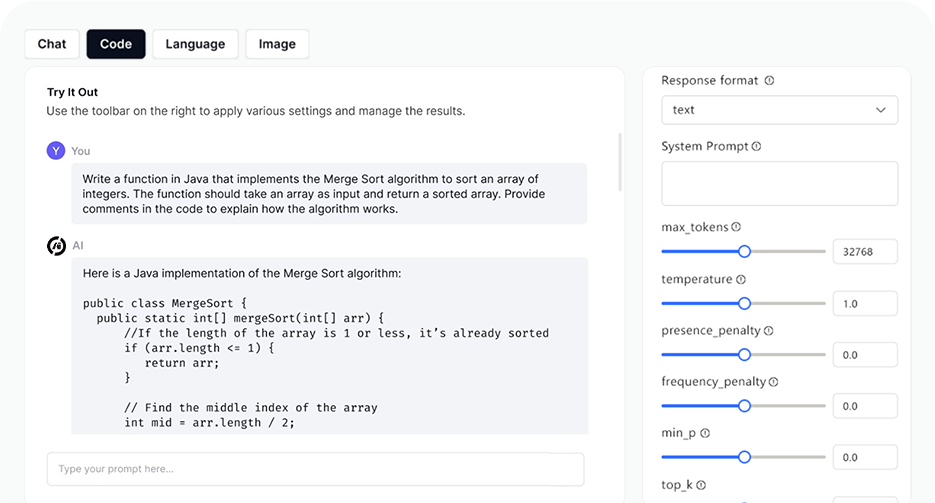
Developers can integrate Vicuna v1.5 into their applications using standard API calls. Below is an example of a potential API snippet (actual implementation details may vary based on platform):
<!-- Example API integration snippet --> <snippet data-name="open-ai.chat-completion" data-model="lmsys/vicuna-7b-v1.5"></snippet> Ethical Considerations
Vicuna v1.5 is developed with a strong emphasis on minimizing biases and ensuring fair and responsible use. Developers are strongly encouraged to use the model ethically and remain aware of potential biases inherent in any AI-generated content.
Licensing
The Vicuna v1.5 model is available for both commercial and non-commercial use. Specific licensing agreements are detailed within its official repository, and users should review these for compliance.
Conclusion
Vicuna v1.5 (7B) emerges as a powerful, fine-tuned language model, purpose-built to elevate conversational AI applications. Its robust transformer architecture, extensive training on diverse datasets, and strong alignment with human preferences position it as a versatile and effective tool for developers aiming to integrate sophisticated language capabilities into their projects.
Frequently Asked Questions (FAQs)
Q1: What is Vicuna v1.5 (7B)?
A1: Vicuna v1.5 (7B) is an advanced large language model (LLM) developed by LMSYS, based on the transformer architecture and fine-tuned from LLaMA-13B, designed to enhance conversational AI applications.
Q2: What are the key features of Vicuna v1.5?
A2: Key features include enhanced conversational abilities, precise instruction following, strong alignment with human preferences, and robust performance across various benchmarks.
Q3: Where does Vicuna v1.5 get its training data?
A3: It is fine-tuned from Llama 2 and trained on approximately 125,000 conversations primarily sourced from ShareGPT.com, covering diverse topics and conversational styles.
Q4: Is Vicuna v1.5 suitable for commercial use?
A4: Yes, Vicuna v1.5 is available for both commercial and non-commercial use. Users should refer to the specific licensing agreements provided in its official repository.
Q5: What is the knowledge cutoff for Vicuna v1.5?
A5: The model's knowledge is up-to-date until September 2021.
AI Playground