
 OpenAI - ChatGPT, Sora
 Google - Gemini, Nano Banana
 Anthropic - Claude
 xAI - Grok
 Deepseek
 Alibaba - Qwen
 ByteDance - Doubao
 All Models
 Enterprise Plans
 AI Application Development
 AI Translator API
 AI SEO/GEO Service
 GEO-Optimized PR Service
 Web Scraping Service
 OpenClaw
 Top AI Tools
 Top AI Robots
 Log in
The Agentic Shift.
From conversation
to execution.
Claude Sonnet 5 landed June 30, 2026 as Anthropic's "most agentic Sonnet model to date." Adaptive Thinking is on by default. Terminal-Bench 2.1 jumps to 80.4%. A new tokenizer inflates token counts by 30%. This is the complete technical breakdown for enterprise architects and production developers.
Reactive assistant · Explicit reasoning config required · Predictable tokenizer · Conversational focus
Autonomous executor · Adaptive Thinking on by default · New +30% tokenizer · Tool + terminal mastery
The landscape of generative AI has fundamentally shifted. For years, the industry measured frontier models by conversational fluency and static benchmark performance. Enterprise workloads do not happen in isolated turns — they demand sustained execution, tool mastery, and robust autonomy.
On June 30, 2026, Anthropic disrupted this baseline by deploying Claude Sonnet 5. Sitting beneath Opus 4.8 and specialized tiers like Fable 5, Sonnet 5 targets the Pareto frontier of AI: delivering frontier-grade reasoning and complex tool use at a mid-tier cost profile.
Two foundational changes — what moved.
Claude Sonnet 5 introduces two paradigm changes that every developer must account for before migration.
The 30% Token Inflation. Text sent to Sonnet 5 generates approximately 30% more tokens than the exact same string sent to Sonnet 4.6. The request payload shape does not change, but four operational axes are directly impacted:
max_tokens boundaries from prior versions risk cutting off generation prematurely. Output thresholds must be adjusted upward aggressively.Adaptive Thinking by default. In Sonnet 4.6, explicit reasoning required specialized API configuration. In Sonnet 5, Adaptive Thinking is natively toggled on. The model computes an internal reasoning path dynamically before outputting its final response. Control is available via the Reasoning Effort Dial (Low to Extra High) or by passing thinking: {type: "disabled"}.
Benchmarks — narrowing the Opus gap.
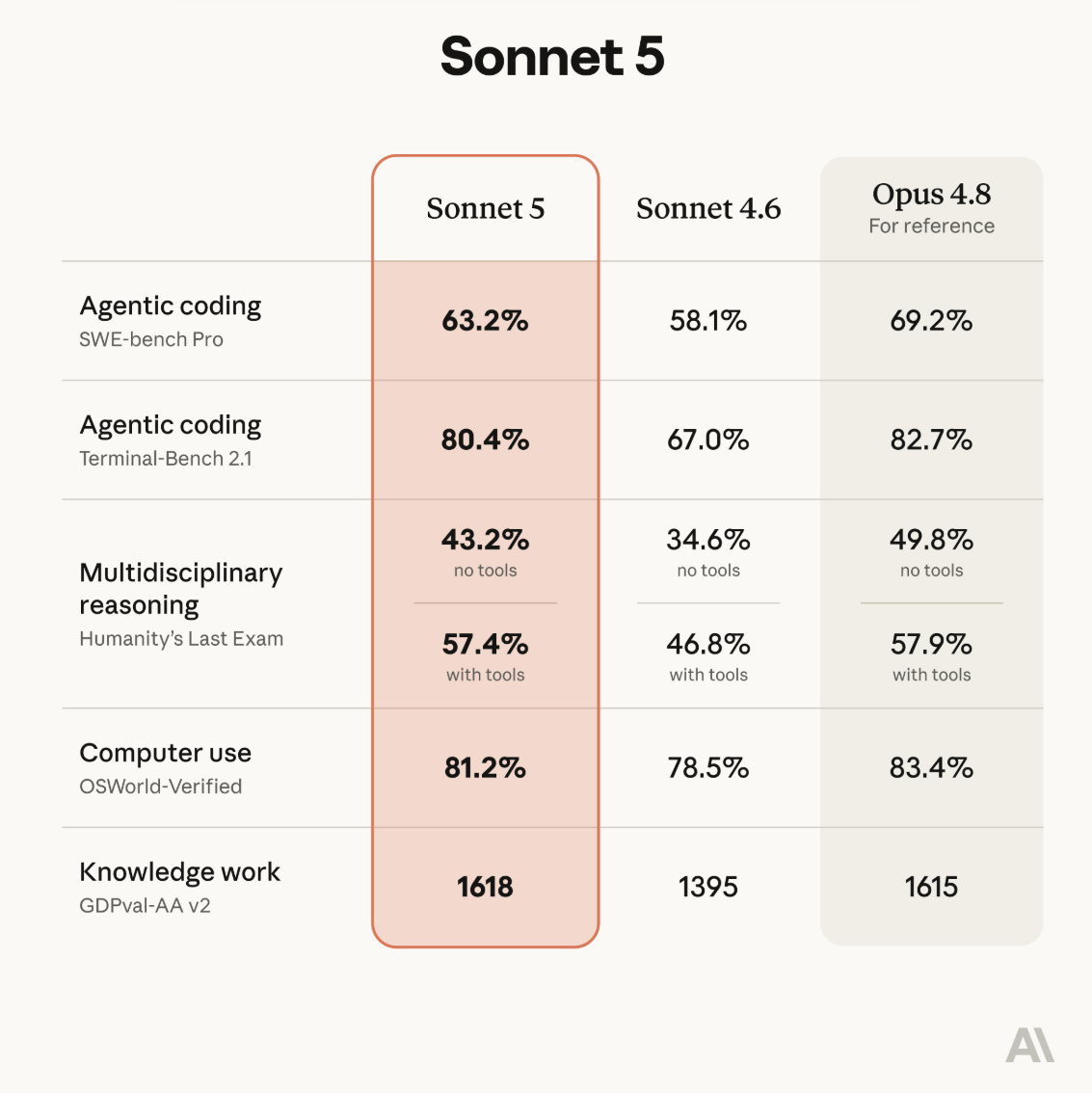
| Benchmark | Sonnet 4.6 | Sonnet 5 | Opus 4.8 (ref) |
|---|---|---|---|
| SWE-Bench Pro · Agentic Coding | |||
| Terminal-Bench 2.1 · CLI & Tools | |||
| Humanity's Last Exam · No Tools | |||
| Humanity's Last Exam · With Tools |
- Agentic Software Engineering (63.2% SWE-Bench Pro): Sonnet 5 has a habitual tendency to write automated tests before writing feature logic, tracing failures down to structural root causes rather than applying temporary patches.
- Tool & Environment Autonomy (80.4% Terminal-Bench 2.1): Pulls nearly level with Opus 4.8 (82.7%). Orchestrates complex tool chains, interacts natively with terminals and browsers via Computer Use, executes multi-file changes without human intervention.
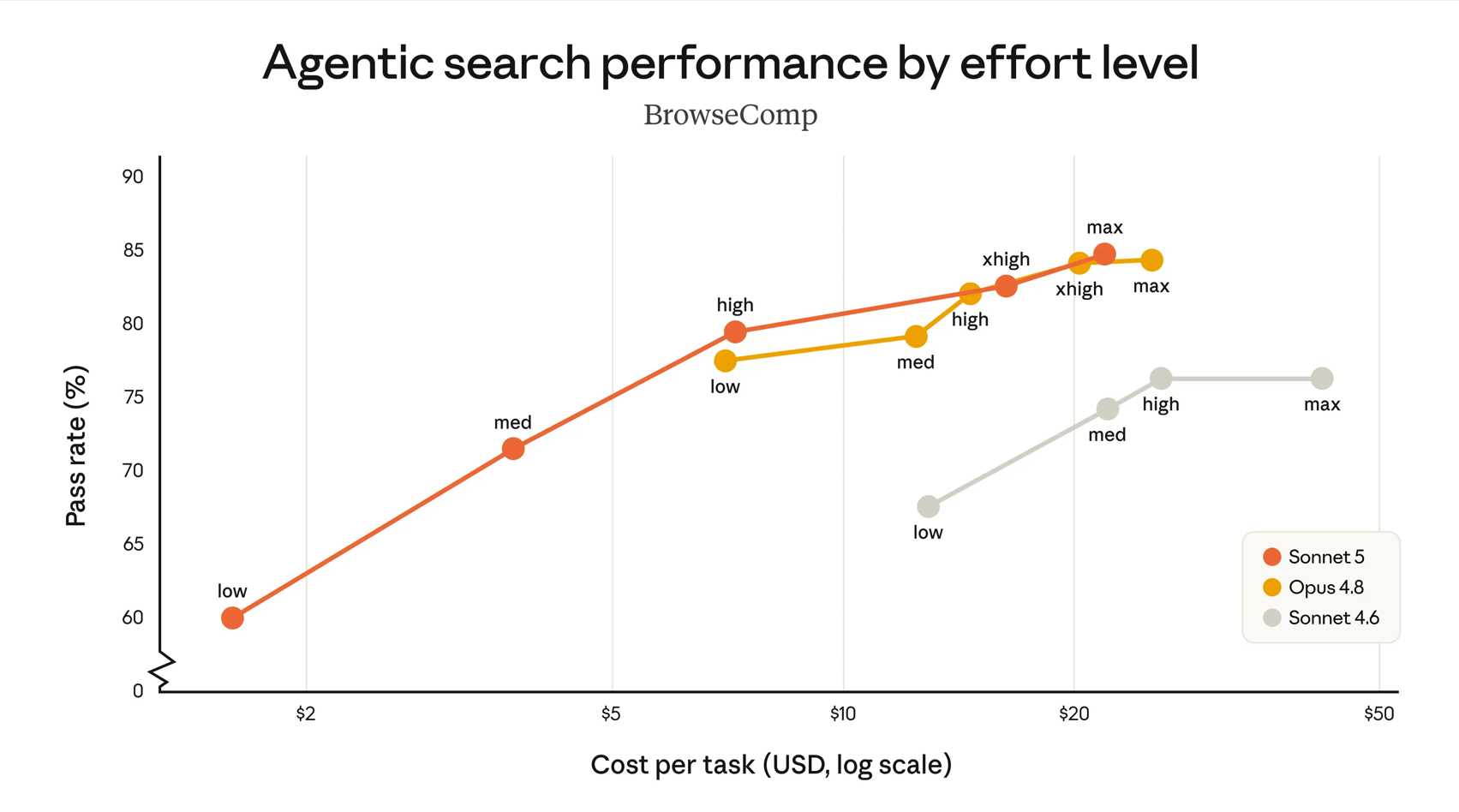
- Effort-to-Accuracy Frontier: At Extra High effort, Sonnet 5 matches or surpasses flagship baseline performance on targeted workflows — at the cost of higher latency and token usage.
The self-correction loop & real-world trade-offs.
In production environments — integrations within Claude Code or AI-driven code review pipelines — Sonnet 5 displays distinct operational habits that differentiate it from prior models.
When tasked with solving a software bug, the model rarely stops at the first logical solution. It engages in sustained autonomous loops: writing a reproducing test case, executing the fix, verifying the test pass, then refactoring for maintenance optimization.
This precision introduces clear trade-offs:
- Slower Interactive TTM: For simple tasks, Sonnet 5 can feel noticeably slower than 4.6. It over-thinks trivial adjustments unless the reasoning effort dial is actively turned down.
- Rewriting Behavior: The model occasionally second-guesses its own execution plans midway through an operation, rewriting its structural map multiple times during long-running tasks.
Pricing, token budgets & enterprise scalability.
Enterprise safety & graceful refusals.
Sonnet 5 is the first mid-tier Anthropic model with real-time cybersecurity safeguards. The built-in safety engine intercepts and blocks high-risk dual-use activities, malicious script generation, and prompt injection exploits before the execution boundary.
Unlike traditional architectures that throw a 4XX or 5XX HTTP error when encountering restricted content, Sonnet 5 handles security flags gracefully — your orchestration pipelines will not crash:
"stop_reason": "refusal" "content": [{ "type": "text", "text": "I cannot generate scripts designed to exploit network vulnerabilities." }] // 200 OK — pipelines stay alive, not a hard 4XX crash
Security professionals should anticipate an uptick in false positives during legitimate penetration testing, as the internal filters lean conservative. Plan for retry logic in security-adjacent workloads.
Drop-in upgrade — four steps.
max_tokens to absorb the tokenizer change.# Before: # client.messages.create(model="claude-sonnet-4-6", ...) client.messages.create( model="claude-sonnet-5", max_tokens=4000 # Expanded for tokenizer )
- Do not manually pass non-default values for
temperature,top_p, ortop_kalongside active reasoning loops — this triggers a hard HTTP 400. - Remove any legacy manual extended thinking flags.
{ "model": "claude-sonnet-5", "thinking": { "type": "enabled", "budget_tokens": 2048 } } The era of pure conversational chat is resolving into an era of autonomous, deterministic execution.
Claude Sonnet 5 changes the structural baseline of what developers can expect from a mid-priced foundation model. By baking adaptive thinking directly into the runtime and scaling autonomous tool execution to near-Opus levels, Anthropic has lowered the financial barrier to entry for complex multi-step agent deployments.
The new tokenizer requires meticulous auditing of token budgets and costs. The benefits — autonomous self-debugging, rigorous pre-testing, native cyber-safeguards — provide an exceptionally stable backbone for modern enterprise AI operations.
Access claude-sonnet-5 through ai.cc — one key, every model.
Claude Sonnet 5 is live on ai.cc at the introductory rate. Alongside Opus 4.8, GPT-5.5, Gemini 3.5 Flash, and 300+ more — one OpenAI-compatible API key, one dashboard, one invoice. Route each task to the right capability tier without managing separate accounts.
Get started at www.ai.cc →