
 OpenAI - ChatGPT, Sora
 Google - Gemini, Nano Banana
 Anthropic - Claude
 xAI - Grok
 Deepseek
 Alibaba - Qwen
 ByteDance - Doubao
 All Models
 Enterprise Plans
 AI Application Development
 AI Translator API
 AI SEO/GEO Service
 GEO-Optimized PR Service
 Web Scraping Service
 OpenClaw
 Top AI Tools
 Top AI Robots
 Log in
Claude Fable 5: Anthropic’s Most Powerful Generally Available AI Model – A Comprehensive 2026 Review
AI.CC · Frontier model review · No. 05
Claude Fable 5
Anthropic’s most powerful generally available model — a Mythos-class intelligence made safe for the world. A comprehensive 2026 review.
In the rapidly evolving landscape of artificial intelligence, Anthropic has once again pushed the boundaries with the release of Claude Fable 5 on June 9, 2026. As a Mythos-class model made safe for broad deployment, Fable 5 stands as Anthropic’s most capable publicly available large language model to date — excelling in long-horizon agentic tasks, advanced coding, scientific reasoning, vision, and complex knowledge work.
This in-depth guide explores everything you need to know: its architecture and capabilities, performance benchmarks, real-world applications, safety innovations, comparisons with contemporaries like Claude Opus 4.8 and Sonnet 5, and strategic implications for developers, enterprises, and researchers. Whether you’re optimizing AI workflows or evaluating frontier models for 2026 and beyond, this article delivers actionable insights grounded in the latest data from Anthropic’s announcements, independent evaluations, and user reports.
From Constitutional AI to Mythos-class models
Anthropic, founded by former OpenAI executives including Dario Amodei, has built its reputation on responsible AI development. Their Constitutional AI framework emphasizes helpfulness, honesty, and harmlessness — setting Claude models apart in an industry often criticized for rushed deployments.
The Claude family evolved rapidly:
Fable 5 represents a significant leap. It shares its core with the more restricted Claude Mythos 5 but includes enhanced safety classifiers. This dual-release strategy allows Anthropic to democratize frontier capabilities while mitigating risks.
What makes Fable 5 unique
Claude Fable 5 (claude-fable-5) is engineered for ambitious, long-running projects that previous models struggled to sustain. Its standout attributes:
-
Extended autonomy & long-horizon reasoning
Fable 5 maintains focus across multi-day tasks, self-corrects, tests its own outputs, and persists through complex workflows — ideal for autonomous agents in software engineering, research synthesis, or financial modeling. Users report sustained performance over hours without degradation.
-
Massive context window
A standard 1 million token context (with beta extensions) allows ingestion of entire codebases, lengthy legal documents, or comprehensive research corpora in one go — reducing fragmentation in agentic pipelines.
-
Superior multimodal & vision capabilities
Enhanced image understanding supports high-resolution analysis, chart interpretation, diagram generation, and visual data extraction. It leads in vision benchmarks for scientific and engineering tasks.
-
Advanced tool use & agentic features
Seamless integration with tools, computer use (cursor control, file system interaction), parallel execution, and dynamic workflows. It excels in Claude Code and Claude Cowork environments.
-
Pricing & accessibility
Available via the Claude API, claude.ai (Pro / Max / Team / Enterprise), AWS Bedrock, Google Vertex AI, and Microsoft Foundry. Introductory access was offered on certain plans.
Note on availability — Shortly after launch, Fable 5 faced temporary restrictions due to U.S. export control concerns and reported jailbreak attempts. It was redeployed globally around July 1, 2026, with strengthened safeguards and an industry framework for jailbreak severity scoring.
Performance benchmarks vs. the competition
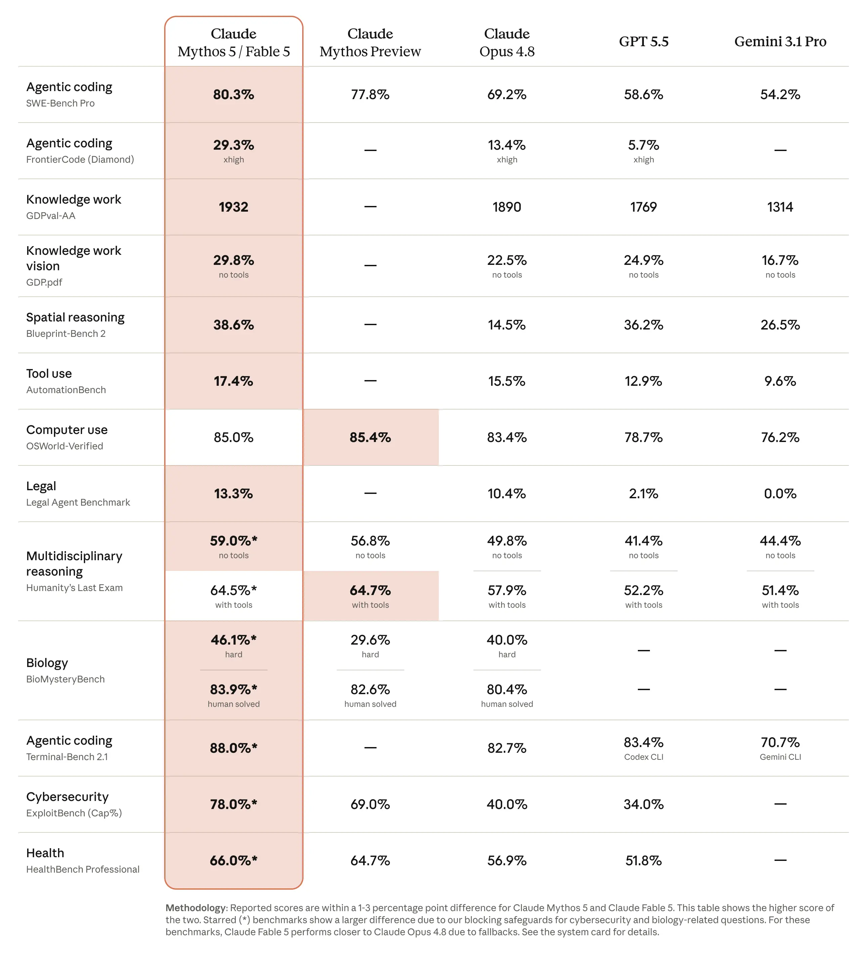
Independent and Anthropic evaluations position Fable 5 at or near the top of 2026 leaderboards, particularly in demanding areas. Key benchmarks (approximate from reports):
Head-to-head comparisons
Vs. Claude Opus 4.8 — Fable 5 offers higher peak capabilities for the most complex tasks, though Opus remains excellent for balanced reasoning at lower cost ($5 / $25).
Vs. Claude Sonnet 5 (released June 30, 2026) — Sonnet 5 provides strong value at $3 / $15, optimized for scale and agentic workflows, but Fable 5 leads in raw intelligence and long-horizon persistence.
Vs. competitors (e.g., OpenAI, Google models) — Fable 5 frequently edges out in coding consistency, low hallucination rates, and safety-tuned performance.
These results stem from rigorous testing, including Anthropic’s Transparency Hub and third-party audits.
Real-world use cases & applications
Software development & engineering
Fable 5 shines in full codebase refactoring, bug hunting across large repos, and generating production-ready code. Developers using tools like Cursor report it compressing multi-day projects into hours with proactive debugging.
Scientific research & knowledge work
Researchers leverage it for literature synthesis, hypothesis generation, data analysis, and modeling complex systems — e.g., aerospace simulations like Boeing 747 modeling in user tests.
Enterprise & agentic automation
Build reliable multi-agent systems for finance (modeling, compliance), legal document review, or operations. Its 30-day data retention policy supports monitoring while enabling persistent sessions.
Creative & multimodal tasks
Generate interactive artifacts, analyze visuals, or create consistent long-form content. The “Fable” naming evokes storytelling prowess alongside technical strength.
Education & professional productivity
Tutoring at graduate level, personalized learning paths, or executive decision support with transparent reasoning.
“Every fable carries a lesson. This one is that frontier capability and responsibility can, finally, share a spine.” — On the Mythos-class release strategy
Safety, ethics & responsible deployment
Anthropic’s approach to Fable 5 exemplifies trustworthiness. New safety classifiers route high-risk queries (cyber, bio, chemistry) to safer models like Opus 4.8. Mythos 5 offers lifted safeguards for vetted partners in Project Glasswing.
This balances innovation with risk management, addressing concerns like autonomous capability escalation and dual-use technologies. Anthropic’s track record of measured releases builds authoritativeness in the AI safety community.
Limitations to consider
Higher token pricing suits high-value tasks rather than casual chat; data retention policies may concern privacy-sensitive users; and the temporary availability hiccups highlight ongoing geopolitical AI tensions.
How to get started
-
Via claude.ai
Upgrade to Pro or higher plans for direct access.
-
API integration
Use the
claude-fable-5endpoint. Start with Anthropic’s SDKs. -
Cloud platforms
Available on Bedrock, Vertex AI, and Microsoft Foundry for enterprise scaling.
-
Best practices
Use structured prompts, chain-of-thought, tool calling, and effort controls for optimal results. Test in Claude Code for agentic projects.
Monitor Anthropic’s docs for updates, as the ecosystem evolves quickly.
Implications for AI in 2026 & beyond
Claude Fable 5 signals a maturing AI industry: frontier models are becoming more accessible yet responsibly gated. It accelerates productivity in coding, research, and knowledge sectors while raising questions about AI governance, export controls, and the path to AGI.
For businesses on www.ai.cc and similar platforms, adopting Fable 5 (or tiered Claude models) can yield competitive advantages in automation and innovation. However, success requires thoughtful integration, prompt engineering expertise, and ongoing evaluation of costs vs. ROI.
As AI capabilities scale, Anthropic’s focus on safety positions them as a leader. Watch for further Mythos expansions, enhanced computer use, and multimodal advancements.
Is Claude Fable 5 right for you?
Claude Fable 5 is not just another model update — it’s a benchmark for what safe, powerful, general-purpose AI can achieve in 2026. Its combination of raw intelligence, sustained autonomy, and robust safeguards makes it ideal for ambitious professionals and organizations tackling hard problems.
If your work involves complex coding, deep research, or scalable agents, Fable 5 deserves priority evaluation. For lighter loads, Sonnet 5 or Opus 4.8 may suffice at better economics.
Stay informed via Anthropic’s newsroom, Transparency Hub, and communities. The AI revolution is here — powered responsibly by models like Claude Fable 5.
finis