
 OpenAI - ChatGPT, Sora
 Google - Gemini, Nano Banana
 Anthropic - Claude
 xAI - Grok
 Deepseek
 Alibaba - Qwen
 ByteDance - Doubao
 All Models
 Enterprise Plans
 AI Application Development
 AI Translator API
 AI SEO/GEO Service
 GEO-Optimized PR Service
 Web Scraping Service
 OpenClaw
 Top AI Tools
 Top AI Robots
 Log in
Claude Opus 4.8 review.
Anthropic's newest flagship builds on Opus 4.7 with real gains in coding precision, agentic reliability, and long-horizon autonomy — the ability to sustain complex work for hours without hand-holding. Same 1M-token context. Same price. We dig into what's new, the benchmarks, and whether you should switch today.
Anthropic dropped a significant upgrade yesterday: Claude Opus 4.8. As the latest flagship in the Opus series, it builds directly on Opus 4.7 with notable gains in coding precision, agentic task reliability, and the ability to sustain complex, long-horizon work without constant human intervention.
In a 2026 landscape dominated by OpenAI's GPT-5.5 and Google's Gemini 3.1 Pro, Opus 4.8 stands out for its hybrid reasoning — combining deep thinking with practical tool use and self-verification. It keeps the massive 1M token context window and arrives at unchanged pricing, making it immediately attractive to developers and enterprises.
What changed in Opus 4.8?
Opus 4.8 is an iterative but meaningful upgrade focused on consistency and autonomy rather than raw scale. The headline improvements:
- Stronger coding & agentic performance — better planning, error recovery, and sustained execution on complex multi-step tasks.
- Dynamic workflows in Claude Code — generate scripts that orchestrate hundreds of parallel sub-agents for large-scale refactoring.
- Effort control / engagement levels — adjustable "thinking depth" to balance speed, cost, and quality per task.
- Improved honesty & self-assessment — more proactive about signaling uncertainty, less prone to hallucination or overconfidence.
- Fast Mode (research preview) — roughly 2.5× faster output at a premium price.
Does it deliver?
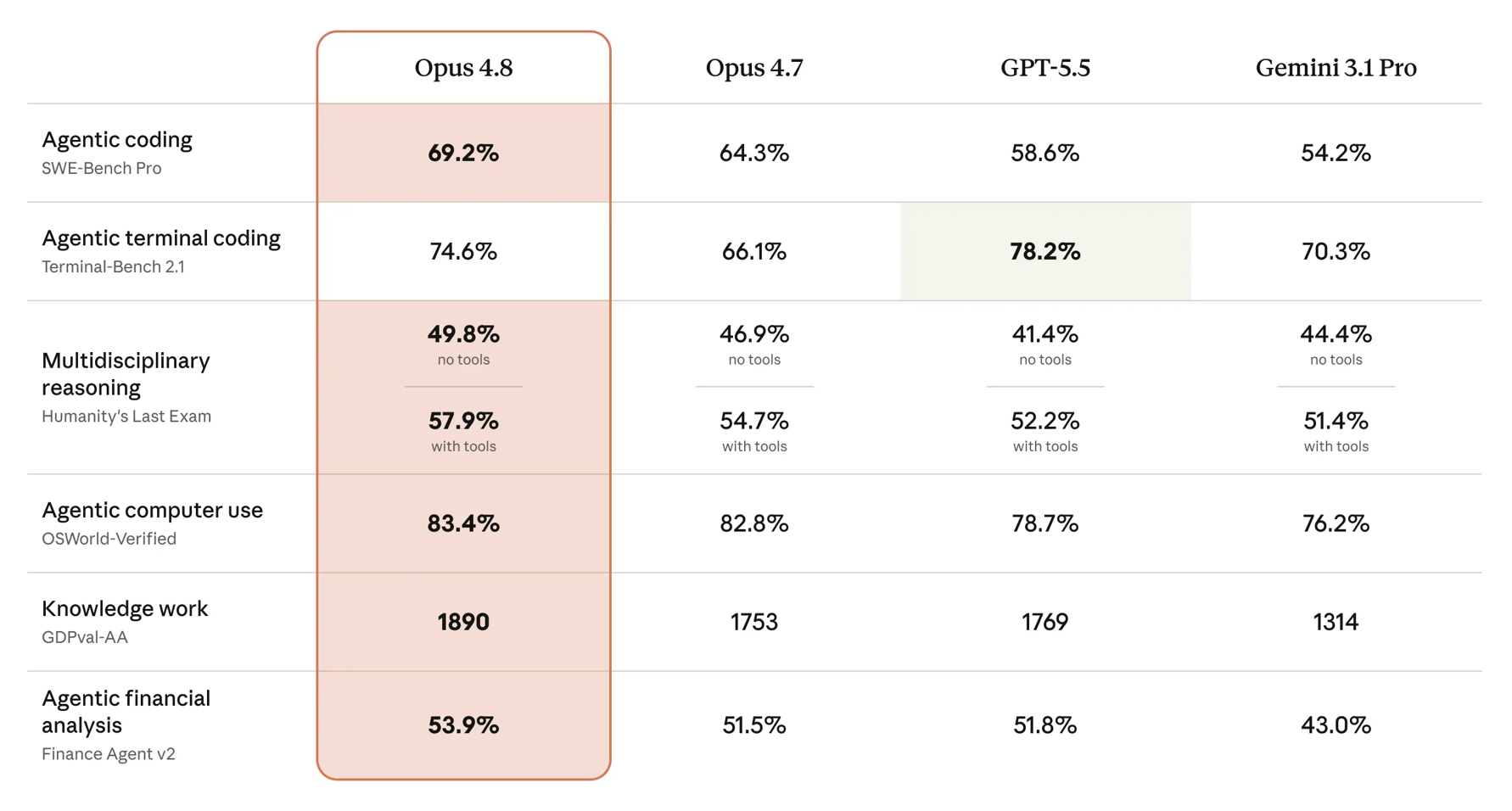
Anthropic positions Opus 4.8 as leading or highly competitive across key frontiers. The standout numbers, compared against its predecessor and the 2026 competition:
| Benchmark | Opus 4.8 | Opus 4.7 | GPT-5.5 | Gemini 3.1 Pro |
|---|---|---|---|---|
| SWE-Bench Pro | 69.2% | 64.3% | ~58.6% | ~54.2% |
| Agentic Coding / Knowledge Work | Leading | — | Competitive | Behind |
| OSWorld (Computer Use) | Strong | — | Competitive | — |
| Multidisciplinary Reasoning | Frontier | Improved | Strong | Strong |
Opus 4.8 shows clear gains in real-world GitHub issue resolution and long-running tasks. It particularly excels where many developers need help most: careful planning, self-correction, and maintaining coherence over extended sessions.
Opus 4.7 on SWE-Bench Pro — already a strong coding model and the previous flagship.
A ~5-point jump on the same benchmark — meaningful for real GitHub issue resolution, at the same price.
Who benefits most?
Large-scale code refactoring, autonomous debugging, and codebase-wide analysis benefit enormously from the 1M context and dynamic workflows. Teams report significantly reduced iteration cycles on complex projects.
Improved tool use, self-verification, and parallel sub-agents make Opus 4.8 one of the strongest foundations for reliable multi-agent systems in 2026.
Financial analysis, research synthesis, document creation, and compliance-heavy workflows benefit from its honesty and long-horizon consistency.
Pro, Max, Team, and Enterprise subscribers get immediate access for demanding personal and collaborative tasks.
Opus 4.8 vs. the 2026 field.
Opus 4.8 leads on coding benchmarks and structured reasoning. GPT-5.5 often edges out in broad agentic terminal tasks and raw creative speed.
Opus 4.8 generally outperforms on reasoning depth and coding. Gemini remains strong on cost-efficiency, speed, and native multimodal tasks.
If your workflow centers on complex software engineering or high-stakes agentic systems, Opus 4.8 is currently one of the strongest choices. For high-volume, lower-cost needs, evaluate Gemini. For general-purpose speed and ecosystem, GPT-5.5 remains excellent.
Pricing, availability & getting started.
Pricing remains unchanged from Opus 4.7 — a key part of why this upgrade is so easy to adopt:
| Tier | Input / M tokens | Output / M tokens |
|---|---|---|
| Standard | $5.00 | $25.00 |
| Fast Mode | $10.00 | $50.00 |
Generous prompt caching and batch discounts are available. You can access Opus 4.8 across:
- Claude.ai — Pro, Max, Team, and Enterprise plans.
- API — direct via the Claude Platform (
claude-opus-4-8). - Cloud providers — Amazon Bedrock, Google Vertex AI, Microsoft Foundry.
- Start with your existing Opus 4.7 prompts — migration is smooth with strong backward compatibility.
- Experiment with Dynamic Workflows for multi-file projects and large refactors.
- Use Effort Control to optimize the cost-vs-quality tradeoff per task.
- Leverage the full 1M context for entire repositories or long documents.
Safety, alignment & what's next.
Anthropic continues its strong emphasis on safety with updated System Cards and refusal mechanisms. Opus 4.8 maintains the company's focus on honest, controllable AI — a key differentiator in an era of increasingly autonomous agents. Looking ahead, this release accelerates the shift toward reliable AI collaborators that can handle days-long tasks with minimal oversight.
Is Claude Opus 4.8 worth it? For demanding coding, agentic, or knowledge work — yes, especially at the same price as its predecessor.
The gains in reliability and autonomy deliver real productivity lifts that often outweigh raw benchmark numbers. If you're already on Opus 4.7, the switch is essentially free upside.
Frequently asked questions.
Does Claude Opus 4.8 have a larger context window than 4.7?
Is Opus 4.8 more expensive than 4.7?
How does Opus 4.8 compare to GPT-5.5 for coding?
When will Sonnet 4.8 or other variants arrive?
How do I access Claude Opus 4.8?
claude-opus-4-8, and through Amazon Bedrock, Google Vertex AI, and Microsoft Foundry. Existing Opus 4.7 prompts migrate smoothly thanks to strong backward compatibility.Run Opus 4.8 alongside every other frontier model — one API.
Claude Opus 4.8 is a top pick for coding and agentic work. But production systems rarely stay single-model — you'll want to route high-volume tasks to cheaper models and keep frontier capability for the steps that matter.
ai.cc gives you one OpenAI-compatible API key across Claude Opus 4.8, GPT-5.5, Gemini 3.1 Pro, and 300+ more — one dashboard, one invoice. Test Opus 4.8 against the field and route each task to the best model without juggling accounts.
Get started at www.ai.cc →