
 OpenAI - ChatGPT, Sora
 Google - Gemini, Nano Banana
 Anthropic - Claude
 xAI - Grok
 Deepseek
 Alibaba - Qwen
 ByteDance - Doubao
 All Models
 Enterprise Plans
 AI Application Development
 AI Translator API
 AI SEO/GEO Service
 GEO-Optimized PR Service
 Web Scraping Service
 OpenClaw
 Top AI Tools
 Top AI Robots
 Log in
DeepSeek Harness: The Open-Source Agent Framework Where Everything Is a Plugin
DeepSeek Harness: The Open-Source Agent Framework Where Everything Is a Plugin
DeepSeek has just released DeepSeek Harness, an open-source agent harness framework that's redefining how we build AI agents. Launched on August 13, 2026, under the MIT license, this Node.js-based framework introduces a revolutionary concept: "Everything is a plugin."
In this article, we'll explore what makes DeepSeek Harness unique, its four run modes, the append-only session log, and how it compares to established players like Claude Code and OpenAI Codex.
What Is DeepSeek Harness?
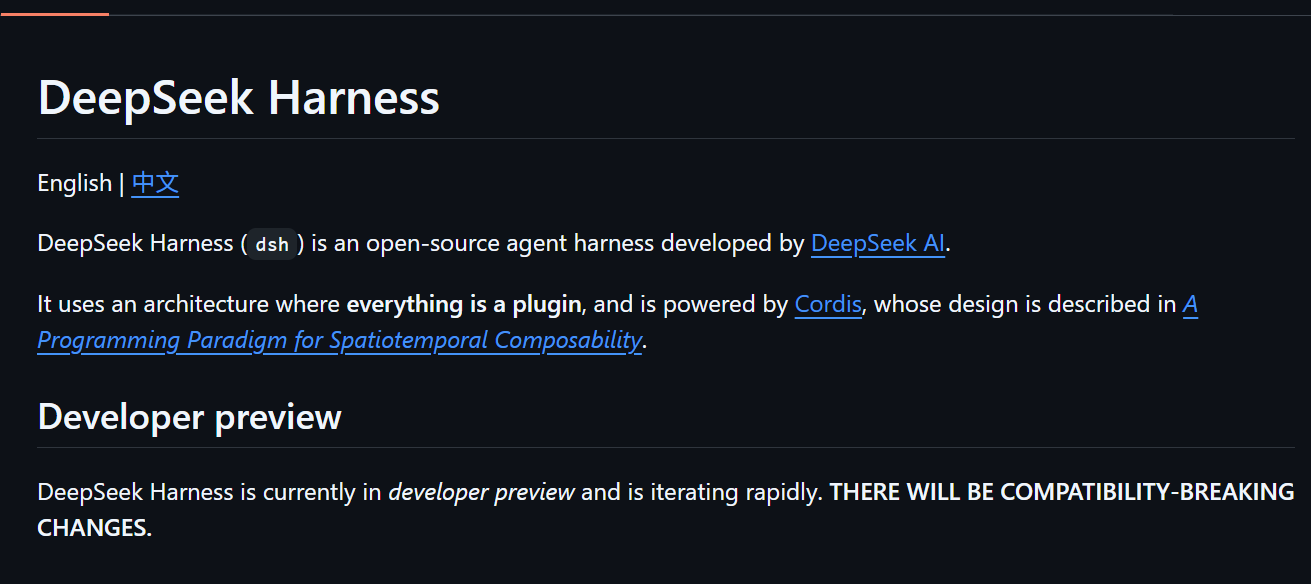
DeepSeek Harness (command name dsh) is an open-source agent harness developed by DeepSeek AI. It's designed to give developers full control over every aspect of AI agent behavior through a modular, plugin-based architecture.
Unlike traditional agent frameworks where core components are fixed, DeepSeek Harness makes every capability — models, tools, skills, sessions, sandboxes, storage, loops, scheduling, and even the UI — a swappable plugin. This means developers can select, replace, or extend any component via configuration without modifying the source code.
The framework is built on Cordis, a plugin kernel that manages mounting, unmounting, and dependencies between plugins. This architectural choice enables unprecedented flexibility and composability.
The Core Philosophy: Everything Is a Plugin
The phrase "everything is a plugin" isn't just marketing language — it's the architectural foundation of DeepSeek Harness. Let's break down what this means in practice:
What's Swappable?
Every part of the agent runtime can be replaced:
- Model adapters — Connect to DeepSeek, OpenAI, Anthropic, or any OpenAI-compatible endpoint
- Tool registries — Define what tools the model can access
- Session logs — Control how conversations are recorded and replayed
- Agent loops — Replace the entire orchestration logic
- Sandboxes — Choose different isolation environments
- File systems — Implement custom filesystem access policies
- UI components — Build entirely different interfaces
No Privileged Core
There's "no privileged core to patch." Extending the harness means mounting a plugin beside the others, and registrations unwind cleanly when their plugin unloads. This eliminates the orphaned state that plagues many extensible systems.
Plugin Composition
Plugins are distributed as bundles and declared in package.json under a dsh field. The framework supports:
-
dsh.profile— Lists a profile's bundles -
dsh.bundle— Points to a bundle's patch file
This structure allows developers to compose complex agent configurations from reusable components.
Four Runtime Modes
DeepSeek Harness ships with four distinct runtime modes, each loading a different default plugin set:
1. Standard Mode
The complete coding agent with the full toolset:
- File editing and shell access
- File and web search capabilities
- Planning and goal management
- Subagents and workflows
- Skills and custom tools
This is the daily-driver configuration, comparable to what Claude Code or Codex provide by default.
2. PTC (Programmatic Tool Calling) Mode
Everything Standard has, but with tools exposed through a Code Mode SDK. Instead of making discrete tool calls, the model writes one TypeScript program against generated bindings. In the registry, run_code is the only wire-level tool under this mode.
This approach is ideal for complex multi-step workflows where orchestrating multiple tool calls in sequence would otherwise require many round trips.
3. Minimal Mode
A deliberately stripped two-tool agent:
- Persistent bash shell
- File editor (str_replace_editor)
Nothing else. This is DeepSeek's published benchmark methodology — the exact agent framework used for V4-Pro-0813's vendor-run code-agent benchmarks. The repo's own BENCHMARK.md documents the eval path.
Minimal mode converts vendor benchmark tables from claims about a black box into claims about inspectable software.
4. Creator Mode
Built for developers who want to create custom agent presets:
- All Standard mode capabilities
- Runtime inspection tools
- In-memory plugin experiments
- Preset-authoring guidance
Creator mode lets you inspect the current runtime, test Cordis plugins in memory, and combine them into new modes — a sandbox for designing the next configuration of DeepSeek Harness.
Interestingly, the on-disk preset folder for Creator mode is named cordis after the plugin kernel, not creator.
Append-Only Session Log
One of DeepSeek Harness's most powerful features is its observability story. Every run is fully traceable through an append-only session log.
What Gets Logged?
Everything the model sees is recorded:
- System prompts
- Chain-of-thought reasoning
- Tool calls and their results
- Sub-agent scheduling
- Every context injection
Why Append-Only Matters
Because the log is append-only, nothing is ever silently rewritten. The record of what happened is preserved exactly as it occurred. This creates a reliable audit trail for debugging and analysis.
Operations on the Event Stream
Several core features operate on this single event stream:
- Resume — Pick up a session where it left off
- Fork — Branch a session into a new direction
- Search — Query through session history
- Replay — Re-execute a session to understand what happened
This approach is genuinely modern — the same direction other 2026 harnesses have converged on.
Installation and Usage
DeepSeek Harness offers multiple installation paths:
Quick Start with npx
The fastest way to try DeepSeek Harness:
npx @deepseek-ai/dsh webThis runs the published package with no clone and no build required.
From Source
For developers who want to read or modify the plugins:
git clone https://github.com/deepseek-ai/deepseek-harness.git cd deepseek-harness pnpm install pnpm build pnpm dsh webImportant: The default branch is master, not main. Raw-file fetches against a /main/ path will 404.
Version Status
The package.json version field reads 0.1.0-rc.5: a release-candidate suffix for a version that has not been finalized. The README warns explicitly:
"DeepSeek Harness is currently in developer preview and is iterating rapidly. THERE WILL BE COMPATIBILITY-BREAKING CHANGES."
Model Support
DeepSeek Harness is model-agnostic. The provider catalog covers:
- DeepSeek — Native integration
- OpenAI — GPT models
- Anthropic — Claude models
- AWS Bedrock — Amazon's managed service
- Microsoft Azure — Enterprise deployments
- Google Gemini — Enterprise Agent Platform
- Custom endpoints — Any OpenAI-compatible gateway
There's also a built-in MCP client and Agent Client Protocol support, plus the ability to read AGENTS.md and CLAUDE.md files.
Comparison with Competitors
Let's see how DeepSeek Harness stacks up against established players:
| Feature | DeepSeek Harness | Claude Code | OpenAI Codex |
|---|---|---|---|
| License | MIT | Commercial | Open source CLI |
| Extensibility | Exceptional | Strong | Strong |
| Model choice | Any provider | Primarily Claude | Primarily OpenAI |
| Primary interface | Local web UI, headless, SDK | Terminal, IDE, desktop | CLI, IDE, cloud |
| Maturity | Developer preview | Production ready | Production ready |
Key Differentiators
- Unmatched extensibility — Every component is replaceable
- Transparency — Benchmark methodology is inspectable
- Model agnostic — No vendor lock-in
- MIT license — True open source with no restrictions
Use Cases
DeepSeek Harness is ideal for:
Agent Framework Development
Build and test custom agent configurations without modifying core code.
Benchmarking
Use Minimal mode to evaluate model performance in controlled environments.
Plugin Ecosystem Building
Create reusable plugins that the community can share and compose.
Research and Experimentation
Fork sessions, replay interactions, and analyze agent behavior in detail.
Getting Started
Ready to try DeepSeek Harness? Here's how to begin:
- Quick evaluation — Run
npx @deepseek-ai/dsh web - Read the docs — Explore the architecture documentation
- Join the community — Participate in GitHub Discussions
- Build plugins — Add the
dsh-plugintopic to your repositories - Experiment — Use Creator mode to test new configurations
The Future of Agent Frameworks
DeepSeek Harness represents a significant shift in how we think about agent infrastructure. By making every component a plugin, it creates a composable, transparent, and truly open ecosystem.
The v0.1 developer preview is explicitly a starting point, not a finish line. DeepSeek is inviting global harness developers to co-build the DSH plugin ecosystem on open, reusable, composable infrastructure.
As the AI agent landscape continues to evolve, frameworks like DeepSeek Harness demonstrate that openness and modularity aren't just philosophical ideals — they're practical engineering decisions that unlock new possibilities.
Conclusion
DeepSeek Harness is more than just another agent framework. It's a architectural statement about what agent infrastructure should look like: open, composable, transparent, and model-agnostic.
With its "everything is a plugin" philosophy, four distinct runtime modes, and append-only session log, it provides developers with unprecedented control over AI agent behavior. While it's still in developer preview with breaking changes expected, the foundation is solid and the vision is compelling.
Whether you're building custom agent configurations, benchmarking models, or creating reusable plugins, DeepSeek Harness offers a unique platform that respects developer autonomy and promotes community innovation.
The MIT license ensures there are no restrictions on how you use it. The plugin architecture ensures you're never locked into any particular approach. And the append-only session log ensures you can always understand what your agents are doing.
For developers looking to build the next generation of AI agents, DeepSeek Harness deserves serious consideration.
Try DeepSeek Harness today with npx @deepseek-ai/dsh web or clone the repository from GitHub. Join the growing community of developers building the future of agent infrastructure.
Last updated: August 16, 2026
Frequently Asked Questions
What is DeepSeek Harness and what makes it unique?
DeepSeek Harness is an open-source agent framework where every component — models, tools, sessions, sandboxes, and even the UI — is a swappable plugin. Built on the Cordis plugin kernel, it allows developers to replace any capability via configuration without modifying source code. This "everything is a plugin" architecture is its key differentiator.
How does DeepSeek Harness compare to Claude Code?
DeepSeek Harness offers unmatched extensibility since every component is replaceable, while Claude Code is a more mature commercial product with established features. DeepSeek Harness is model-agnostic and MIT-licensed, whereas Claude Code primarily uses Claude models. Both support planning, subagents, and tool use.
What are the four run modes in DeepSeek Harness?
Standard mode provides the complete toolset for everyday agentic work. PTC mode lets the model write code to compose multiple tool calls. Minimal mode offers just bash and a file editor for benchmarking. Creator mode enables runtime inspection and plugin experimentation for building custom presets.
Is DeepSeek Harness production ready?
No, it's currently in developer preview (version 0.1.0-rc.5) with breaking changes expected. It's ideal for experimentation, benchmarking, and plugin development, but teams should pin versions and follow the repository before production use.
Can I use DeepSeek Harness with non-DeepSeek models?
Yes, DeepSeek Harness is model-agnostic. It supports OpenAI, Anthropic, AWS Bedrock, Azure, Google Gemini, and any OpenAI-compatible endpoint. You can register custom adapters on ctx.llm to add new model providers.