
 OpenAI - ChatGPT, Sora
 Google - Gemini, Nano Banana
 Anthropic - Claude
 xAI - Grok
 Deepseek
 Alibaba - Qwen
 ByteDance - Doubao
 All Models
 Enterprise Plans
 AI Application Development
 AI Translator API
 AI SEO/GEO Service
 GEO-Optimized PR Service
 Web Scraping Service
 OpenClaw
 Top AI Tools
 Top AI Robots
 Log in
DeepSeek V4 Pro Goes GA: The $0.435 Frontier Model That Costs 46x Less Than Claude
DeepSeek V4 Pro Goes GA: The $0.435 Frontier Model That Costs 46x Less Than Claude
- DeepSeek V4 Pro hit general availability on August 13, 2026 — ending a 4-month preview period
- 1.6T parameter MoE model with 49B active parameters, MIT license, open weights
- Priced at $0.435/$0.87 per million input/output tokens — roughly 46x cheaper than Claude Fable 5
- Self-reported benchmarks: 80.6% SWE-bench Verified, 87.9% Terminal-Bench, 93.5% LiveCodeBench
- Independent verification pending — all published scores are DeepSeek-reported
- Pricing increase announced for near future; peak/off-peak tiers start August 16
DeepSeek shipped the production version of its flagship model on August 13 without a blog post, without a press release, and without an announcement. The only evidence was a model version string on its API pricing page: DeepSeek-V4-Pro-0813. After four months in preview, V4 Pro was live.
The numbers that followed tell a story the company did not need to marketing-spread. At $0.435 per million input tokens and $0.87 per million output tokens, DeepSeek V4 Pro costs roughly 46 times less than Anthropic's Claude Fable 5 on blended workloads. On coding benchmarks, it lands within striking distance of models that cost thousands of percent more. On agent tasks, DeepSeek claims it now matches or exceeds the American frontier.
The catch: every performance claim is self-reported. No independent lab has verified the 0813 build. And DeepSeek has announced a pricing increase is coming.
What DeepSeek V4 Pro Actually Is
DeepSeek V4 Pro is a mixture-of-experts model with 1.6 trillion total parameters, activating 49 billion parameters per token during inference. The architecture uses two attention variants — Compressed Sparse Attention and Heavily Compressed Attention — that DeepSeek says reduce single-token inference compute to 27% and KV cache to 10% of what the previous V3.2 generation required at the million-token setting.
The model was pre-trained on more than 32 trillion tokens and supports a 1 million token context window with a maximum output of 384,000 tokens. It runs in three modes: non-thinking, high reasoning effort, and max effort — the last pushing what DeepSeek describes as "the boundary of model reasoning capability."
API access supports OpenAI ChatCompletions format, Anthropic Messages format, and DeepSeek's own Responses API, with tool calling and structured JSON output. The Pro endpoint carries a concurrency limit of 500.
Benchmarks: What DeepSeek Claims
DeepSeek published a comparison table showing V4 Pro 0813's performance against its own preview build. The improvements are substantial:
| Benchmark | V4 Pro Preview | V4 Pro 0813 | Change |
|---|---|---|---|
| Terminal-Bench 2.1 | 72.1% | 87.9% | +15.8 pts |
| CyberGym | 52.7% | 83.3% | +30.6 pts |
| DeepSWE | 12.8% | 62.7% | +49.9 pts |
| AutomationBench | 12.8% | 31.8% | +19.0 pts |
| DSBench-Hard | 31.1% | 67.2% | +36.1 pts |
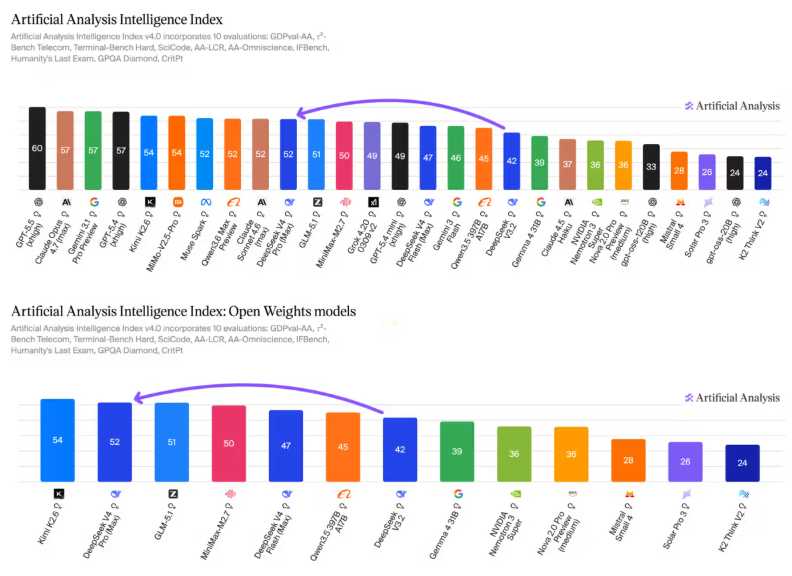
Additional self-reported scores include SWE-bench Verified at 80.6%, LiveCodeBench at 93.5%, GPQA Diamond at 90.1%, and a Codeforces rating of 3,206. On the BenchLM public leaderboard, V4 Pro 0813 ranks #49 of 217 models with a score of 61 out of 100.
DeepSeek also compared V4 Pro against Claude Fable 5 across nine agent benchmarks. Fable 5 led by an average of 5.3%, but DeepSeek won on two individual benchmarks. Excluding Humanity's Last Exam — where the gap was largest at 10.6 points — the average difference narrowed to approximately 2.8%.
The Price Story: 46x Cheaper Than Claude
The pricing is the most verifiable part of this launch, because it comes from DeepSeek's own API documentation rather than benchmark charts:
| Model | Input (cache miss) | Input (cache hit) | Output |
|---|---|---|---|
| DeepSeek V4 Pro | $0.435 | $0.003625 | $0.87 |
| DeepSeek V4 Flash | $0.14 | $0.0028 | $0.28 |
| Claude Fable 5 | $10.00 | $0.50 | $50.00 |
| GPT-5.5 | $5.00 | $0.625 | $30.00 |
| Gemini 3.1 Pro | $3.50 | — | $21.00 |
The cost differential is stark. A team burning 10 million output tokens per day would pay approximately $261 per month on V4 Pro. The same workload on Claude Fable 5 would cost roughly $15,000 per month. On cache-heavy workloads with stable system prompts — common in RAG applications over fixed codebases — the savings widen further with V4 Pro's $0.003625 cache-hit pricing.
Independent analysis from Artificial Analysis measured cost per benchmark task at approximately 3 cents for V4-Flash against $3.15 for Claude Fable 5 — a 105x difference. Hugging Face CEO Clément Delangue put the per-task spread at over $31 versus roughly $0.04.
What the 0813 Build Changes
The move from preview to general availability is not just a label change. The 0813 build adds several capabilities that were absent from the preview:
- Reasoning effort levels — low, high, and max modes for controlling inference depth
- Responses API support — DeepSeek's native API format with one-click Codex setup
- Anthropic API compatibility — drop-in replacement for Claude endpoints
- Expert Mode — available in the DeepSeek app for power users
- Conversation-prefix continuation — beta feature for non-thinking mode
- Fill-in-the-middle completion — beta feature for code completion workflows
The architectural improvements reportedly cut inference compute to 27% of V3.2 levels at the million-token setting, making long-context workloads economically viable in ways they were not before.
The Independent Verification Gap
Every performance claim attached to V4 Pro 0813 comes from a single source: DeepSeek. The company's own comparison table uses the preview build as its baseline, not competitor models. No independent lab has published verified benchmark results for the 0813 checkpoint.
This matters because the Hugging Face model card still describes the V4 series as "a preview version," and the 0813 weights have not been publicly released despite a repository existing on Hugging Face. DeepSeek's standing in the open-weight community was built on actually shipping weights — the absence of 0813 artifacts is notable.
The BenchLM leaderboard shows V4 Pro 0813 at #49 with a score of 61, but its evidence status is listed as "Estimated" rather than "Verified." The profile notes that 34 of 431 tracked benchmark slots have displayable evidence, with missing categories left blank.
Independent evaluation will likely follow. DeepSeek releases weights under the MIT license, and the model is accessible through both DeepSeek's API and OpenRouter. The data necessary for third-party verification is available — it simply has not been published yet.
Pricing Changes Coming August 16
DeepSeek's pricing page states that the company plans "a significant increase" in overall API pricing in the near future. Effective 16:00 UTC on August 16, 2026, V4 Pro moves to peak/off-peak tiers:
| Tier | Input (cache miss) | Input (cache hit) | Output |
|---|---|---|---|
| Off-peak | $0.66 | $0.022 | $1.98 |
| Peak (01:00–04:00, 06:00–10:00 UTC) | $1.32 | $0.044 | $3.96 |
The off-peak rate represents roughly 1.96x the current flat input price and 2.94x the current output price. Even at peak pricing, V4 Pro remains significantly cheaper than Claude Fable 5 ($10/$50) or GPT-5.5 ($5/$30). But the era of $0.435 input pricing is ending.
How V4 Pro Fits in the Multi-Model Landscape
For developers building cost-effective AI systems, V4 Pro occupies a specific niche: high coding capability at commodity pricing. It is not the most powerful model on every benchmark — Claude Opus 5 leads on SWE-bench Verified at 96%, and Qwen3.7-Max scores higher on HLE. But on cost-adjusted metrics, V4 Pro is difficult to match.
Multi-model platforms like AICC can route coding-heavy workloads to V4 Pro while directing reasoning-intensive tasks to models with stronger performance on HLE or GPQA. The combination of V4 Pro's coding strength and its sub-dollar output pricing makes it a strong candidate for high-volume coding agents, code review systems, and automated development workflows.
The key trade-off is reliability. V4 Pro's near-floor score on AA-Omniscience (0.83 versus Claude Opus 5's 37.07) indicates a weakness in knowing what it does not know — a critical factor for production systems where unflagged hallucination carries business risk.
Frequently Asked Questions
What is DeepSeek V4 Pro?
DeepSeek V4 Pro is a 1.6 trillion parameter mixture-of-experts model with 49 billion active parameters per token. It supports a 1 million token context window, 384K max output, and three reasoning modes (non-thinking, high, max). The model went general availability on August 13, 2026, after four months in preview. It is MIT-licensed with open weights on Hugging Face.
How much does DeepSeek V4 Pro cost?
Current pricing is $0.435 per million input tokens (cache miss), $0.003625 per million input tokens (cache hit), and $0.87 per million output tokens. Peak/off-peak pricing starts August 16 at roughly 2x current rates. Even at peak pricing, V4 Pro remains significantly cheaper than Claude or GPT alternatives.
How does DeepSeek V4 Pro compare to Claude Fable 5?
DeepSeek's self-reported benchmarks show Claude Fable 5 leading by an average of 5.3% across nine agent benchmarks. The models trade wins individually. The critical difference is cost: V4 Pro is approximately 46x cheaper on blended rates. Claude Opus 5, not Fable 5, leads on SWE-bench Verified at 96%.
Can I access DeepSeek V4 Pro through AICC?
Yes. AICC provides unified API access to DeepSeek V4 Pro alongside more than 300 models from Google, OpenAI, Anthropic, Alibaba, ByteDance, xAI, and other providers. AICC's intelligent routing can automatically direct coding workloads to V4 Pro while routing other tasks to cost-optimal alternatives.
Are the benchmarks independently verified?
As of August 14, 2026, no. All published performance claims for the 0813 build are DeepSeek-reported. The company's testing infrastructure has not been publicly released. Independent verification is expected as developers gain access to the model through API and OpenRouter, but no third-party results have been published yet.
Conclusion
DeepSeek V4 Pro 0813 represents the most aggressive price-to-performance positioning in the AI API market. At $0.435 per million input tokens, it undercuts every major competitor by double-digit multiples while claiming coding performance within a few percentage points of the frontier.
The open questions are real. All benchmarks are self-reported. The GA weights have not been released. Pricing is increasing on August 16. And the model's weakness on hallucination-awareness metrics means it is not a universal replacement for more expensive alternatives.
For developers building cost-sensitive coding agents, V4 Pro is likely the best value proposition available today. For organizations managing multiple AI workloads, platforms like AICC can route to V4 Pro where its cost-performance profile is optimal — while reserving stronger models for tasks where the 46x price premium buys meaningful capability gains.
The independent data will come. Until then, the pricing alone is enough to reshape how developers think about the cost of frontier AI.