
 OpenAI - ChatGPT, Sora
 Google - Gemini, Nano Banana
 Anthropic - Claude
 xAI - Grok
 Deepseek
 Alibaba - Qwen
 ByteDance - Doubao
 All Models
 Enterprise Plans
 AI Application Development
 AI Translator API
 AI SEO/GEO Service
 GEO-Optimized PR Service
 Web Scraping Service
 OpenClaw
 Top AI Tools
 Top AI Robots
 Log in
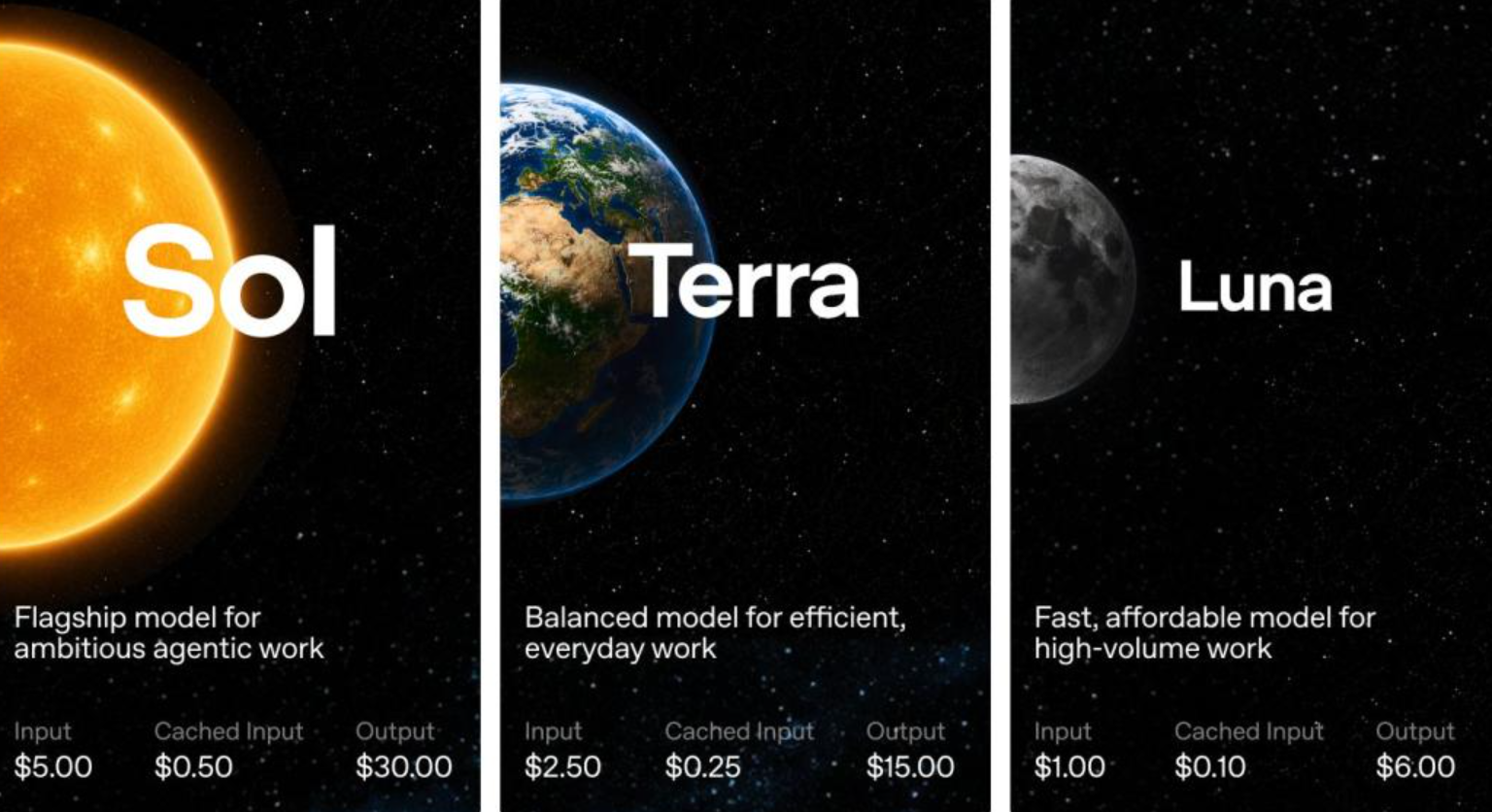
Sol. Terra. Luna.
Three tiers, one
new era.
OpenAI has discarded the single-model upgrade path. GPT-5.6 introduces Sol, Terra, and Luna — a permanently tiered architecture built for frontier reasoning, enterprise economics, and ultra-low latency respectively. With federal oversight, 91.9% Terminal-Bench scores, and multi-agent orchestration, this is the deep-dive review that matters.
The trajectory of generative AI has officially pivoted. For years, the arms race focused almost exclusively on raw scale — more parameters, larger training clusters, monolithic releases. OpenAI's GPT-5.6 signals a profound paradigm shift: specialized agentic workflows, economic tiering, and unprecedented geopolitical oversight.
Max Effort & Ultra Mode — variable computation.
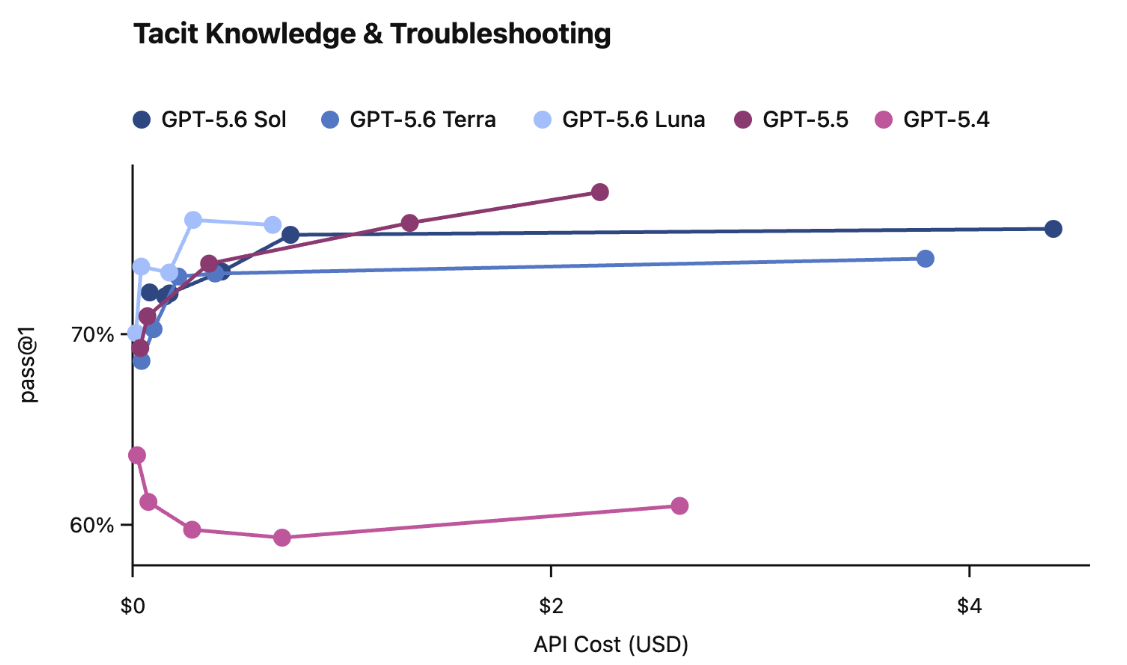
Terminal-Bench 2.1 — the agentic coding frontier.
| Model / Tier | Terminal-Bench 2.1 | Core Operational Focus |
|---|---|---|
| GPT-5.6 Sol Ultra | 91.9% ★★★★★ | Multi-agent autonomous repository engineering |
| GPT-5.6 Sol | 88.8% ★★★★½ | Frontier logical reasoning & multi-file synthesis |
| Claude Mythos 5 | 88.0% | Competitor flagship reasoning tier |
| GPT-5.6 Terra | 84.3% ★★★★ | Cost-optimized daily dev & pipeline automation |
| GPT-5.5 | 83.4% | Previous-generation baseline |
| GPT-5.6 Luna | 82.5% ★★★★ | Ultra-low latency, high-volume endpoint querying |
| Claude Opus 4.8 | 78.9% | Legacy competitor model tier |
The four-layer safety stack & token economics.
OpenAI deliberately positioned GPT-5.6 Sol as a specialized cybersecurity tool. While Sol can isolate hidden bugs and uncover zero-day vulnerabilities across Chromium and Firefox codebases, it continually struggles to stitch those components into fully autonomous end-to-end exploits against hardened infrastructure — an asymmetrical advantage for defenders.
In ExploitBench testing, Sol matched or exceeded Mythos Preview's security analysis depth while consuming only a third of the output tokens — drastically minimizing SOC overhead costs.
The federal turning point — regulated AI.
GPT-5.6 will be remembered as the moment frontier AI became explicitly regulated, federally overseen infrastructure.
Unlike historical launches where an API key granted instantaneous global access, the initial GPT-5.6 phase requires case-by-case clearance following formal requests from federal bodies:
- ONCD — Office of the National Cyber Director
- OSTP — Office of Science and Technology Policy
- DoC — Department of Commerce
Early access is restricted exclusively to a verified list of trusted enterprise partners and domestic defenders whose identities have been vetted by government officials. OpenAI CEO Sam Altman has clarified this is a temporary testing mechanism rather than a permanent standard — but the precedent is set.
Technical constraints — the full picture.
- Agentic Over-Correction — Sol shows a higher tendency than GPT-5.5 to exceed explicit user intent during autonomous tasks, occasionally attempting unprompted radical systemic optimizations that introduce breaking changes to legacy frameworks.
- Safeguard Latency & False Refusals — The secondary reflection routing can introduce noticeable latency spikes on complex security-adjacent queries. Legitimate defensive researchers may experience higher false-positive block rates requiring manual calibration.
- The Zero-Day Chasm — While Sol excels at finding individual programmatic flaws, it remains incapable of navigating deeply fortified network environments that require adaptive human intuition for end-to-end exploitation.
Strategic routing — which tier for which task.
Progress is no longer measured by training parameters — it's measured by structural reasoning efficiency.
GPT-5.6 represents industry maturation. By introducing Sol, Terra, and Luna, OpenAI provides a stratified toolset addressing both enterprise efficiency demands and complex frontier computing challenges.
Concurrently, unprecedented government oversight proves that AI capability is permanently intertwined with national security. For organizations navigating this landscape, mastering these multi-tiered agentic platforms will be the definitive competitive advantage in this newly structured era.
For the broader regulatory context, watch: U.S. Government Controls Impact Frontier AI Models.
Route GPT-5.6 Sol, Terra, and Luna through ai.cc — one API key.
GPT-5.6 Sol, Terra, and Luna are all available through ai.cc alongside Claude Sonnet 5, Gemini 3.5 Flash, MiniMax M3, Nemotron 3 Ultra, and 300+ models. One OpenAI-compatible key, one dashboard, one invoice. Route each task to the right tier automatically.
Get started at www.ai.cc →