
 OpenAI - ChatGPT, Sora
 Google - Gemini, Nano Banana
 Anthropic - Claude
 xAI - Grok
 Deepseek
 Alibaba - Qwen
 ByteDance - Doubao
 All Models
 Enterprise Plans
 AI Application Development
 AI Translator API
 AI SEO/GEO Service
 GEO-Optimized PR Service
 Web Scraping Service
 OpenClaw
 Top AI Tools
 Top AI Robots
 Log in
GPT-5.6: OpenAI's Revolutionary Model Family – Sol, Terra, and Luna Explained (2026 Update)
GPT‑5.6
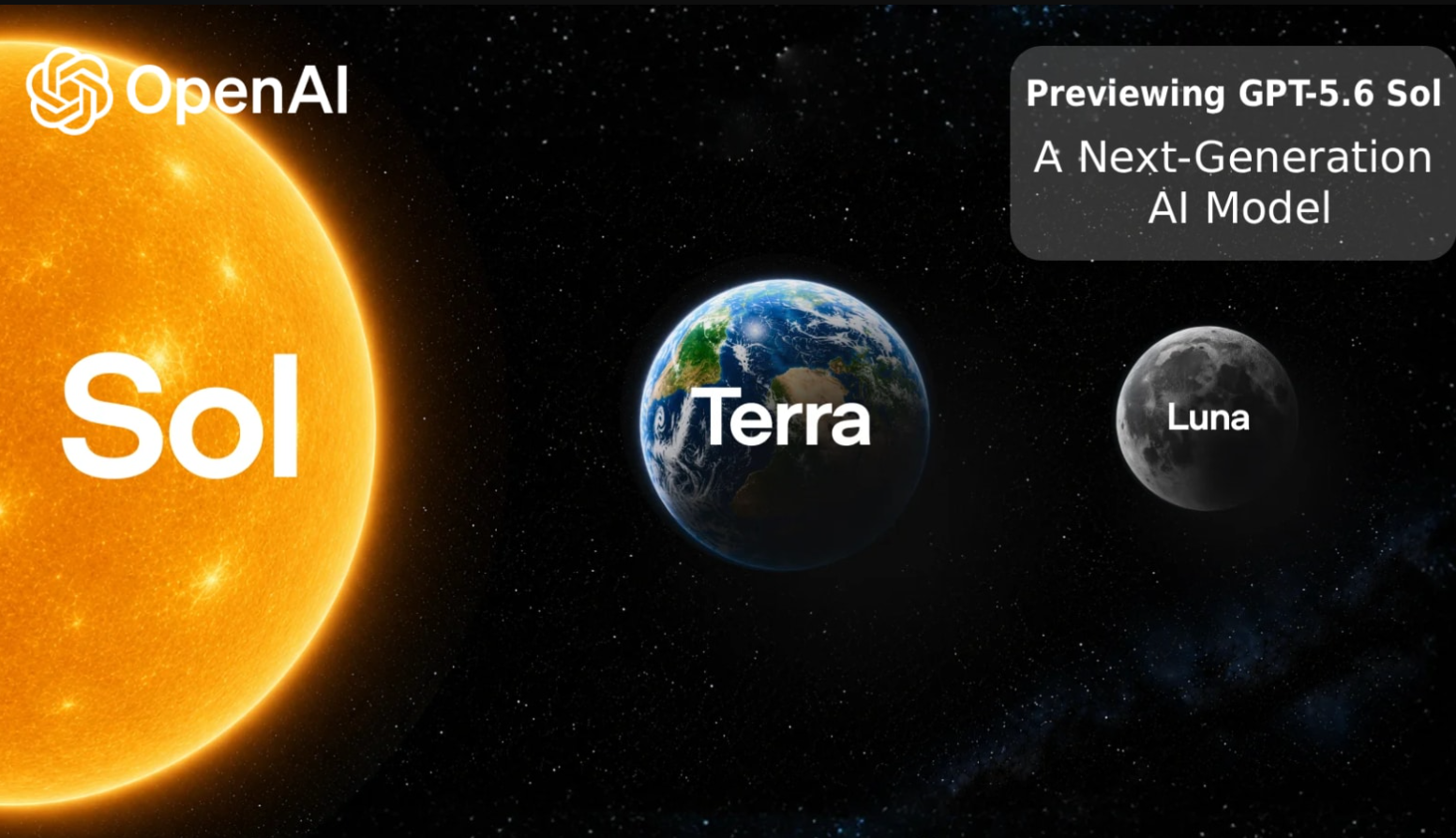
In the rapidly evolving world of artificial intelligence, OpenAI continues to push boundaries. On June 26, 2026, the company previewed GPT-5.6, not as a single model but as a sophisticated family: GPT-5.6 Sol (flagship), GPT-5.6 Terra (balanced), and GPT-5.6 Luna (fast and affordable). This marks a significant shift in OpenAI's approach, introducing a new naming convention where the number denotes the generation and Sol/Terra/Luna represent durable capability tiers.
Whether you're a developer building the next big app, a researcher tackling complex scientific problems, a business leader optimizing workflows, or an everyday user seeking smarter assistance, GPT-5.6 promises to deliver frontier intelligence that scales with your needs. This in-depth guide covers its architecture, groundbreaking capabilities, benchmarks, real-world applications, safety measures, pricing, and practical tips.
The Evolution: From GPT-5 to GPT-5.6 — Why This Matters
OpenAI's GPT series has consistently raised the bar. GPT-5 (released August 2025) introduced a unified system with adaptive reasoning, making expert-level intelligence accessible to millions. GPT-5.6 builds on this foundation with a tiered family designed for efficiency, specialization, and broader accessibility.
The new naming scheme is more than cosmetic. "5.6" signals the generation, while Sol (Sun — brightest and most powerful), Terra (Earth — balanced and practical), and Luna (Moon — fast and efficient) provide clear, enduring tiers that can evolve independently. This allows OpenAI to optimize for different use cases without forcing users into a one-size-fits-all model.
- Max Reasoning Effort (Sol-only): allocates more compute time for deeper single-model analysis on tough problems.
- Ultra Mode (Sol-only): leverages multiple specialized sub-agents working in parallel for complex, long-horizon tasks.
- Efficiency gains: enhanced token efficiency, better intent understanding, programmatic tool calling, and improved prompt caching.
These features make GPT-5.6 particularly strong in agentic workflows, where the model doesn't just respond but plans, iterates, uses tools, and verifies results autonomously.
Deep Dive Into the GPT-5.6 Family
Sol
The flagship for the most demanding tasks. OpenAI's strongest model yet, excelling in complex coding, cybersecurity, quantitative biology, and multi-step reasoning. Only Sol unlocks Max Effort and Ultra Mode. Ideal for frontier research, advanced software development, and high-stakes decision-making.
Terra
The balanced workhorse. Delivers performance competitive with GPT-5.5 at roughly half the cost. Perfect as a default for enterprise applications, document processing, customer support, and everyday developer workflows.
Luna
The speed demon for high-volume, cost-sensitive tasks. Strong capabilities for routine work like classification, summarization, chatbots, and interactive apps where latency matters more than peak intelligence.
This tiered approach gives users and developers unprecedented flexibility. You can route simple queries to Luna for speed and cost savings, escalate complex ones to Terra or Sol, and even use the gpt-5.6 alias, which defaults to Sol.
Performance Benchmarks: Setting New Standards
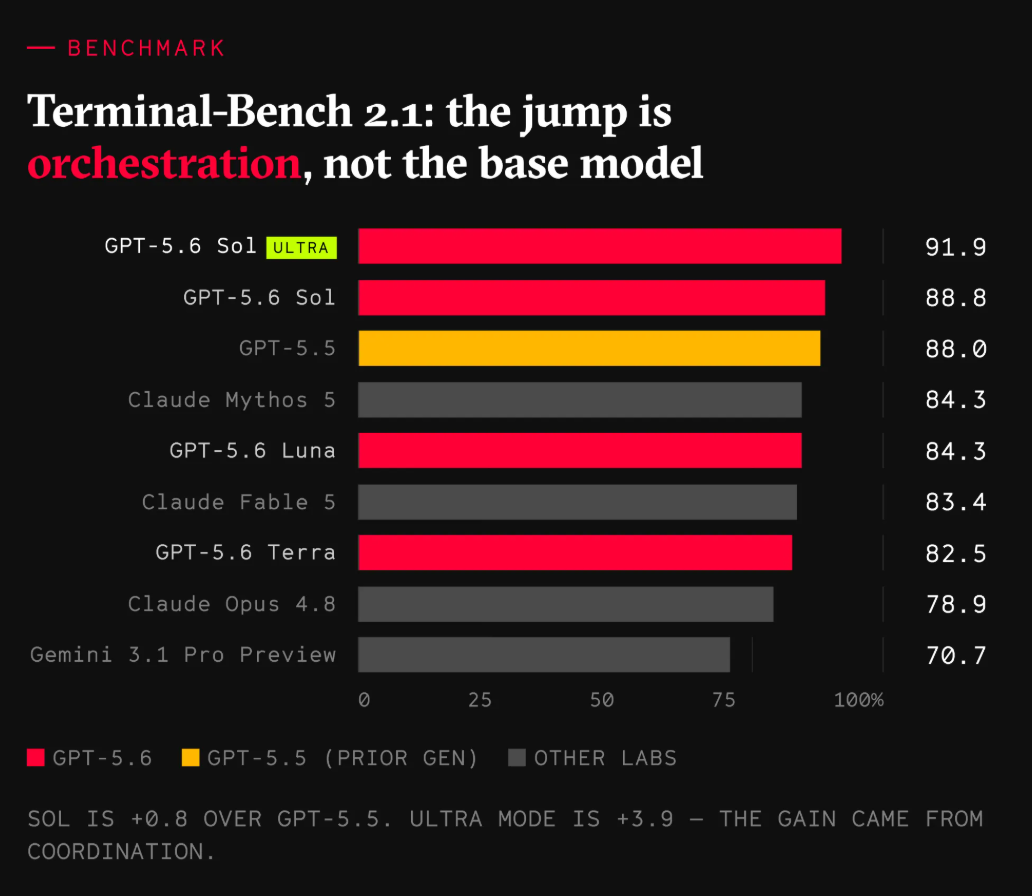
GPT-5.6 shines in agentic and specialized benchmarks:
This is a new state-of-the-art, outperforming previous leaders like Claude Mythos 5. In GeneBench v1 (genomics and quantitative biology), Sol posts stronger results than GPT-5.5 with fewer tokens. On ExploitBench / ExploitGym (cybersecurity, vulnerability research), it's competitive with top restricted models while using significantly fewer tokens — with meaningful improvements in long-horizon security tasks, staying below "critical" thresholds.
Other gains include better frontend design judgment, multimodal understanding (text + images), and overall token efficiency. Independent evaluations note high biology knowledge and improved agentic capabilities, though some highlight the need for careful oversight in high-risk domains. Compared to competitors, GPT-5.6 Sol positions OpenAI strongly in coding and cybersecurity, while the family offers better price-performance across the board.
Real-World Applications and Use Cases
Software Development & Coding
Sol's agentic prowess allows it to handle end-to-end tasks like building full SaaS dashboards, reviewing large PRs, refactoring codebases, or generating production-ready applications from high-level descriptions. Developers report fewer hallucinations and better adherence to project constraints.
Scientific Research & Biology
Quantitative biology, genomics analysis, and hypothesis generation benefit from deeper reasoning and tool integration. Researchers can use it for long-horizon simulations or data interpretation.
Cybersecurity
Enhanced vulnerability discovery and defensive testing, with robust safeguards preventing misuse. Useful for red-teaming and security research (within limits).
Business & Productivity
Terra or Luna for summarizing reports, generating presentations, customer service automation, or data analysis. Combine with tools for agentic workflows like trip planning or financial categorization.
Creative & Educational Uses
Build interactive games, websites, learning tools, or personalized content. Multimodal support helps with image analysis and generation prompts.
Enterprise Integration
Via OpenAI API, Codex, or ChatGPT. Programmatic tool calling and multi-agent orchestration (beta) enable sophisticated automations.
Safety, Ethics, and Responsible AI
OpenAI emphasizes its most robust safeguards yet, including layered protections against high-risk cyber activity and repeated misuse. The models underwent extensive red-teaming and automated testing. Under the Preparedness Framework, they rate "High" in cybersecurity and bio risks but below critical thresholds for self-improvement.
Access started as a limited preview for trusted partners (coordinated with the U.S. government), with broader rollout planned. This cautious approach balances innovation with responsibility. Users should always verify outputs for critical applications.
Pricing and Availability
| Tier | Input | Output |
|---|---|---|
| Sol | $5 / 1M | $30 / 1M |
| Terra | $2.50 / 1M | $15 / 1M |
| Luna | $1 / 1M | $6 / 1M |
Sol matches previous flagship pricing, while Terra and Luna offer significant savings. Prompt caching improvements further reduce costs for repeated contexts. Wider availability in ChatGPT, Codex, and API is rolling out, with Sol on Cerebras hardware promising up to 750 tokens/second inference for select users.
How to Get Started and Pro Tips
Access
Check ChatGPT (paid tiers for full Sol access) or the OpenAI API. Use the model picker or aliases.
Prompting Best Practices
Be specific with goals, constraints, and success criteria. Use shorter prompts for efficiency. Specify reasoning effort (e.g., "use max reasoning"). For agentic tasks, provide plans and verification steps.
Examples
A few starting prompts across disciplines:
Coding: "Build a full-stack SaaS dashboard with auth and analytics using Next.js. Plan first, then implement." Analysis: "Review this dataset for trends. Use max reasoning and visualize key insights." Creative: "Design an interactive browser game based on [description]."Experiment with tiers to optimize cost vs. capability. Monitor OpenAI's docs for updates on multi-agent features and integrations.
The Future of AI With GPT-5.6
GPT-5.6 represents a maturation of large language models — moving from monolithic powerhouses to intelligent, efficient families tailored to real needs. It brings us closer to reliable AI agents while addressing practical concerns like cost, speed, and safety.
As broader access expands, expect transformative impacts across industries. For AI enthusiasts and professionals, now is the time to master these tools. The intelligence is here; the question is how ambitiously you'll deploy it.