
 OpenAI - ChatGPT, Sora
 Google - Gemini, Nano Banana
 Anthropic - Claude
 xAI - Grok
 Deepseek
 Alibaba - Qwen
 ByteDance - Doubao
 All Models
 Enterprise Plans
 AI Application Development
 AI Translator API
 AI SEO/GEO Service
 GEO-Optimized PR Service
 Web Scraping Service
 OpenClaw
 Top AI Tools
 Top AI Robots
 Log in
Grok 4.5: xAI's (SpaceXAI) Game-Changing Leap in Coding, Agentic AI, and Cost-Efficient Frontier Intelligence
GROK 4.5
In the rapidly evolving world of artificial intelligence, few releases have generated as much anticipation and immediate impact as Grok 4.5 from SpaceXAI (formerly xAI). Launched on July 8, 2026, this model isn't just another incremental upgrade — it's a purpose-built powerhouse optimized for real-world engineering, coding, agentic workflows, and knowledge work. Positioned as an "Opus-class" model but delivered at significantly faster speeds, higher token efficiency, and a fraction of the cost of competitors like Claude Opus 4.8 or GPT-5.5, Grok 4.5 is redefining what's possible for developers, businesses, and power users.
Whether you're a software engineer debugging complex repositories, a data analyst automating multi-tool workflows, or an enterprise team seeking frontier-level performance without breaking the bank, Grok 4.5 delivers tangible advantages. This in-depth review covers its architecture, benchmarks, real-world capabilities, pricing, comparisons, use cases, limitations, and future outlook — backed by independent evaluations from Artificial Analysis and official announcements.
The Road to Grok 4.5: From 4.3 to a 1.5T Parameter Beast
SpaceXAI's journey with the Grok series has been marked by rapid iteration and a focus on maximum truth-seeking and utility. Grok 4.5 builds on the V9 foundation model — a massive 1.5 trillion parameter architecture, roughly three times larger than its predecessor's V8-small base. Trained on vast datasets spanning coding, science, engineering, and mathematics using tens of thousands of NVIDIA GB300 GPUs at the Memphis Colossus cluster, it received supplemental training with data from Cursor (a coding tool acquired by SpaceX).
This wasn't a general intelligence model retrofitted for tasks; it was engineered from the ground up for coding and agentic performance. Private beta testing at SpaceX and Tesla provided real engineering feedback from rocket scientists, autonomy experts, and production teams — environments where hallucinations or inefficiency could be costly. The result? A model that prioritizes practical usefulness over benchmark chasing.
- Input modalities: Text + Images (Vision)
- Output: Text (with strong tool-calling and function calling)
- Reasoning: Configurable (low / medium / high effort; high default)
- Built-in tools: Function calling, web search, X search, code execution
- API name: grok-4.5
This architecture shift enables superior handling of long-running agentic tasks, multi-repository codebases, and complex knowledge work with minimal human intervention.
Benchmarks: Frontier Performance With Efficiency Wins
Grok 4.5 doesn't claim to be the undisputed king of every leaderboard, but it punches well above its weight — especially when factoring in cost and speed. Independent evaluations from Artificial Analysis place it #4 overall on the Intelligence Index (score 54), behind only Claude Fable 5, GPT-5.5, and Claude Opus 4.8, with a massive 16-point jump from Grok 4.3.
AA-Briefcase (Agentic Knowledge Work): strong Elo, Pareto frontier on cost/time.
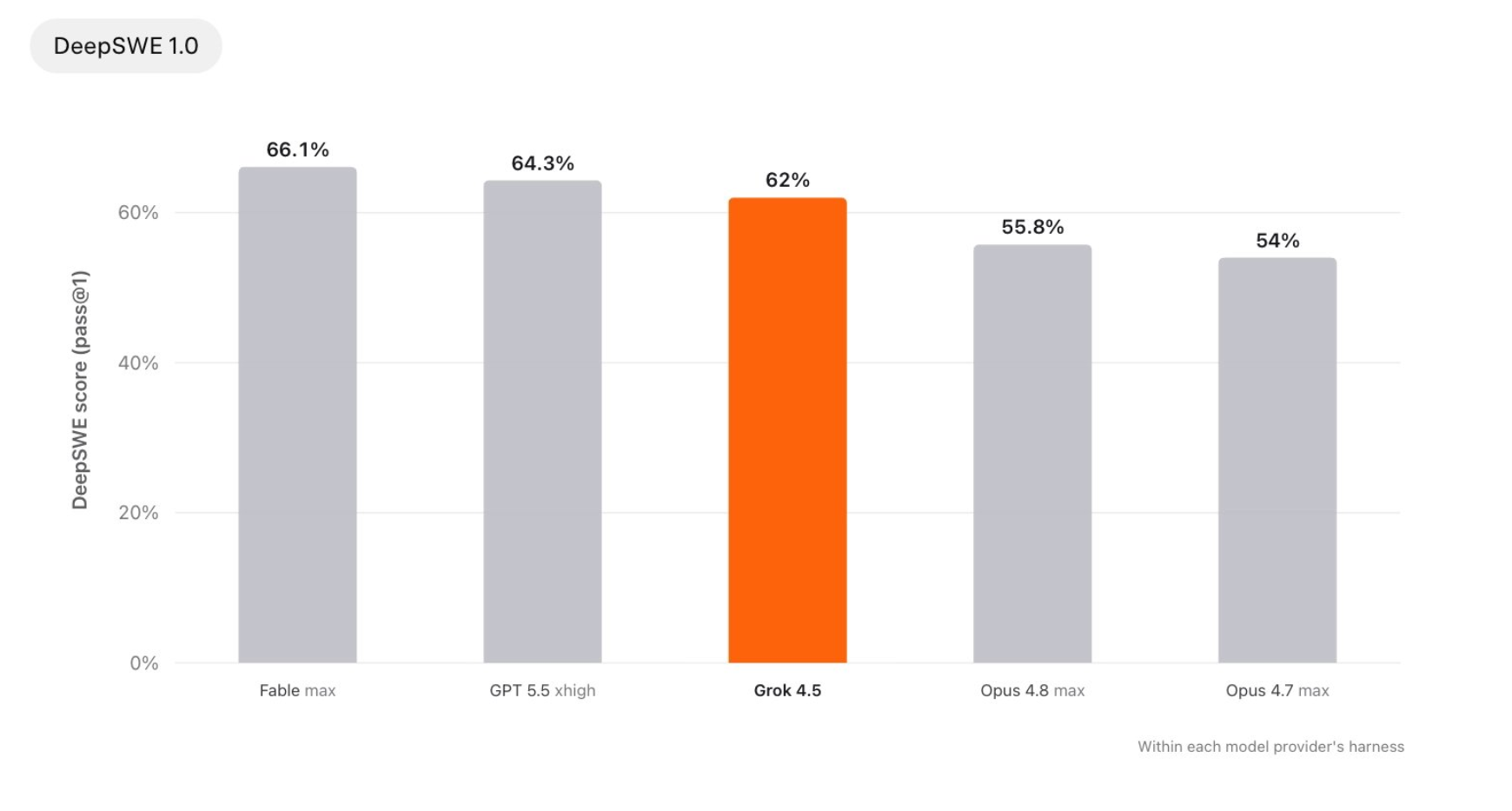
What truly sets Grok 4.5 apart is token efficiency. It resolves SWE-Bench Pro tasks with ~15,954 output tokens on average — 4.2x fewer than Claude Opus 4.8. On broader indexes, it uses far fewer tokens per task while delivering comparable or superior results in agentic scenarios. This efficiency translates directly to real-world value: faster iterations, lower costs, and reduced "noise" in long agent chains.
Pricing: Democratizing Frontier AI
In an era where top models command premium prices, Grok 4.5 stands out with aggressive, value-driven pricing:
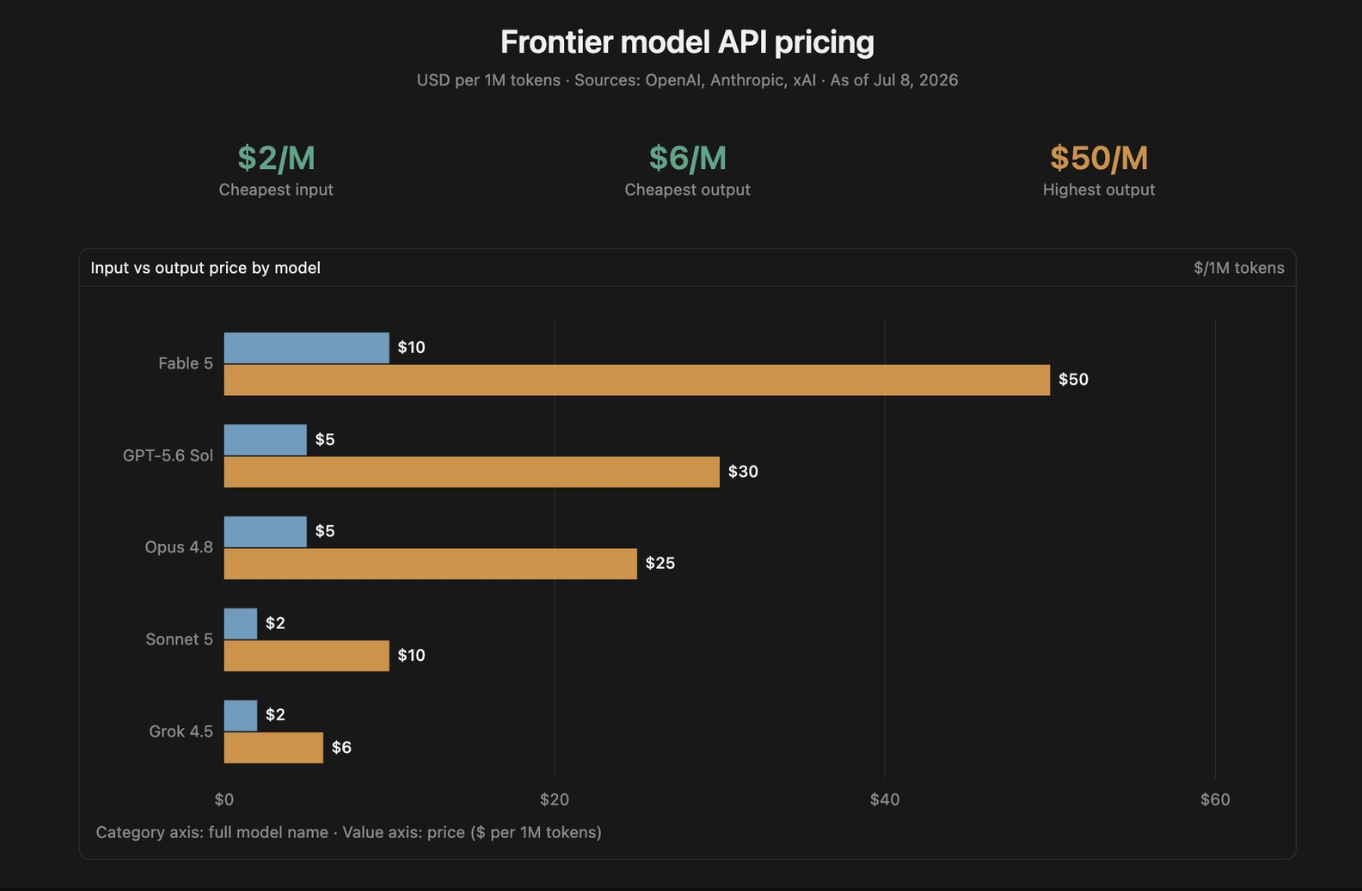
Compare this to Claude Opus 4.8 (~$5/$25) or GPT-5.5 equivalents (higher output costs). Per-task costs are dramatically lower — e.g., $0.31 on Intelligence Index tasks and ~$2.49 on Coding Agent tasks — making it 5x or more economical for high-volume use. This pricing, combined with speed and efficiency, puts frontier-adjacent intelligence within reach for startups, agencies, and individual developers.
Real-World Capabilities: Beyond Benchmarks
Coding & Software Engineering
Excels in multi-step, repository-level tasks. Deeply integrated with Cursor and Grok Build, handling full application generation, PR stacks, and debugging across languages (including Rust, C/C++), plus long-running agent loops — building complex Excel workbooks and native Word/PowerPoint output.
Agentic Workflows
Tops benchmarks in tool use, parallel calling, and SaaS automation (Gmail, Sheets, Slack, etc.). Configurable reasoning allows trading depth for speed. Leads in finance-heavy tasks and maintains guardrails better in some scenarios.
Knowledge Work & Productivity
Strong on GPQA, professional benchmarks (law, education, healthcare), and AA-Briefcase. Vision support aids multimodal tasks like analyzing diagrams or UI mockups.
Speed & User Experience
At 80+ TPS with concise outputs, it keeps users in flow state — crucial for creative and iterative work. "Capable enough and very fast" unlocks massive productivity gains.
Availability: public via grok.com, X app, API, Grok Build, Cursor, and partners like OpenRouter. EU rollout expected soon.
Comparison: Grok 4.5 vs. Leading Competitors
| Aspect | Grok 4.5 | Claude Opus 4.8 | GPT-5.5 |
|---|---|---|---|
| Intelligence Index | 54 (#4) | 56 | 55 |
| Coding Agent Index | ~76 (efficient) | Competitive | On par |
| Context | 500K (→1M) | 1M | Varies |
| Price (In/Out) | $2/$6 | $5/$25 | $5/$30+ |
| Speed (TPS) | 80–86 | Slower | Slower |
| Token Efficiency | Excellent (4x fewer) | Higher usage | Higher usage |
| Agentic Strength | #1 in several | Strong | Strong |
Grok 4.5 wins on value, speed, and specific agentic niches; rivals may edge out in raw creativity or certain presentations.
Use Cases: Who Benefits Most?
Developers & Teams
Autonomous coding agents, full-stack app building, codebase refactoring.
Enterprises
Cost-effective automation of office workflows (Excel, Word, PPT plugins), compliance-heavy tasks.
Researchers / Analysts
Scientific reasoning, data synthesis over large contexts, multimodal analysis.
Startups
High-volume experimentation without prohibitive costs.
Content & Knowledge Workers
Fast research, structured outputs, agentic pipelines.
Limitations and Honest Assessment
- Context starts at 500K (upgrade incoming)
- No native video input (text + images only)
- Presentation quality can lag behind some peers in visual-heavy deliverables
- Hallucination rates improved but not eliminated — always verify critical outputs
- Newer model; ecosystem integrations maturing rapidly
It's not perfect for every task, but its focus on efficiency and utility makes it a standout choice for practical applications.
The Bigger Picture: SpaceXAI's Vision and Future
Grok 4.5 reflects SpaceXAI's ethos: accelerate scientific discovery and human progress through maximally truthful, useful AI. With daily refinements, a 2T model on the horizon, and integration across SpaceX/Tesla ecosystems, the pace is blistering. Elon Musk has emphasized real-world engineering validation over hype. This release accelerates the industry toward faster, more affordable, agentic AI — democratizing tools once reserved for big tech budgets.
Conclusion: Is Grok 4.5 Worth It?
Absolutely — for most practical, high-volume, or cost-sensitive use cases, yes. It delivers near-frontier intelligence with unmatched efficiency, making advanced AI more accessible and enjoyable.
Start Building at GROK.X.AI