
 OpenAI - ChatGPT, Sora
 Google - Gemini, Nano Banana
 Anthropic - Claude
 xAI - Grok
 Deepseek
 Alibaba - Qwen
 ByteDance - Doubao
 All Models
 Enterprise Plans
 AI Application Development
 AI Translator API
 AI SEO/GEO Service
 GEO-Optimized PR Service
 Web Scraping Service
 OpenClaw
 Top AI Tools
 Top AI Robots
 Log in
Grok 4.6: SpaceXAI's New Frontier Model for Coding and Agents
Grok 4.6: SpaceXAI's New Frontier Model for Coding and Agents
SpaceXAI has just released Grok 4.6, the latest addition to its frontier AI model family. Launched on August 12, 2026, just 35 days after Grok 4.5, this new version focuses on long-running agents, coding, and knowledge work. With a 500,000-token context window and pricing at $2 per million input tokens and $6 per million output tokens, Grok 4.6 delivers performance comparable to OpenAI's GPT-5.6 Sol at a fraction of the cost.
In this article, we'll explore what makes Grok 4.6 stand out, its benchmark results, pricing details, and how it compares to other leading AI models.
What Is Grok 4.6?
Grok 4.6 is SpaceXAI's frontier model designed for coding, agentic tasks, and knowledge work. It builds on Grok 4.5 with a particular focus on long-running agents and more ambitious interactive and visual work. The model stays with complex tasks across many steps, whether researching a topic, analyzing information, working across a codebase, or turning an idea into a polished application.
Unlike some AI models that excel at single-turn tasks, Grok 4.6 is built for sustained, multi-step workflows. This makes it particularly valuable for developers and knowledge workers who need AI that can maintain context and progress over extended sessions.
Key Features and Improvements
Grok 4.6 introduces several notable improvements over its predecessor:
Enhanced Agent Capabilities
The model underwent a longer supplemental training run with curated model-generated data for reasoning and advanced technical concepts. This produced a stronger foundation for the supervised fine-tuning (SFT) and reinforcement learning (RL) stages that followed.
Grok 4.6 is trained on a wide range of agentic RL tasks, including knowledge work, general coding, and domain-specific environments for kernel optimization, web development, computer-aided design, and more.
New Reasoning Effort Level
A significant addition is the new xhigh reasoning effort level. While Grok 4.5 silently downgraded xhigh requests to high, Grok 4.6 actually honors this setting. This gives developers more control over the model's reasoning depth for different task complexities.
Stronger First Passes
The model produces stronger first passes on visual and interactive projects than Grok 4.5. Given a concrete product idea, it can establish structure and visual language for an application in one pass, making it especially useful for rapid prototyping.
Benchmark Performance
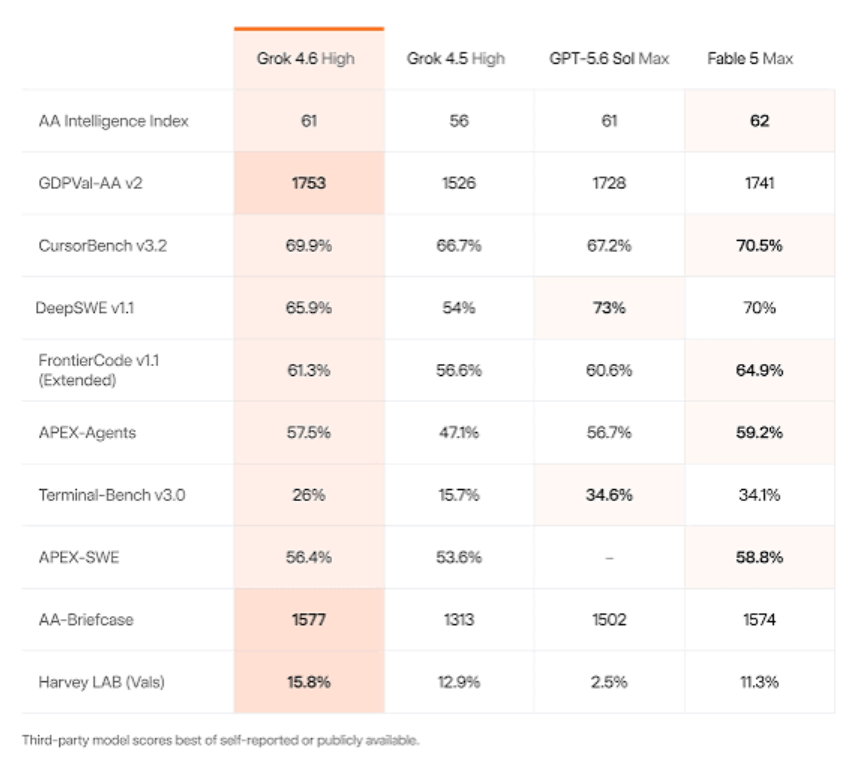
Grok 4.6 achieves frontier intelligence across several agentic coding and knowledge work benchmarks. On the Artificial Analysis Intelligence Index, it scores 61, matching GPT-5.6 Sol at its maximum reasoning level and trailing Claude Fable 5 by just one point.
Key Benchmark Results
- Artificial Analysis Intelligence Index: 61 (tied with GPT-5.6 Sol)
- GDPval-AA v2: 1753 Elo (behind only Claude Opus 5)
- Terminal-Bench v2.1: 88.39%
- SWE-bench (Vals): 95.60% (up 9 points from Grok 4.5)
- CursorBench v3.2: 69.9%
Turn Efficiency
One of Grok 4.6's most impressive features is its turn efficiency. Artificial Analysis measured that it completes tasks in approximately 53 turns and 0.5B input tokens on average, compared to Claude Opus 5's ~103 turns and 2.0B tokens. This efficiency translates into significant cost savings for long-horizon agentic work.
Areas for Improvement
Despite its strengths, Grok 4.6 shows some regression in specific areas:
- Agentic coding scores down to 54.2 from Grok 4.5's 56.5 on LiveBench
- SkillsBench performance down to 55.77 from 66.03
- Time to first token increased from 8.7 seconds to 31.2 seconds
Pricing Details
Grok 4.6 maintains the same headline pricing as its predecessor (see xAI pricing):
| Tokens | Price per 1M | Notes |
|---|---|---|
| Input | $2.00 | Standard rate |
| Cached input | $0.50 | Up from $0.30 in Grok 4.5 |
| Output | $6.00 | Standard rate |
| Prompts ≥200K tokens | $4.00 / $12.00 | Doubles rate for entire request |
The cached-input price has increased by 67%, which particularly affects agent loops where each turn re-sends the accumulated conversation. For long agentic sessions, this is the line item that will impact costs most significantly.
When compared to competitors, Grok 4.6 offers exceptional value:
- Claude Opus 5: $5/$25 per 1M tokens (2.5x more expensive for input, 4x for output)
- GPT-5.6 Sol: $5/$30 per 1M tokens (2.5x more expensive for input, 5x for output)
Availability and Access
Grok 4.6 is available through multiple channels:
- xAI API: As
grok-4.6 - Cursor: Available on all plans
- Grok Build: As the default model
- Partners: OpenRouter, Vercel, and Cloudflare
During the first week, both Cursor and Grok Build are offering 2x included usage to encourage developers to try the new model.
How Grok 4.6 Compares to Competitors
The AI model landscape is more competitive than ever, and Grok 4.6 positions itself strategically in this crowded field.
vs. GPT-5.6 Sol
Grok 4.6 matches GPT-5.6 Sol on the Artificial Analysis Intelligence Index but at less than half the output token price. This makes it an attractive alternative for cost-conscious developers who need frontier-level performance.
vs. Claude Opus 5
While Claude Opus 5 scores slightly higher (63 vs. 61), Grok 4.6 is significantly more efficient in terms of turns and tokens required to complete tasks. For long-horizon work, this efficiency can translate into substantial cost savings.
vs. Meta's Muse Spark 1.2
Meta's Muse Spark 1.2 offers roughly half the cost per task with twice the context window (1M vs. 500K tokens). However, the two models are statistically tied on several benchmarks, making the choice dependent on specific use cases.
Use Cases and Applications
Grok 4.6 excels in several key areas:
Software Development
The model is particularly strong at turning broad product ideas into working first versions. It can research unfamiliar domains, structure applications, implement core interactions, and refine results through multiple feedback rounds.
Knowledge Work
For tasks involving research, analysis, and document creation, Grok 4.6's ability to maintain context over long sessions makes it valuable for producing comprehensive outputs.
Interactive and Visual Projects
The model produces stronger first passes on visual and interactive projects, establishing structure and visual language in a single pass. This is particularly useful for rapid prototyping and design iterations.
Getting Started with Grok 4.6
For developers looking to try Grok 4.6, here are some steps:
- API Access: Use the model ID
grok-4.6through the xAI API - Cursor Integration: Available on all Cursor plans
- Grok Build: Try it directly in Grok Build's interface
- Partner Platforms: Access through OpenRouter, Vercel, or Cloudflare
Remember to set a prompt_cache_key (or use the x-grok-conv-id header on Chat Completions) to ensure reliable cache hits and avoid full input pricing.
The Future of AI Models
Grok 4.6 represents a significant step forward in making frontier AI performance more accessible and cost-effective. As the AI industry continues to evolve rapidly, models like Grok 4.6 demonstrate that high performance doesn't necessarily come with prohibitive price tags.
The focus on agent capabilities and sustained multi-step workflows reflects the industry's shift toward AI systems that can handle complex, real-world tasks rather than just answering questions. This trend is likely to continue as AI models become increasingly integrated into professional workflows.
Conclusion
SpaceXAI's Grok 4.6 delivers frontier-level intelligence at a competitive price point, matching GPT-5.6 Sol's performance while maintaining the same $2/$6 pricing as its predecessor. Its strengths in agent tasks, coding, and knowledge work make it a compelling choice for developers and organizations looking to leverage AI for complex, multi-step workflows.
While it shows some regression in specific benchmarks and has limitations in context window size compared to some competitors, its overall value proposition is strong. The model's efficiency in completing tasks with fewer turns and tokens can translate into significant cost savings for long-horizon work.
As the AI landscape continues to evolve rapidly, Grok 4.6 positions SpaceXAI as a serious contender in the race to build more capable and accessible AI systems. Whether you're a developer looking for powerful coding assistance or an organization seeking efficient knowledge work automation, Grok 4.6 deserves consideration. For more details, check out our FAQ section below.
Frequently Asked Questions
What is Grok 4.6 and how does it differ from previous versions?
Grok 4.6 is SpaceXAI's latest frontier AI model focused on coding, agent tasks, and knowledge work. It builds on Grok 4.5 with enhanced agent capabilities, a new xhigh reasoning effort level, and improved performance on multi-step workflows. The model scores 61 on the Artificial Analysis Intelligence Index, matching GPT-5.6 Sol's performance.
How much does Grok 4.6 cost compared to other AI models?
Grok 4.6 costs $2 per million input tokens and $6 per million output tokens, maintaining the same pricing as Grok 4.5. This makes it significantly cheaper than competitors like Claude Opus 5 ($5/$25) and GPT-5.6 Sol ($5/$30). However, cached input prices have increased to $0.50 per million tokens, and prompts over 200K tokens are billed at double rates.
What are the main use cases for Grok 4.6?
Grok 4.6 excels at software development, knowledge work, and interactive/visual projects. It's particularly strong at turning broad product ideas into working applications, maintaining context over long sessions, and producing strong first passes on design projects. The model is designed for sustained, multi-step workflows rather than simple single-turn tasks.
Is Grok 4.6 available through all major AI platforms?
Yes, Grok 4.6 is available through the xAI API (as grok-4.6), Cursor (on all plans), Grok Build (as the default model), and partner platforms including OpenRouter, Vercel, and Cloudflare. During the first week, Cursor and Grok Build are offering 2x included usage to encourage adoption.
What are the limitations of Grok 4.6?
Grok 4.6 has a 500,000-token context window, which is smaller than some competitors offering 1M+ tokens. It shows some regression in specific benchmarks like agentic coding and SkillsBench, and time to first token has increased. The cached input price increase may impact long agentic sessions.
Try Grok 4.6 today through the xAI API, Cursor, or Grok Build. With 2x included usage during the first week, there's never been a better time to experience frontier AI performance at an accessible price point.
Last updated: August 16, 2026