
 OpenAI - ChatGPT, Sora
 Google - Gemini, Nano Banana
 Anthropic - Claude
 xAI - Grok
 Deepseek
 Alibaba - Qwen
 ByteDance - Doubao
 All Models
 Enterprise Plans
 AI Application Development
 AI Translator API
 AI SEO/GEO Service
 GEO-Optimized PR Service
 Web Scraping Service
 OpenClaw
 Top AI Tools
 Top AI Robots
 Log in
Microsoft Orchard: Open-Source Framework for Scalable Agentic AI
Microsoft Orchard: Open-Source Framework for Scalable Agentic AI
- Microsoft Orchard is an open-source framework for training and evaluating scalable agentic AI systems
- Orchard-SWE achieves 69.7% on SWE-bench Verified with only ~3 billion active parameters
- Supports software engineering, web navigation, and personal assistant agents through a unified environment
- Released with complete training data, evaluation methods, and Kubernetes-based infrastructure
- Enables training directly inside real deployment harnesses like Codex, OpenClaw, and ZeroClaw
Microsoft Orchard represents a paradigm shift in how AI agents are trained and evaluated. This open-source framework from Microsoft Research provides a reusable, scalable environment for building autonomous agents that can fix bugs, navigate the web, and manage complex workflows—all while maintaining production-ready quality.
This article is for AI researchers, machine learning engineers, and developers who want to understand how Microsoft Orchard enables training frontier-level agents with remarkable parameter efficiency.
What is Microsoft Orchard?
Microsoft Orchard is an open-source framework for scalable agentic AI research, released by Microsoft Research in August 2026. At its core is Orchard Env, a lightweight Kubernetes-based environment service that provides reusable isolated components for running and building agents at scale.
Unlike existing frameworks that require custom infrastructure for each task type, Orchard Env supports multiple agent domains—software engineering, web navigation, and personal assistance—without modification. The same environment can generate training data, run reinforcement learning rollouts, and evaluate final models.
The framework addresses a critical gap in agent development: the mismatch between simplified training environments and complex production deployments. Orchard enables training agents directly inside real deployment harnesses such as Claude Code, Codex, and ZeroClaw, ensuring that capabilities learned during training transfer seamlessly to production.
Key Features of Microsoft Orchard
Orchard Env: Reusable Environment Service
The foundation of Orchard is Orchard Env, a Kubernetes-based environment that creates, manages, and removes thousands of isolated components in parallel. This lightweight service supports different agent systems and task types without requiring modifications to the underlying infrastructure.
Multi-Domain Agent Support
Orchard ships with three specialized agent workflows: Orchard-SWE for software engineering, Orchard-GUI for web navigation, and Orchard-Claw for personal assistance. Each workflow demonstrates that relatively small open-weight models can achieve strong results on complex real-world tasks.
Harness-Agnostic Training
Most agents operate through sophisticated harnesses that manage multi-turn reasoning, tool use, and external system connections. Orchard enables training directly inside these real deployment harnesses—including Claude Code, Codex, OpenClaw, and ZeroClaw—eliminating the gap between training and deployment environments.
Open-Source Training Data and Evaluation
Alongside the framework, Microsoft releases complete training data and evaluation methods. This transparency enables the broader research community to build and study open agentic systems using the same tools and data that powered Orchard's results.
Kubernetes-Based Scalability
Orchard Env's Kubernetes foundation enables parallel execution of thousands of isolated agent rollouts. This scalability is essential for reinforcement learning, where agents need extensive practice across diverse scenarios to develop robust capabilities.
Orchard-SWE: Software Engineering Agent
Orchard-SWE represents the most demanding application of the Orchard framework, requiring multi-step reasoning over real codebases, tool use, and error recovery. Built using the Mini-SWE-Agent framework, Orchard-SWE autonomously solves software engineering tasks on the widely used SWE-bench Verified benchmark.
The training pipeline combines several advanced techniques:
Balanced Adaptive Rollout
This technique dynamically adjusts the number of practice attempts based on task difficulty. Easier problems receive fewer rollouts, while challenging tasks get more opportunities for the agent to discover successful solutions.
Dense-Reward Reinforcement Learning
Instead of sparse binary rewards, Orchard-SWE uses dense reward signals that provide feedback at each step of the problem-solving process. This approach accelerates learning and produces more reliable agent behavior.
Value Model Reranking
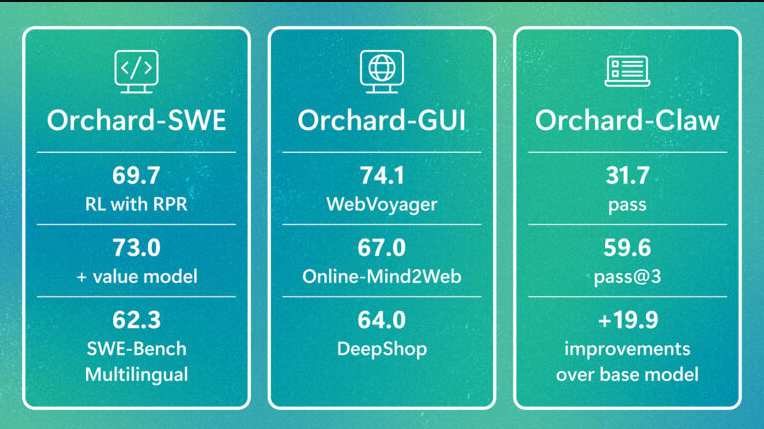
A compact 4-billion-parameter value model trained on past rollouts recognizes high-quality solutions. At problem-solving time, this model scores several candidate answers and selects the best one, boosting performance from 69.7% to 73% on SWE-bench Verified.
The result: a model with only ~3 billion active parameters achieves 69.7% on SWE-bench Verified, rising to 73% with value-model reranking. This performance approaches frontier systems using more than 10 times larger models.
Benchmark Performance
Microsoft reports strong benchmark results across multiple agent domains:
Software Engineering (Orchard-SWE)
69.7% on SWE-bench Verified with ~3B active parameters, rising to 73% with value-model reranking. This represents a new state-of-the-art among open-source models of comparable size.
Web Navigation (Orchard-GUI)
74.1% on WebVoyager, 67.0% on Online-Mind2Web, and 64.0% on DeepShop, for an average of 68.4%. The model achieves these results with only 400 distilled demonstrations combined with 2,200 open-ended training tasks.
Personal Assistance (Orchard-Claw)
59.6% success rate on Claw-Eval with up to three attempts, increasing to 73.9% when paired with the ZeroClaw agent system. Training across multiple harnesses—including ReACT, ZeroClaw, OpenClaw, and Codex—substantially improves reliability.
Parameter Efficiency
All three agent types achieve competitive performance with remarkably small models. Orchard-SWE uses ~3B active parameters, Orchard-GUI uses 4B parameters, and Orchard-Claw trains on just 200 synthetic tasks.
Comparison with Other Agent Frameworks
| Feature | Microsoft Orchard | Databricks Omnigent | LangChain | AutoGen |
|---|---|---|---|---|
| Type | Training framework | Meta-harness | Chain framework | Multi-agent |
| Open Source | ✓ (MIT) | ✓ (Apache 2.0) | ✓ (MIT) | ✓ (MIT) |
| SWE-bench Score | 69.7% (73% rerank) | N/A | N/A | N/A |
| Active Parameters | ~3B | Varies | Varies | Varies |
| Multi-domain | ✓ SWE/GUI/Claw | ✓ | ✓ | ✓ |
| Training Data | ✓ Included | ✗ | ✗ | ✗ |
| Direct Harness Training | ✓ | ✓ | ✗ | ✗ |
Microsoft Orchard distinguishes itself through its focus on training infrastructure rather than deployment orchestration. While frameworks like Omnigent and LangChain focus on composing and deploying agents, Orchard provides the tools to train them from scratch with production-ready quality.
How to Use Microsoft Orchard
Step 1: Clone the Repository
Access the Orchard repository on GitHub. The framework includes Orchard Env, training workflows for SWE, GUI, and Claw agents, along with complete training data and evaluation methods.
Step 2: Set Up Orchard Env
Deploy Orchard Env on a Kubernetes cluster. The environment service handles isolation, scaling, and lifecycle management for agent rollouts. Local development uses lightweight containers for rapid iteration.
Step 3: Choose Agent Type
Select the appropriate workflow for your use case: Orchard-SWE for code generation and bug fixing, Orchard-GUI for web navigation tasks, or Orchard-Claw for personal assistance workflows.
Step 4: Train and Evaluate
Run the training pipeline with your chosen configuration. Orchard supports reinforcement learning, supervised fine-tuning, and value model training. Evaluation metrics are automatically computed against standard benchmarks.
Pro Tips:
- Start with Orchard-GUI for faster iteration—web tasks require less compute than code generation
- Use the provided training data as a baseline before collecting custom demonstrations
- Enable value model reranking for production deployments where accuracy matters most
- Monitor resource usage during large-scale rollouts—Orchard Env provides built-in observability
FAQ
What is Microsoft Orchard?
Microsoft Orchard is an open-source framework for scalable agentic AI research. Built around Orchard Env, a Kubernetes-based environment service, it enables training and evaluating autonomous agents across software engineering, web navigation, and personal assistance domains.
How does Orchard-SWE achieve 69.7% on SWE-bench?
Orchard-SWE combines Balanced Adaptive Rollout, dense-reward reinforcement learning, and value model reranking. These techniques enable a model with only ~3 billion active parameters to match frontier systems using 10 times more parameters.
Is Microsoft Orchard open source?
Yes, Microsoft Orchard is released under the MIT license. The framework includes complete training data, evaluation methods, and Kubernetes-based infrastructure for building and studying open agentic systems.
What are the system requirements?
Orchard Env requires a Kubernetes cluster for production deployments. Local development uses Docker containers. Minimum requirements include 16GB RAM and a modern CPU; GPU acceleration is recommended for training workloads.
How does Orchard compare to LangChain?
Orchard focuses on training agents from scratch, while LangChain focuses on composing existing models into chains. Orchard includes training data and evaluation benchmarks; LangChain provides deployment orchestration. They serve complementary purposes in the agent development lifecycle.
Can I use Orchard commercially?
Yes, the MIT license permits commercial use. The released training data and evaluation methods can be used to train production agents for commercial applications.
Conclusion
Microsoft Orchard represents a significant advancement in agentic AI infrastructure. By providing reusable environments, harness-agnostic training, and complete evaluation pipelines, Orchard enables researchers and developers to build frontier-quality agents with remarkable parameter efficiency.
The framework's ability to train directly inside production deployment harnesses eliminates the gap between research and deployment, ensuring that capabilities learned during training transfer seamlessly to real-world applications.
For developers and businesses seeking to integrate multiple AI models into their applications, consider exploring AICC's unified AI API platform. AICC provides access to leading AI models through a single interface, simplifying integration and reducing development overhead.
Ready to build scalable agentic AI? Visit AICC to access leading AI models through a unified API, or explore the Microsoft Orchard repository to start training your own frontier-quality agents today.