
 OpenAI - ChatGPT, Sora
 Google - Gemini, Nano Banana
 Anthropic - Claude
 xAI - Grok
 Deepseek
 Alibaba - Qwen
 ByteDance - Doubao
 All Models
 Enterprise Plans
 AI Application Development
 AI Translator API
 AI SEO/GEO Service
 GEO-Optimized PR Service
 Web Scraping Service
 OpenClaw
 Top AI Tools
 Top AI Robots
 Log in
98.2% cheaper.
Same frontier
performance.
MiniMax M3 launched June 1, 2026 with a 1-million-token context window, native multimodality, and pricing that drops the cost of an autonomous coding run from $15.00 to $0.27. We analyzed the architecture and the economics. Here is why this is the real inflection point for production AI agents.
For the past two years, artificial intelligence has felt like a spectator sport. Every month, a tech giant takes the stage with a new chart showing decimal-point improvements on obscure benchmarks. But for software engineers, product managers, and enterprise growth teams building actual applications, the reality has been a series of friction points. Three, to be precise.
- The Context Window Tax — Feeding a full codebase or execution history into a 1M-token window has been prohibitively slow and financially crippling.
- The Modal Separation — Daisy-chaining separate vision and text models bleeds latency and semantic cohesion along the way.
- The Proprietary Lockdown — Closed-source APIs leave companies vulnerable to price spikes, model drift, and strict compliance constraints.
On June 1, 2026, the structural balance shifted. MiniMax M3 resolves all three constraints at once.
MiniMax Sparse Attention — the efficiency breakthrough.
The fundamental problem with standard Transformer attention is quadratic complexity: O(N²). Double the input length and you quadruple the KV-cache footprint. MiniMax M3 resolves this with MiniMax Sparse Attention (MSA).
Instead of every token cross-referencing every other token across the full context, MSA uses a lightweight index branch that scans incoming tokens and flags only the semantically relevant blocks of the KV cache. Attention executes only on those selected blocks.
At the 1M token threshold, the efficiency gains are staggering:
In production, this yields approximately 100 tokens per second output — roughly three times faster than Claude Opus, while preserving structural coherence across the full million-token context.
Open weights entering frontier territory.
| Model | SWE-Bench Pro | BrowseComp | Input / 1M tokens | Output / 1M tokens |
|---|---|---|---|---|
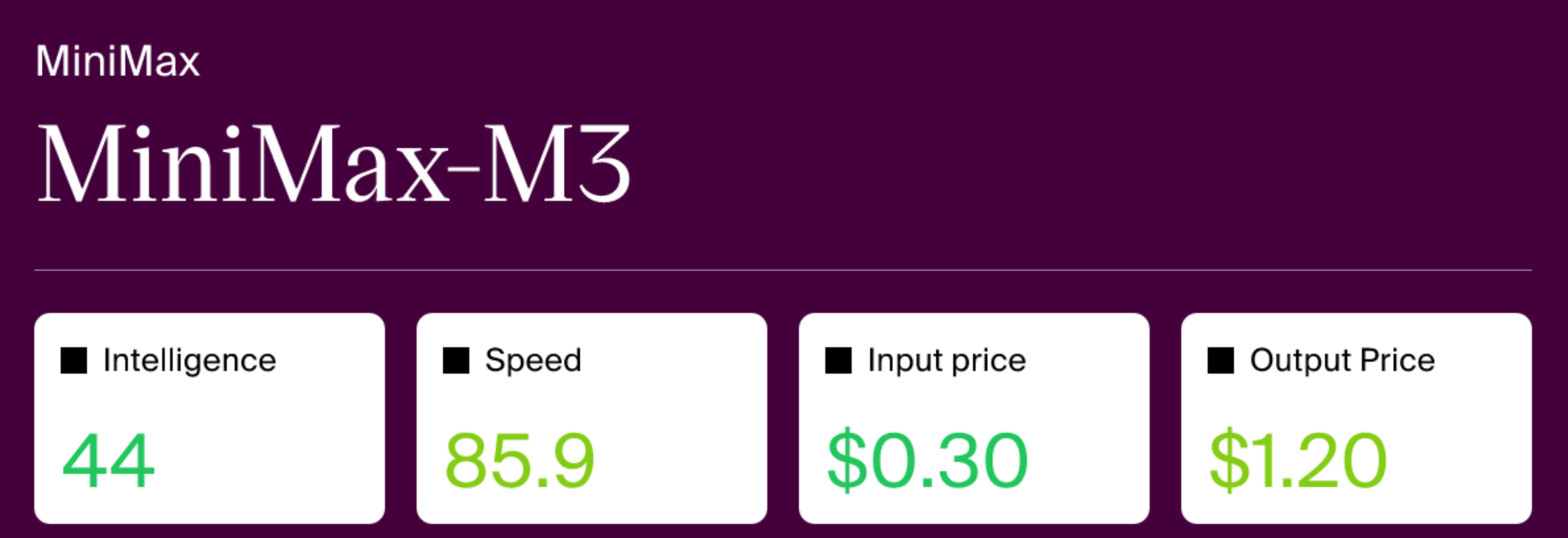
| MiniMax M3 | 59.0% | 83.5% | $0.30 (promo) | $1.20 (promo) |
| GPT-5.5 | ~56.5% | 81.0% | $5.00 | $15.00 |
| Gemini 3.1 Pro | 54.2% | 80.8% | $1.25 | $5.00 |
| Claude Opus 4.7 | 61.3% | 82.1% | $15.00 | $75.00 |
M3 outright bypasses several flagship proprietary models and pulls within striking distance of Claude Opus 4.7. On BrowseComp — which tests autonomous web operation — 83.5% marks it as an elite choice for web scraping, automated research, and GEO testing pipelines.
The P&L statement — per execution run.
Consider a typical agentic coding workflow: an autonomous agent reads 500,000 tokens of legacy codebase and outputs 100,000 tokens of refactored code. Here is the real-world cost per run:
For a bootstrapped startup or an enterprise processing thousands of automated pull requests daily, this economic reality transforms autonomous agents from an expensive experiment into a highly profitable infrastructure component.
The thinking parameter — three operating modes.
M3 introduces granular runtime configuration through a dedicated thinking parameter, letting developers tailor behavior directly in the API payload:
{ "model": "minimax/minimax-m3", "messages": [ { "role": "user", "content": "Analyze this repo trace and optimize CUDA memory." } ], "thinking": "adaptive" } Where MiniMax M3 is not the right tool.
- The Token Burn Trap — When
thinking: enabled, M3 can enter over-analytical loops on edge cases. In abstract poker strategy simulations, it has been observed spending thousands of reasoning tokens arguing with its own internal premises before reaching a conclusion. - Abstract Reasoning vs. Concrete Execution — M3 excels at concrete execution paths: translating architectures into code, visual document ingestion, tool calling. For abstract philosophical reasoning or high-semantic-ambiguity riddles, pure closed-source reasoning systems still have an edge.
The barrier to launching production-grade AI agent ecosystems has officially collapsed.
MiniMax M3 proves that frontier-tier coding and autonomous workflows are no longer exclusive to closed Western tech conglomerates. By open-sourcing a model with a 1M-token context window, native multimodality, and pricing that reduces per-run costs by 98.2%, MiniMax has democratized the building blocks of true software autonomy.
For a complete breakdown including five automated use cases in action, watch the MiniMax M3 Real Use Cases walkthrough covering autonomous research replication, codebase debugging, and API integration patterns.
Run MiniMax M3 at $0.30/M tokens through ai.cc — one API key.
MiniMax M3 is now live on ai.cc. No separate account, no NVIDIA API Catalog setup, no OpenRouter integration — just one OpenAI-compatible API key across MiniMax M3, Claude Opus 4.8, GPT-5.5, Gemini 3.5 Flash, and 300+ more models. Route each workload to the cheapest capable model automatically.
Get started at www.ai.cc →