 OpenAI - ChatGPT, Sora
 Google - Gemini, Nano Banana
 Anthropic - Claude
 xAI - Grok
 Deepseek
 Alibaba - Qwen
 ByteDance - Doubao
 All Models
 Enterprise Plans
 AI Application Development
 AI Translator API
 AI SEO/GEO Service
 GEO-Optimized PR Service
 Web Scraping Service
 OpenClaw
 Top AI Tools
 Top AI Robots
 Log in


                                        const { OpenAI } = require('openai');

const api = new OpenAI({
  baseURL: 'https://api.ai.cc/v1',
  apiKey: '',
});

const main = async () => {
  const result = await api.chat.completions.create({
    model: 'openai/gpt-4.1-nano-2025-04-14',
    messages: [
      {
        role: 'system',
        content: 'You are an AI assistant who knows everything.',
      },
      {
        role: 'user',
        content: 'Tell me, why is the sky blue?'
      }
    ],
  });

  const message = result.choices[0].message.content;
  console.log(`Assistant: ${message}`);
};

main();
                                        import os
from openai import OpenAI

client = OpenAI(
    base_url="https://api.ai.cc/v1",
    api_key="",
)

response = client.chat.completions.create(
    model="openai/gpt-4.1-nano-2025-04-14",
    messages=[
        {
            "role": "system",
            "content": "You are an AI assistant who knows everything.",
        },
        {
            "role": "user",
            "content": "Tell me, why is the sky blue?"
        },
    ],
)

message = response.choices[0].message.content

print(f"Assistant: {message}")


Product Detail
Introducing GPT-4.1 Nano: Speed, Efficiency, and Accessibility
OpenAI's GPT-4.1 Nano stands out as the fastest and most cost-effective model in the GPT-4.1 family. Engineered for applications where speed and economic viability are paramount, it delivers impressive performance for a broad spectrum of practical use cases such as text classification, intelligent autocomplete, and efficient data extraction. This model underscores OpenAI's dedication to making advanced AI capabilities more accessible to a wider range of developers and organizations, especially those with constrained resources and demanding latency requirements.
Key Takeaway: GPT-4.1 Nano is optimized for speed and cost-efficiency, bringing advanced AI to practical, real-world applications. ⚡️💰
Technical Specifications & Performance Highlights
Context Window and Knowledge Cutoff 📚
GPT-4.1 Nano is capable of processing extensive input contexts, supporting up to 1,047,576 tokens (equivalent to approximately 750,000 words). This matches the capacity of the full GPT-4.1 model, enabling it to handle vast amounts of information. The model can generate outputs up to 32,768 tokens in a single response, and its training data cutoff date is May 31, 2024.
API Pricing 💰
- Input tokens: $0.105 per million tokens
- Output tokens: $0.42 per million tokens
- Cost for 1,000 tokens: $0.000105 (input) + $0.00042 (output) = $0.000525 total
- Cost to process 1 page of text (~500 words / ~650 tokens): $0.00006825 (input) + $0.000273 (output) = $0.00034125 total
Performance Benchmarks ⚙️
Despite its focus on speed and cost, GPT-4.1 Nano maintains robust performance across crucial benchmarks:
- MMLU Benchmark: Achieves an impressive 80.1% accuracy on general knowledge and reasoning tasks.
- Long Context Processing: Full 1 million token context handling capability without performance degradation.
- Speed: Recognized as OpenAI's fastest model to date, meticulously optimized for minimal latency.
- Instruction Following: Demonstrates strong adherence to basic instructions.
Core Capabilities: What Makes GPT-4.1 Nano Unique
Minimal Latency and Maximum Speed ⚡️
GPT-4.1 Nano delivers OpenAI's most rapid response times, making it an ideal choice for real-time applications. It processes inputs and generates outputs at significantly higher speeds than other GPT models, offering immediate feedback essential for features like autocomplete suggestions and classification tasks. The model prioritizes speed without significant quality degradation on standard tasks, maintaining high performance even with million-token inputs.
Unmatched Cost Optimization 💰
This model makes million-token context processing economically viable for large-scale deployments. It provides exceptional value for repetitive tasks and automated workflows involving similar inputs, enabling organizations to deploy AI solutions more broadly and affordably.
Practical Use Cases 🎯
GPT-4.1 Nano excels across a variety of practical applications:
- Text Classification: Highly effective for content moderation, sentiment analysis, and intent recognition.
- Efficient Autocomplete: Provides seamless autocomplete functionality for code editors, search engines, and text entry applications.
- Rapid Data Extraction: Quickly extracts structured and semi-structured data from documents.
- Document Categorization: Offers robust capabilities for metadata tagging and organizing documents.
- It serves as an excellent "workhorse" for high-volume, straightforward AI tasks where prioritizing speed over intricate complexity is key.
Long Context Without Compromise 📚
GPT-4.1 Nano efficiently processes and maintains context across documents containing up to 1 million tokens. This allows it to handle entire codebases or lengthy reports while maintaining essential information retrieval capabilities. It successfully performs "needle-in-a-haystack" retrieval tasks across its full context window, offering full long-context capabilities without the premium pricing typically associated with larger models.
API Integration 🔌
GPT-4.1 Nano is readily available to developers and organizations through AIML's API services. While OpenAI has not yet announced direct integration into the ChatGPT interface, the system can be immediately explored and tested via OpenAI's API Playground. Its design ensures seamless integration with existing workflows already built using other OpenAI models.
For comprehensive API details and technical specifications, refer to the API References: Documentation.
Limitations and Considerations ⚠️
To achieve its exceptional speed and efficiency, GPT-4.1 Nano involves certain tradeoffs:
- Reduced Reasoning: It may exhibit lower performance on sophisticated coding tasks and complex reasoning compared to its larger siblings.
- Prompt Specificity: Requires more specific and explicit prompts for optimal results, a characteristic shared with other models in the GPT-4.1 family.
- Nuanced Instructions: The model might struggle with highly nuanced instructions or multi-step reasoning tasks, prioritizing practical utility over cutting-edge capabilities for specialized domains.
Important: GPT-4.1 Nano is best suited for applications where speed and cost are critical, rather than extreme cognitive complexity.
Optimal Use Cases for GPT-4.1 Nano 📈
GPT-4.1 Nano is perfectly suited for scenarios that demand:
- High-volume classification tasks requiring rapid responses and cost-efficiency.
- Seamless autocomplete functionality in development environments and text interfaces.
- Cost-effective document processing and information extraction from large corporate data lakes.
- Practical solutions for data tagging, categorization, and foundational content generation.
- Backend support for interactive applications where immediate responses with reasonable quality are essential.
How GPT-4.1 Nano Stands Out From the Crowd 🌟
- MMLU Score: Achieves an impressive 80.1% on the MMLU benchmark, remarkable for OpenAI's smallest and fastest model.
- Cost-Efficiency Leader: Offers the full 1-million token context window at a fraction of the cost of other models with similar capabilities.
- Superior Latency: Delivers significantly lower latency than GPT-4.1 and GPT-4.1 Mini, crucial for time-sensitive applications.
- It costs 96% less than the full GPT-4.1 model, while preserving essential functionality for a vast array of use cases. This positions it as the most economical entry point into OpenAI's advanced capabilities, complete with a full context window.
Summary: The New Standard for Accessible AI
GPT-4.1 Nano represents a significant leap forward in democratizing advanced AI capabilities. Its unprecedented combination of speed, affordability, and practical performance unlocks new possibilities for high-volume, latency-sensitive applications that previously couldn't justify the cost of more expensive models. While not designed for complex reasoning or highly sophisticated tasks, its optimized balance of capability and efficiency makes it an ideal workhorse for a wide range of everyday AI applications, driving innovation and accessibility across industries.
Frequently Asked Questions (FAQ) ❓
Q1: What is GPT-4.1 Nano primarily designed for?
GPT-4.1 Nano is engineered for applications where speed and cost-efficiency are critical. It excels in tasks like classification, autocomplete, data extraction, and other high-volume, straightforward AI workloads.
Q2: What is the context window size of GPT-4.1 Nano?
It boasts an impressive input context window of up to 1,047,576 tokens (approximately 750,000 words), enabling it to process and maintain context across very large documents or codebases effectively.
Q3: How does GPT-4.1 Nano compare in cost to other GPT-4.1 models?
GPT-4.1 Nano is remarkably cost-efficient, costing 96% less than the full GPT-4.1 model. It offers the same 1-million token context window at a fraction of the price, with API pricing at $0.105 per million input tokens and $0.42 per million output tokens.
Q4: What are the main limitations of GPT-4.1 Nano?
Its primary limitations include reduced capabilities for highly complex reasoning tasks, advanced coding, and nuanced multi-step instructions. It generally requires more specific and explicit prompts for optimal results compared to its larger siblings.
Q5: Can I access GPT-4.1 Nano through ChatGPT?
Currently, OpenAI has not announced direct integration of GPT-4.1 Nano into the ChatGPT interface. It is primarily available for developers through AIML's API services and can be tested immediately via OpenAI's API Playground.
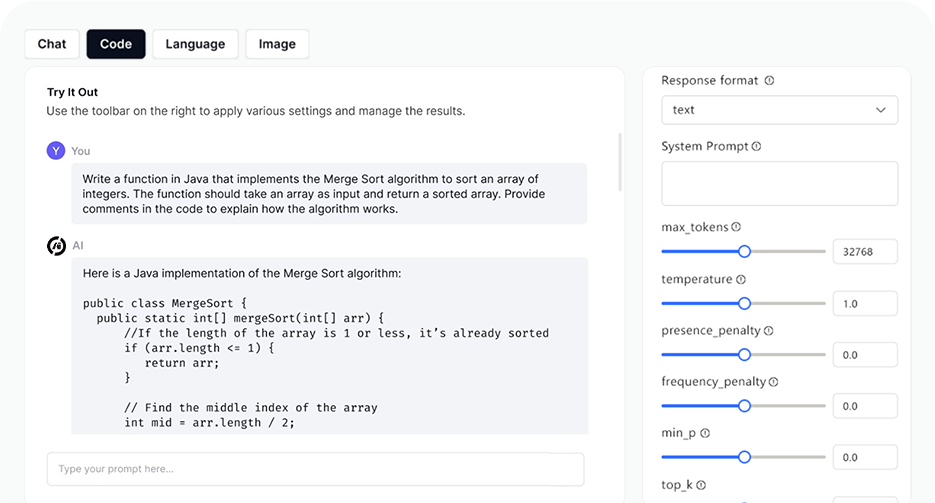
AI Playground