 OpenAI - ChatGPT, Sora
 Google - Gemini, Nano Banana
 Anthropic - Claude
 xAI - Grok
 Deepseek
 Alibaba - Qwen
 ByteDance - Doubao
 All Models
 Enterprise Plans
 AI Application Development
 AI Translator API
 AI SEO/GEO Service
 GEO-Optimized PR Service
 Web Scraping Service
 OpenClaw
 Top AI Tools
 Top AI Robots
 Log in


                                        const { OpenAI } = require('openai');

const api = new OpenAI({
  baseURL: 'https://api.ai.cc/v1',
  apiKey: '',
});

const main = async () => {
  const result = await api.chat.completions.create({
    model: 'moonshot/kimi-k2-6',
    messages: [
      {
        role: 'system',
        content: 'You are an AI assistant who knows everything.',
      },
      {
        role: 'user',
        content: 'Tell me, why is the sky blue?'
      }
    ],
  });

  const message = result.choices[0].message.content;
  console.log(`Assistant: ${message}`);
};

main();
                                        import os
from openai import OpenAI

client = OpenAI(
    base_url="https://api.ai.cc/v1",
    api_key="",
)

response = client.chat.completions.create(
    model="moonshot/kimi-k2-6",
    messages=[
        {
            "role": "system",
            "content": "You are an AI assistant who knows everything.",
        },
        {
            "role": "user",
            "content": "Tell me, why is the sky blue?"
        },
    ],
)

message = response.choices[0].message.content

print(f"Assistant: {message}")


Kimi K2.6
Moonshot AI's Kimi K2.6 is the most capable open-source model available today. It scores 80.2% on SWE-Bench Verified, orchestrates up to 300 parallel sub-agents, and sustains autonomous execution across 4,000+ tool calls — matching closed frontier models at a fraction of the cost.
Why Kimi K2.6 matters
Kimi K2.6 is the latest model in Moonshot AI's fast-moving K2 family — a line of open-source large language models that has consistently punched well above its weight since the original K2 debuted in July 2025. Where other releases make incremental gains, each Kimi K2 update has targeted a specific capability dimension and delivered genuine, measurable improvement.
K2.6 is no different. It picks up where K2.5 left off, already the top-ranked open model on the Artificial Analysis Intelligence Index, and doubles down on the three things developers and enterprises actually care about: long-horizon autonomous coding, scalable multi-agent orchestration, and production-ready deployment at low cost.
API Pricing
- Input (cache hit): $0.208
- Input (cache miss): $1.235
- Output: $5.20
Technical overview
What Makes Kimi K2.6 Different
Every K2 release has had a defining capability. K2.6 has several that work together to enable a new category of autonomous, long-running AI tasks.
300-Agent Swarm Orchestration
K2.6 scales to 300 parallel sub-agents per run — up from 100 in K2.5. The orchestrator decomposes tasks into independent subtasks, routes them to domain-specialized agents, and synthesizes outputs autonomously. This is not a single chatbot loop. It's a coordinated AI workforce.
Long-Horizon Execution: 4,000+ Tool Calls
K2.6 supports sustained autonomous execution for 12+ hours and 4,000+ sequential tool calls without losing coherence. Most models break down after a few hundred steps. K2.6 handles end-to-end software projects from a single prompt.
Native Multimodal
Built on the MoonViT-3D vision encoder, K2.6 understands images, UI screenshots, and video workflows natively, not as an afterthought. It can generate code directly from a design mockup, analyze diagrams, and orchestrate tools based on visual inputs.
Advanced Frontend Generation
K2.6 introduces improved frontend animation generation, including support for video backgrounds and 3D effects. It can produce production-ready interfaces from natural language descriptions, complete with interactive animations and responsive design.
Proactive Agents for 24/7 Autonomous Operation
A new capability in K2.6 is proactive agent mode — agents that operate continuously without waiting for user prompts. Once configured, they monitor conditions, execute scheduled tasks, and adapt to new information on their own initiative.
Kimi K2.6 Benchmarks: Beats GPT-5.4, Claude Opus & More
Kimi K2.6 demonstrates strong performance across coding, reasoning, and tool-use benchmarks, positioning it as a leading open-source agentic model.
Kimi K2.6 is increasingly recognized as a new open-source leader in agentic coding, especially in long-context and multi-agent execution scenarios.
What Developers and Teams Are Using Kimi K2.6 For
Kimi K2.6 is designed for real-world production systems, not just experimental prompts. It performs reliably in environments where stability, scalability, and consistency are critical.
Long-Horizon Software Engineering
Multi-file refactors, codebase migrations, and end-to-end feature implementation that take hours. K2.6 handles the full cycle: planning, execution, debugging, and testing.
Enterprise Research Automation
Competitive analysis, pricing research, financial report synthesis. K2.6 Thinking with 300-step tool calling is used by teams at companies like AlphaEngine for full macro analysis pipelines.
Legal & IP Document Workflows
Contract review, patent analysis, and compliance checking that demands strict logical structure and precise terminology. The 256K context window handles entire legal document sets in one pass.
Frontend UI Generation from Design
Turn a Figma screenshot or hand-drawn mockup into production HTML/CSS, including animations, 3D effects, and video backgrounds. K2.6's MoonViT encoder understands visual layouts natively.
Scientific & Chemical Literature Analysis
DP Technology and XtalPi use K2.5/K2.6 to extract insights from dense scientific papers and chemical charts, accelerating drug discovery and materials R&D workflows.
Content Production Agent Pipelines
Moonshot's own marketing team runs end-to-end content production on Claw Groups — demo creation, benchmarking, social media, and video, all coordinated by K2.6 acting as an adaptive orchestrator.
Model Comparison
Frequently Asked Questions about Kimi K2.6
What is Kimi K2.6?
Kimi K2.6 is a multimodal open-source AI model designed for coding, agent orchestration, and long-context reasoning. It enables developers to build autonomous workflows and full-stack systems with minimal manual intervention. Unlike traditional chat models, it focuses on execution-driven AI systems. It is widely used in production environments for scalable AI applications.
Is Kimi K2.6 open source?
Yes, Kimi K2.6 is positioned as an open-source model by Moonshot AI. This allows developers to integrate, modify, and deploy it in custom environments. Open access makes it especially attractive for startups and research teams. However, deployment conditions may vary depending on platform usage.
How does Kimi K2.6 compare to Claude Opus 4.6 and GPT-5.4?
It's genuinely competitive. On SWE-Bench Pro (58.6% vs 53.4% for Claude), Humanity's Last Exam with tools (54.0% vs 52.1% for GPT-5.4), and Toolathlon agentic benchmarks (50.0 vs 47.2 for Claude), K2.6 leads. Claude Opus 4.6 holds a slim edge on SWE-Bench Verified (80.8% vs 80.2%). Neither model dominates across the board — it's true parity with closed frontier models.
What's the difference between Agent Mode and Agent Swarm in K2.6?
Agent Mode runs a single sequential agent that uses tools one after another. Agent Swarm coordinates up to 300 specialized sub-agents running in parallel. The orchestrator decomposes a task into independent subtasks, assigns them to domain-specific agents, and synthesizes the outputs. On tasks requiring wide information gathering, Agent Swarm significantly outperforms single-agent mode — BrowseComp scores jump from ~60% to over 83% in K2.6.
What's the recommended temperature setting for K2.6?
Moonshot recommends temperature 1.0 for Thinking mode and 0.6 for Instant mode. Top-p of 0.95 applies to both. To enable Instant mode via the API, pass {'chat_template_kwargs': {"thinking": false}} in extra_body.
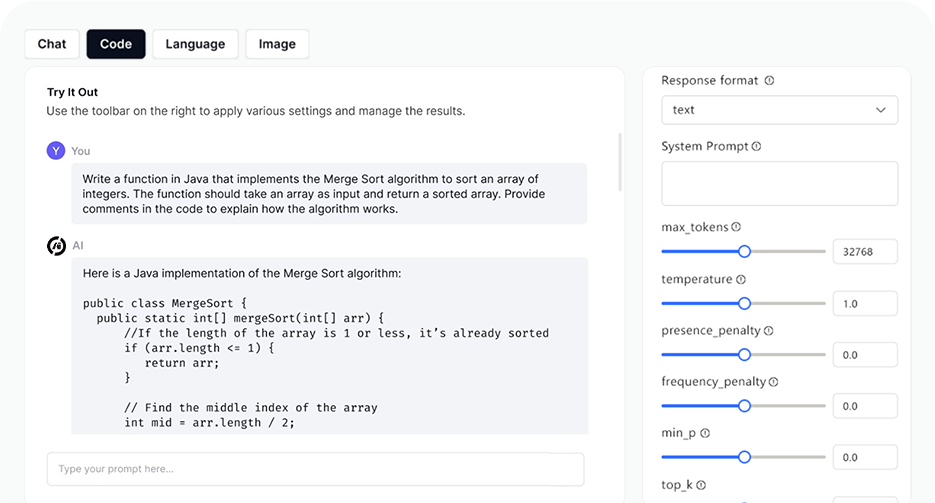
AI Playground