
 OpenAI - ChatGPT, Sora
 Google - Gemini, Nano Banana
 Anthropic - Claude
 xAI - Grok
 Deepseek
 Alibaba - Qwen
 ByteDance - Doubao
 All Models
 Enterprise Plans
 AI Application Development
 AI Translator API
 AI SEO/GEO Service
 GEO-Optimized PR Service
 Web Scraping Service
 OpenClaw
 Top AI Tools
 Top AI Robots
 Log in






Counterintuitive New Chip Solves AI Twin Trap and Improves Performance
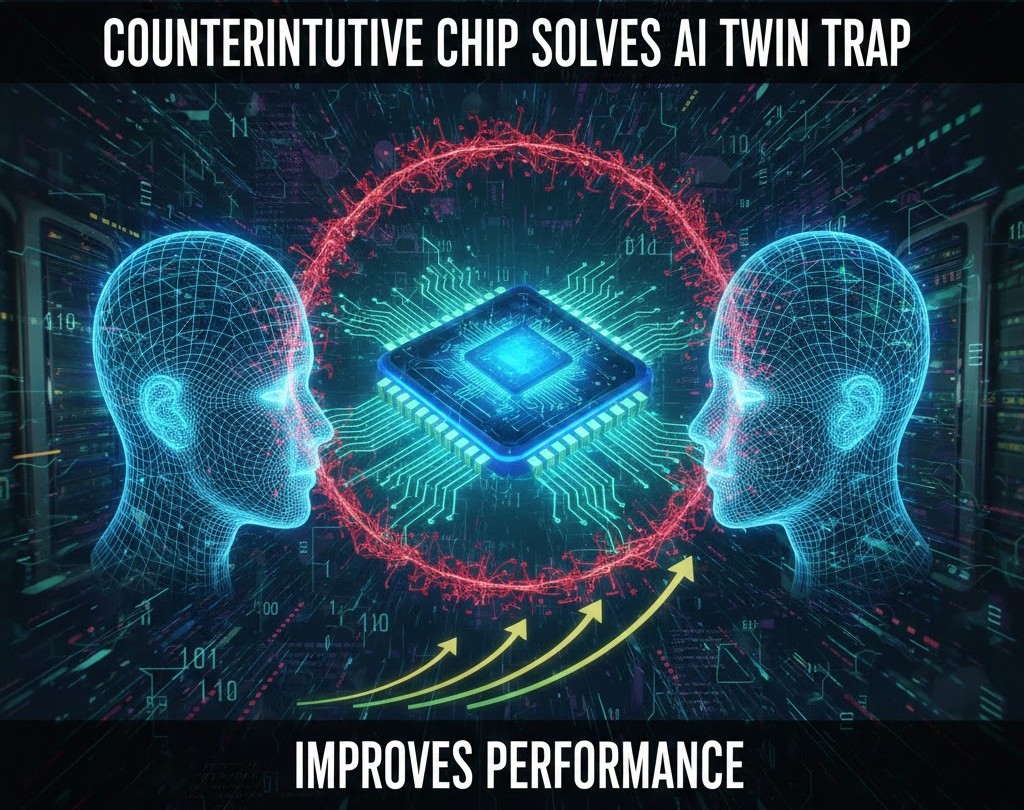
AI startup Counterintuitive is pioneering a shift toward "reasoning-native computing," aiming to move machines beyond mere mimicry into the realm of genuine comprehension. This breakthrough seeks to transform AI from basic pattern recognition to human-like decision-making systems.
According to Gerard Rego, Chairman of Counterintuitive, the industry currently faces a "Twin Trap"—a fundamental problem that prevents even the most advanced AI from achieving stability and true intelligence.
Breaking the Precision Barrier
The first "trap" involves outdated mathematical foundations. Today’s AI relies on floating-point arithmetic originally designed for gaming and graphics, which lacks the precision required for high-stakes fields like law and healthcare.
In current numerical systems, tiny mathematical errors accumulate, leading to non-determinism—where the same model produces different results for the same query. This lack of provability often results in "hallucinations," making AI difficult to audit or trust in professional environments.
Moving from Mimicry to Memory
The second trap lies in architecture. Most modern AI models lack long-term reasoning memory. They function like "predictive text on steroids," predicting the next token without understanding why they made that choice. Once a decision is output, the reasoning process is lost.
To solve this, Counterintuitive is developing a Reasoning-Native Computing Stack. Key features of this new approach include:
- Deterministic Reasoning Hardware: Solving the inconsistency of probabilistic computing.
- Causal Memory Systems: Allowing AI to retain and build upon its own logic.
- Artificial Reasoning Unit (ARU): A new compute category that executes causal logic directly in silicon, breaking away from traditional GPU limitations.
"The ARU will usher in the next age of computing, redefining intelligence from imitation to understanding," says co-founder Syam Appala. This technology aims to power critical economic sectors without the massive hardware and energy budgets currently required.
By integrating memory-driven causal logic, Counterintuitive hopes to replace the traditional "black-box" model with transparent, accountable, and highly efficient AI systems.
This article was adapted from the original report: Counterintuitive’s new chip aims escape the AI ‘twin trap’ .