 OpenAI - ChatGPT, Sora
 Google - Gemini, Nano Banana
 xAI - Grok
 Deepseek
 Alibaba - Qwen
 ByteDance - Doubao
 All Models
 Enterprise Plans
 AI Application Development
 AI Translator API
 AI SEO/GEO Service
 GEO-Optimized PR Service
 Web Scraping Service
 OpenClaw
 Top AI Tools
 Top AI Robots
 Log in


                                        const Anthropic = require('@anthropic-ai/sdk');

const api = new Anthropic({
  baseURL: 'https://api.ai.cc/',
  authToken: '',
});

const main = async () => {
  const message = await api.messages.create({
    model: 'anthropic/claude-opus-4-7',
    max_tokens: 2048,
    system: 'You are an AI assistant who knows everything.',
    messages: [
      {
        role: 'user',
        content: 'Tell me, why is the sky blue?',
      },
    ],
  });

  console.log('Message:', message);
};

main();
                                        import asyncio
from anthropic import Anthropic

client = Anthropic(
    base_url="https://api.ai.cc/",
    auth_token="",
)


def main():
    message = client.messages.create(
        model="anthropic/claude-opus-4-7",
        max_tokens=2048,
        system="You are an AI assistant who knows everything.",
        messages=[
            {
                "role": "user",
                "content": "Hello, Claude",
            }
        ],
    )

    print("Message:", message.content)


if __name__ == "__main__":
    main()


Claude Opus 4.7
Claude Opus 4.7 is a high-performance frontier model designed for real-world production workloads: complex software engineering, long-horizon agentic systems, multimodal reasoning, and enterprise-grade knowledge work.
What’s New
Claude Opus 4.7 refines the Opus line with stronger engineering reliability, better multimodal grounding, and improved long-task stability. The focus is on reducing failure points in complex workflows rather than just increasing benchmark scores.
Engineering Reliability
A key shift in 4.7 is not just “more intelligence,” but more controllable intelligence under long execution chains.
| Area | Improvement |
|---|---|
| Coding performance | +13% Internal Benchmark |
| Complex SWE tasks | Higher success rate w/ minimal supervision |
| Long-running workflows | Stable context retention |
| Output quality | Better design taste and coherence |
| Vision | Higher-resolution interpretation |
Performance
Claude Opus 4.7 demonstrates its strongest gains in long-horizon reasoning and software engineering tasks. The improvements are most visible when the model is required to maintain context over large inputs or coordinate multiple steps of execution.

API Pricing
- INPUT: $6.5 / MTok
- OUTPUT: $32.5 / MTok
Capabilities
Software Engineering & Coding
Designed for serious engineering workloads that go beyond simple code generation. It performs strongly in environments that require understanding of architecture, dependencies, and long-range system behavior.
Agentic Workflows
Capable of executing multi-step workflows with minimal supervision, maintaining state across steps and validating its own outputs. It handles tool usage more reliably and is better at planning sequences of actions.
Multimodal Vision
The vision system handles higher-resolution inputs like UI layouts, dashboards, and diagrams. It better understands relationships between visual components and textual context.
Professional Design Output
Emphasis is on clarity, hierarchy, and usability. Outputs feel more “designed” rather than purely generated—ideal for product documentation and technical reporting.
1M Token Context
With a context window of up to 1 million tokens, Opus 4.7 is capable of working with full codebases, research collections, or extensive technical documentation in a single session.
Ideal Use Cases
// ENTERPRISE ENGINEERING
Tasks involving large codebases, complex dependencies, and multi-stage workflows.
// AGENT DEVELOPMENT
Building autonomous systems that follow structured plans with high reliability.
// KNOWLEDGE SYSTEMS
Synthesis across extensive research archives or internal knowledge bases.
// PRODUCT & DESIGN
UI/UX systems, interface design, and structured documentation workflows.
Comparisons
vs Sonnet 4.6
Sonnet 4.6 is optimized for speed and cost efficiency. Opus 4.7 prioritizes deeper reasoning, long-context handling, and higher output reliability. Speed vs Sustained Cognitive Depth.
vs Opus 4.6
Compared to Opus 4.6, 4.7 improves coding reliability, instruction adherence, and multimodal understanding during long sessions.
FAQ
What is the context window of Claude Opus 4.7?
It supports up to 1,000,000 tokens, enabling full-scale document and codebase reasoning.
Is Claude Opus 4.7 better at coding?
Yes, it shows a +13% gain on internal coding benchmarks and stronger performance in complex engineering tasks.
Does it support vision tasks?
Yes, it includes improved high-resolution vision capabilities for UI analysis, diagrams, and document interpretation.
Is it suitable for autonomous AI agents?
Yes, it is optimized for agentic workflows involving multi-step reasoning and long-horizon planning.
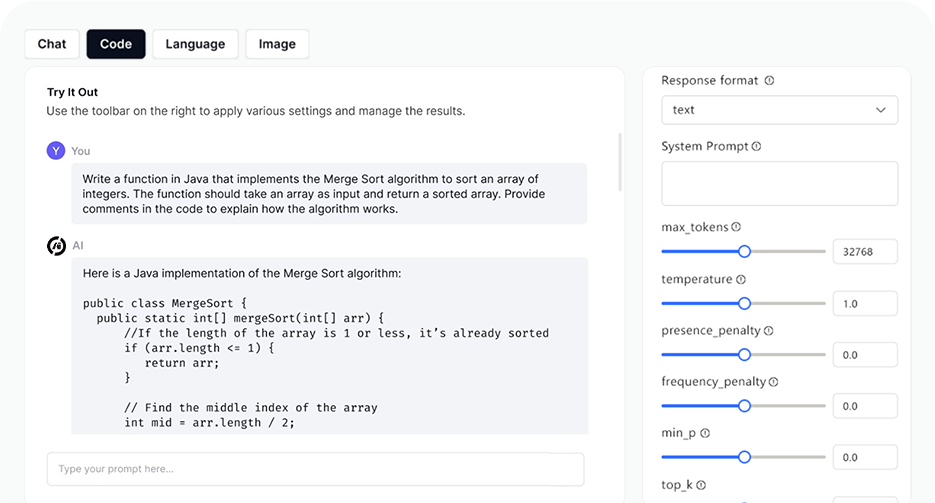
AI Playground