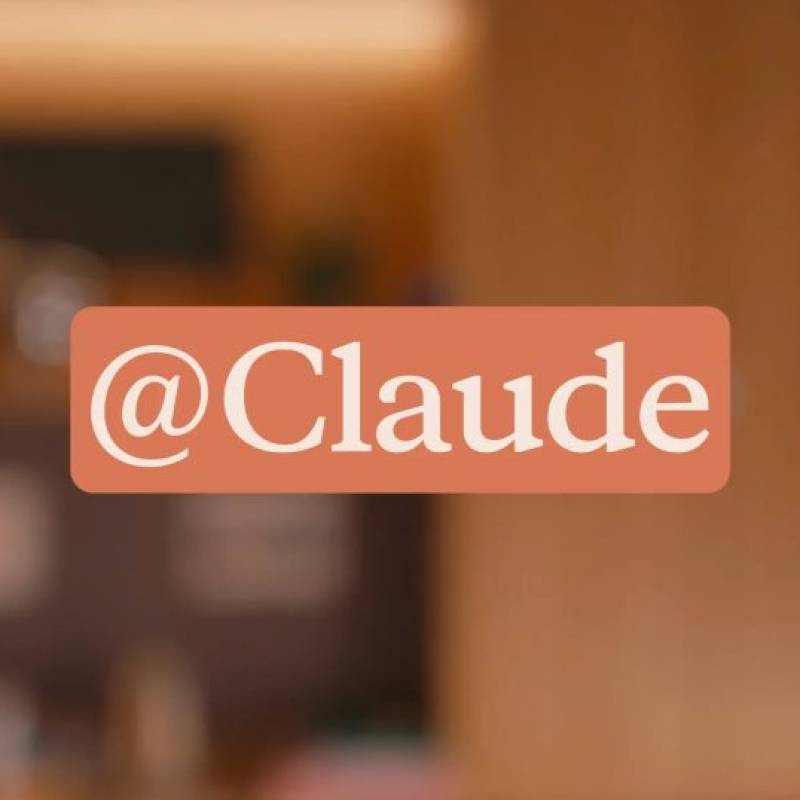
Anthropic has launched a beta version of its Claude Tag feature for Enterprise and Team tiers, integrating its AI chat model directly into shared Slack channels. Rather than relying on traditional isolated chat interfaces, users can now pull the artificial intelligence model into active group threads simply by typing @Claude.
The integration allows any team member within the channel to delegate tasks, review AI-generated outputs, and resume discussion threads from any prior point. This structural shift follows a US$65 billion Series H funding round that elevated Anthropic's post-money valuation to US$965 billion — surpassing rival OpenAI's US$852 billion mark.
📈 Following a confidential S-1 filing for an initial public offering, market competition for enterprise software placement remains intense. According to Ramp's May 2026 AI Index, Anthropic's enterprise adoption rate has reached 34.4%, overtaking OpenAI's 32.3% footprint.
🔁 Modifying the Channel Workstream
Standard generative AI software typically requires enterprise employees to shuttle data between team chat platforms and separate browser windows. Anthropic aims to eliminate this friction by redesigning workplace AI agents to operate natively within multiplayer communication environments.
💬 "Instead of a private back-and-forth, Claude Tag shows up in the open," stated Rob Seaman, General Manager of Slack, describing the application's operational mechanics.
This shared visibility fundamentally changes how context is tracked within an organisation. Because Claude Tag logs its task status directly inside the communication window, multiple employees can simultaneously monitor live execution steps. The system also builds a contextual background by tracking ongoing information from active channels — reducing the need for team members to repeatedly re-enter foundational company data or project scopes.
⚙️ Functional Mechanics and Asynchronous Tasks
The technical foundation of this channel integration is built on Anthropic's Opus 4.8 engine. When assigned a request, the model breaks the operation into sequential execution phases and leverages connected corporate databases, development tools, and code repositories to complete the work.
A key operational distinction for these workplace AI agents is their ability to function asynchronously — without requiring real-time human prompting. When a network administrator activates the tool's "ambient" configuration, Claude Tag autonomously monitors threads and tracks tasks independently. Specifically, the agent:
- ✅ Checks inactive text threads for pending actions
- ✅ Signals priority notifications from integrated software extensions
- ✅ Tracks unresolved assignments across multi-day intervals
💬 "The form factor of being able to tag it the same way that you would a coworker is really powerful," — Cat Wu, Head of Product for Claude Code, speaking to Reuters.
Wu further explained that connecting her personal Claude Tag agent to her email archive enables the system to analyse incoming communications, categorise urgent entries, and deliver immediate alerts directly inside Slack.
📊 Metrics and Administrative Controls
Internal reporting from Anthropic reveals that automated code generation has measurably altered engineering workflows. Notably, 65% of the firm's internal codebase is now produced through its private version of Claude Tag.
Beyond software development, Anthropic is targeting non-technical office workforces. Early enterprise deployments focus on:
- 🔍 Querying database metrics
- 🔍 Parsing analytics data
- 🔍 Processing internal IT support tickets
This expansion of background agent operations demands a robust security infrastructure. To restrict data access to approved departments, system administrators must establish scoped Claude identities. All localised memories and tool integrations are confined strictly to channels authorised by the IT department. Management portals also provide full tracking logs of user queries alongside configurable monthly token cost caps.
⚖️ The Enterprise Calculation: Autonomy vs. Governance
Moving generative AI tools from individual sandboxes into persistent corporate communication channels presents clear operational trade-offs. The upside is significant: by centralising information logs directly inside active threads, organisations can lower task friction, capture context across evolving project teams, and reduce time spent on manual codebase tracking or database updates.
⚠️ Key Governance Risks to Consider
- Delegating cross-app workflows to background agents introduces significant data-exposure risks if access boundaries are misconfigured.
- Sensitive proprietary context could inadvertently cross into unapproved channels.
- Autonomous asynchronous execution removes direct human verification from intermediate workflow stages, leaving teams vulnerable to systemic errors if the model misinterprets instructions mid-task.
Corporate decision-makers must ultimately evaluate whether the productivity gains of channel-based automation outweigh the rigorous auditing, compliance overhead, and channel-by-channel security configurations required to safely govern an always-on AI agent operating at the heart of their organisation's communication infrastructure.

 OpenAI - ChatGPT, Sora
 Google - Gemini, Nano Banana
 Anthropic - Claude
 xAI - Grok
 Deepseek
 Alibaba - Qwen
 ByteDance - Doubao
 All Models
 Enterprise Plans
 AI Application Development
 AI Translator API
 AI SEO/GEO Service
 GEO-Optimized PR Service
 Web Scraping Service
 OpenClaw
 Top AI Tools
 Top AI Robots
 Log in