 OpenAI - ChatGPT, Sora
 Google - Gemini, Nano Banana
 Anthropic - Claude
 xAI - Grok
 Deepseek
 Alibaba - Qwen
 ByteDance - Doubao
 All Models
 Enterprise Plans
 AI Application Development
 AI Translator API
 AI SEO/GEO Service
 GEO-Optimized PR Service
 Web Scraping Service
 OpenClaw
 Top AI Tools
 Top AI Robots
 Log in


                                        const { OpenAI } = require('openai');

const api = new OpenAI({
  baseURL: 'https://api.ai.cc/v1',
  apiKey: '',
});

const main = async () => {
  const result = await api.chat.completions.create({
    model: 'minimax/m2-1',
    messages: [
      {
        role: 'system',
        content: 'You are an AI assistant who knows everything.',
      },
      {
        role: 'user',
        content: 'Tell me, why is the sky blue?'
      }
    ],
  });

  const message = result.choices[0].message.content;
  console.log(`Assistant: ${message}`);
};

main();
                                        import os
from openai import OpenAI

client = OpenAI(
    base_url="https://api.ai.cc/v1",
    api_key="",
)

response = client.chat.completions.create(
    model="minimax/m2-1",
    messages=[
        {
            "role": "system",
            "content": "You are an AI assistant who knows everything.",
        },
        {
            "role": "user",
            "content": "Tell me, why is the sky blue?"
        },
    ],
)

message = response.choices[0].message.content

print(f"Assistant: {message}")


MiniMax-M2.1
Lightweight. Code-Optimized. Agentic-Ready.
Multilingual Code Generation & Refactoring AI Model
MiniMax-M2.1 is a cutting-edge large language model built for high-performance code generation, refactoring, and cross-language reasoning. Optimized for real-world developer workflows, it supports languages such as Rust, Java, Go, C++, TypeScript, and JavaScript, offering fast, clean, and reliable outputs.
Technical Specifications
- Model type: Multilingual Transformer-based LLM
- Architecture: Hybrid dense-attention model with optimized code tokenization
- Context window: 204,800 tokens (input + output)
- Supported languages: Rust, Go, Java, C++, TypeScript, JavaScript, Python, SQL
Performance Benchmarks
Evaluated using rigorous internal frameworks (e.g., OctoCodingbench, SWE Review), with results averaged over 4 runs.

API Pricing
- Input: $0.39 / 1M tokens
- Output: $1.56 / 1M tokens
Key Features
- Multilingual Coding Mastery: Excels across 6+ major programming languages with syntax-aware generation and refactoring
- Agentic Reasoning: Maintains coherent reasoning between turns, critical for tool use, IDE integration, and long-horizon tasks
- Concise & Clean Outputs: Minimizes verbosity while preserving functional correctness and style consistency
- Real-Time Developer Workflows: Optimized for low latency and high throughput in coding assistants and CI/CD pipelines
- Open & Deployable: Fully open-source weights enable on-prem, edge, or custom deployment scenarios
Core Use Cases
- Cross-Language Code Migration: Seamlessly rewrite applications between Rust, Go, and JavaScript without losing logic integrity.
- Code Review & Refactoring: Automate code readability enhancements, style consistency, and optimization opportunities.
- Automated Documentation: Generate aligned docstrings, inline comments, and technical documentation for complex repositories.
- Intelligent Debugging: Detect potential bugs and suggest fixes within a single inference cycle.
- Developer Tool Integration: Connect via SDKs or APIs to augment IDEs such as VSCode, JetBrains, or Neovim with real-time AI assistance.
Model Comparison
vs. Claude Sonnet 4.5: M2.1 matches or exceeds Sonnet 4.5 in coding-specific benchmarks while using far fewer activated parameters. Offers significantly lower inference cost and latency, making it ideal for high-throughput coding agents.
vs. DeepSeek-Coder: M2.1 demonstrates stronger instruction following in complex, multi-step coding scenarios (e.g., full-stack feature implementation). Excels in real-world tool integration and stateful reasoning, critical for IDE plugins and autonomous agents.
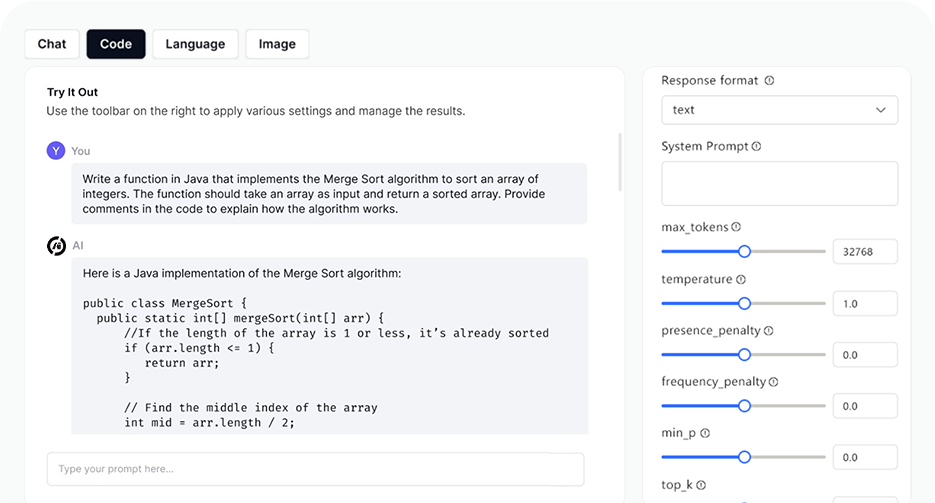
AI Playground