
 OpenAI - ChatGPT, Sora
 Google - Gemini, Nano Banana
 Anthropic - Claude
 xAI - Grok
 Deepseek
 Alibaba - Qwen
 ByteDance - Doubao
 All Models
 Enterprise Plans
 AI Application Development
 AI Translator API
 AI SEO/GEO Service
 GEO-Optimized PR Service
 Web Scraping Service
 OpenClaw
 Top AI Tools
 Top AI Robots
 Log in









Stanford HAI 2026 AI Index Report: US-China AI Parity, Record-Breaking Adoption, and the Urgent Governance Gap
Stanford HAI 2026 AI Index Report: US-China AI Parity, Record-Breaking Adoption, and the Urgent Governance Gap
The Stanford Institute for Human-Centered AI (HAI) just dropped its 2026 AI Index Report—and it’s a wake-up call for anyone building, investing in, or regulating artificial intelligence. Released on April 13, 2026, this year’s 400+ page analysis (the most comprehensive yet) shows AI capabilities surging ahead while measurement, transparency, and governance struggle to keep pace.
From near-parity in frontier model performance between the US and China to generative AI reaching 53% global adoption in just three years (faster than the PC or internet), the data paints a picture of explosive progress mixed with sobering challenges. Whether you’re a founder scaling an AI product, a policymaker shaping regulation, or an executive integrating AI into operations, this report delivers the hard numbers you need to navigate 2026 and beyond.
Why this report matters now The AI Index isn’t just another industry survey. It’s the field’s most trusted, independently sourced annual benchmark—tracking technical performance, economic impact, research output, public sentiment, and responsible AI across nine detailed chapters. This edition highlights a widening gap: what AI can do is accelerating faster than our ability to manage, measure, or equitably distribute it.
1. The US-China AI Race: The Lead Has Nearly Evaporated
For years, the United States dominated frontier AI development. Not anymore.
As of March 2026, the top US model (Anthropic’s Claude Opus 4-6) leads the top Chinese model by just 2.7% on the Arena Elo leaderboard. US and Chinese models have traded the top spot multiple times since early 2025, with DeepSeek-R1 briefly matching the US leader in February 2025.
The US still leads in:
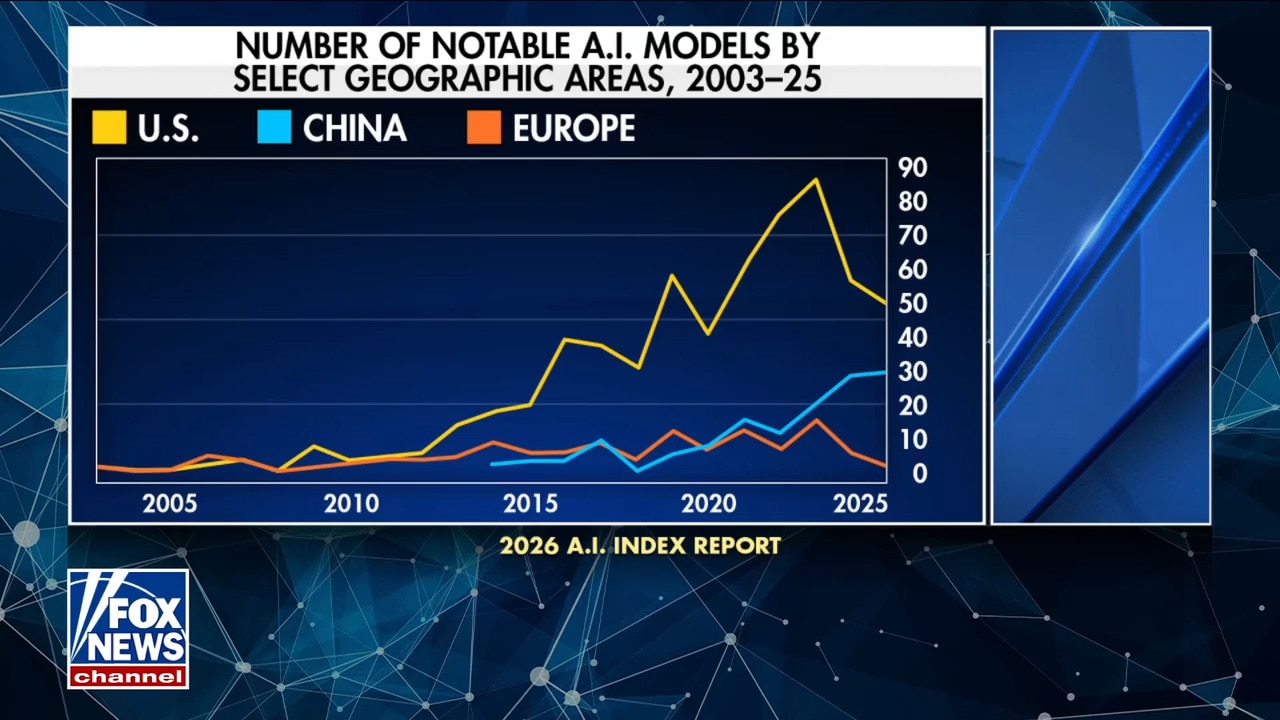
- Number of top-tier notable models (50 vs. China’s 30 in 2025)
- Higher-impact patents
China leads in:
- Publication volume and citations
- Patent output (volume)
- Industrial robot installations
South Korea stands out with the highest AI patents per capita.
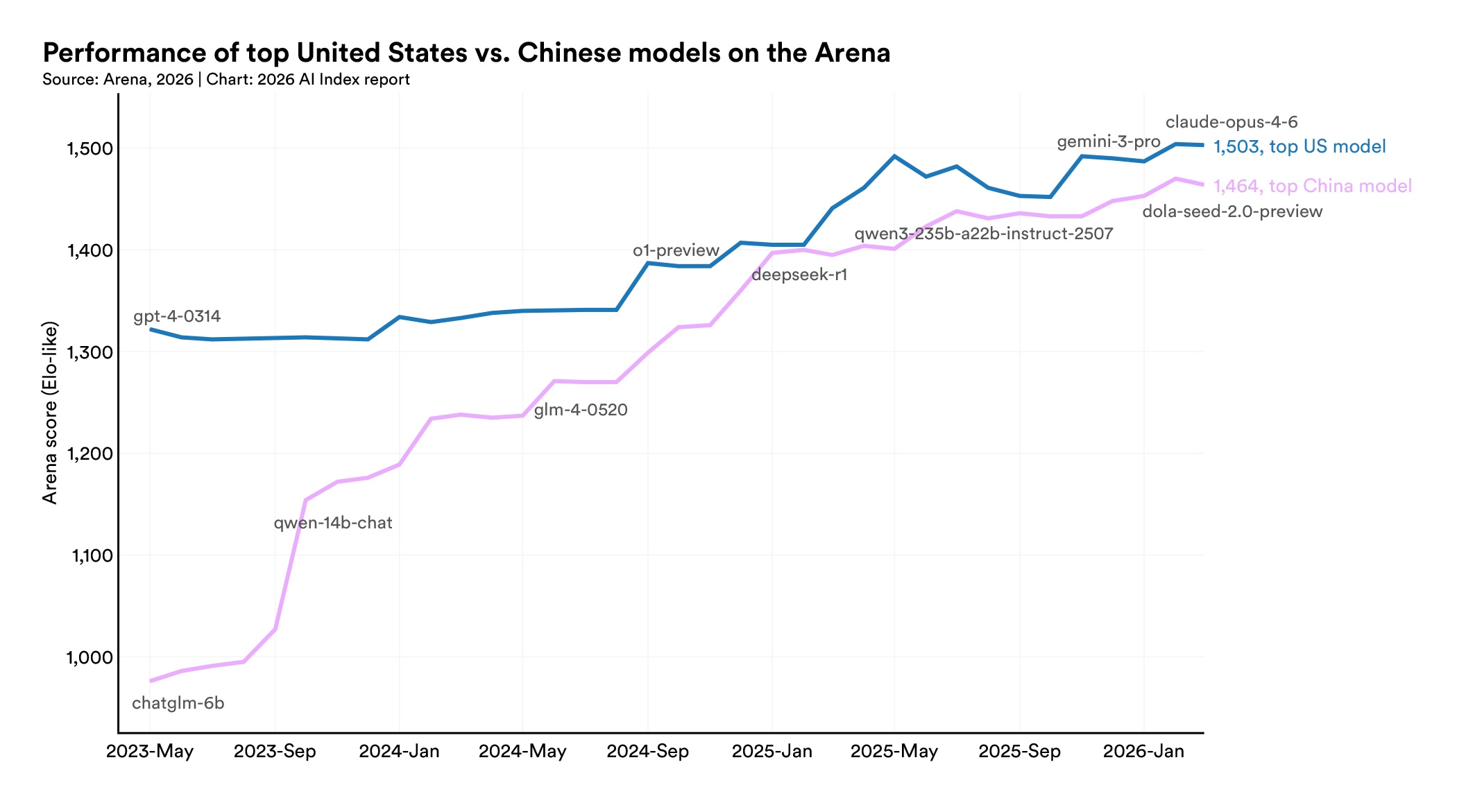
Implication: The competitive landscape is shifting from “US dominance” to “global parity with concentrated power.” Model production remains heavily US- and China-centric, but open-source contributions from the rest of the world are closing the gap on GitHub, enabling more linguistically diverse models and benchmarks.
2. AI Adoption Is Happening at Historic Speed
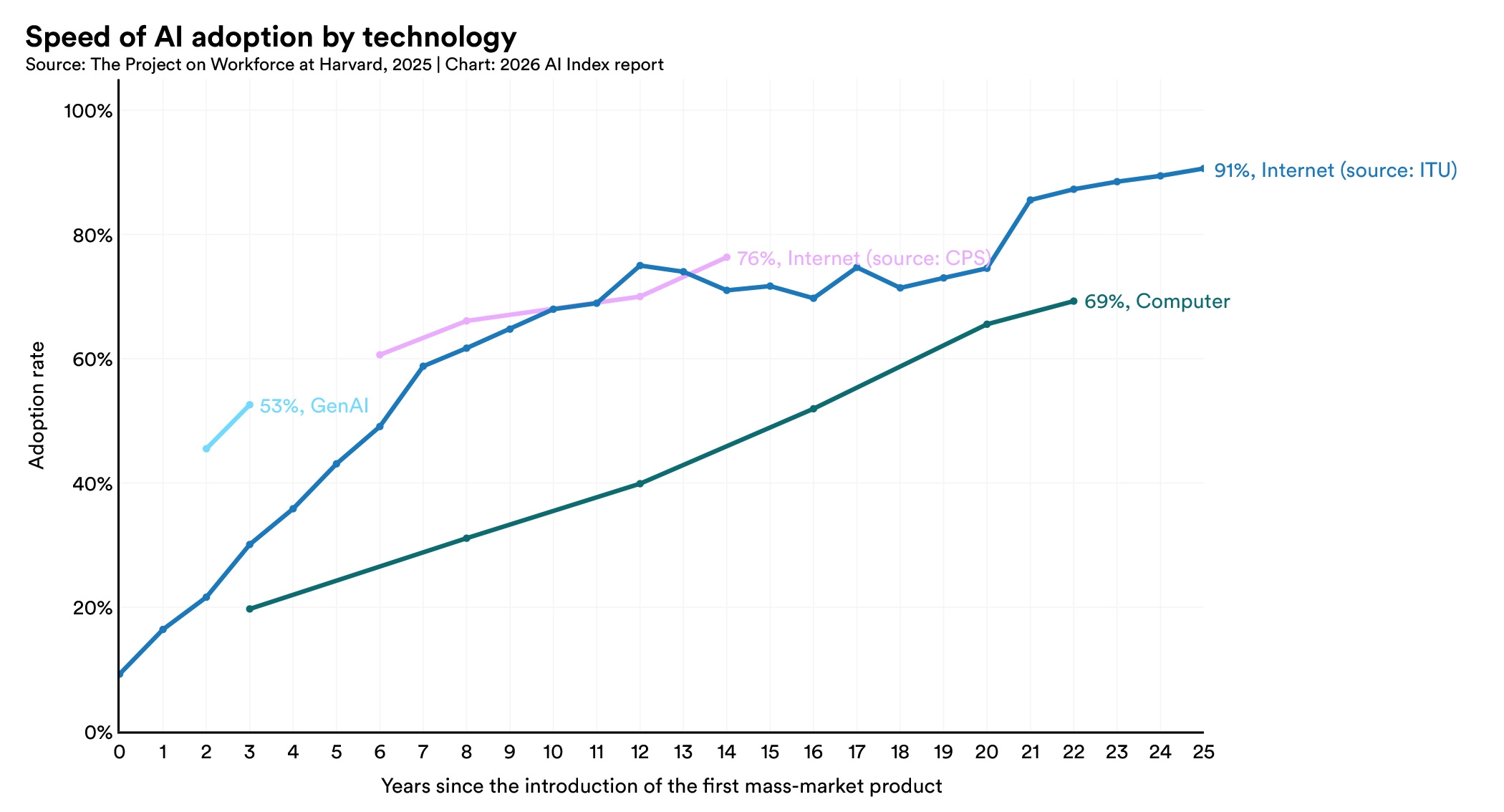
Generative AI has achieved 53% population adoption globally in just three years—outpacing the personal computer and internet. Adoption strongly correlates with GDP per capita, but outliers like Singapore (61%) and the UAE (54%) show cultural and policy factors matter too. The US sits at 28.3% (24th globally).
Consumer value is massive: US users alone derive an estimated $172 billion annually from generative AI tools, with median per-user value tripling year-over-year.
In the enterprise world, AI skills now appear in 2.5% of all US job postings—up dramatically—and “agentic AI” skills have surged over 280%. Productivity gains are already visible, but they’re hitting entry-level roles hardest (e.g., software developers aged 22–25 saw ~20% employment drop since 2024).
3. The Investment Surge (and Talent Drain)
Global corporate AI investment hit $581.7 billion in 2025, up 130% YoY. Private investment alone reached $344.7 billion (up 127.5%), with the US leading at $285.9 billion—23 times China’s private figure (though China’s total spending is likely higher via government guidance funds).
The US funded 1,953 new AI companies in 2025—more than 10× the next country. Yet talent inflow is collapsing: the number of AI researchers and developers moving to the US has dropped 89% since 2017 (and 80% in the last year alone).
4. Technical Breakthroughs Meet a “Jagged Frontier”
AI is smashing benchmarks:
- Frontier models gained 30 percentage points in one year on “Humanity’s Last Exam.”
- Agent success on real-world tasks jumped from 20% to 77.3% (Terminal-Bench).
- Cybersecurity agents now solve problems 93% of the time (up from 15% in 2024).
- SWE-bench Verified coding performance soared from ~60% to near 100%.
But the frontier is jagged. Models still struggle with:
- Reading analog clocks (~50% accuracy)
- Coherent long-form video generation
- Household robotics (only 12% success on real chores)
Industry now produces >90% of notable models, but the most capable ones are also the least transparent. The Foundation Model Transparency Index dropped to 40/100 (from 58 last year).
5. Public Sentiment: Optimism Up, But Anxiety and Distrust Rising
Globally, 59% of people see more benefits than drawbacks from AI (up from 55%), yet 52% feel nervous about it. In the US:
- Only 33% expect AI to improve their jobs (vs. 40% global average).
- 64% believe AI will lead to fewer jobs over the next 20 years.
- Trust in government to regulate AI is just 31%—the lowest among surveyed countries.
Experts and the public remain sharply divided on AI’s economic and medical impact.
What This Means for Builders, Leaders, and Policymakers
The 2026 AI Index confirms AI is no longer experimental—it’s infrastructure. Capabilities are outpacing benchmarks, adoption is exploding, and investment is pouring in. But environmental costs (training emissions, water use, data-center power rivaling entire countries), transparency declines, talent concentration risks, and lagging governance create real vulnerabilities.
Key action items:
- For companies: Double down on agentic systems, responsible AI frameworks, and talent pipelines beyond traditional US hubs.
- For policymakers: Prioritize transparency mandates, compute governance, and international coordination—especially as US-China parity intensifies.
- For individuals: AI literacy (prompting to engineering) is now table stakes at every career stage.
The report’s core message is clear: AI’s potential is immense, but realizing it equitably and safely requires closing the gap between technological speed and societal readiness.
At ai.cc, we track these shifts daily to help you stay ahead. Dive deeper into the full Stanford HAI 2026 AI Index Report here, and subscribe for weekly AI trend briefings, tool roundups, and strategic insights tailored to builders and decision-makers.